


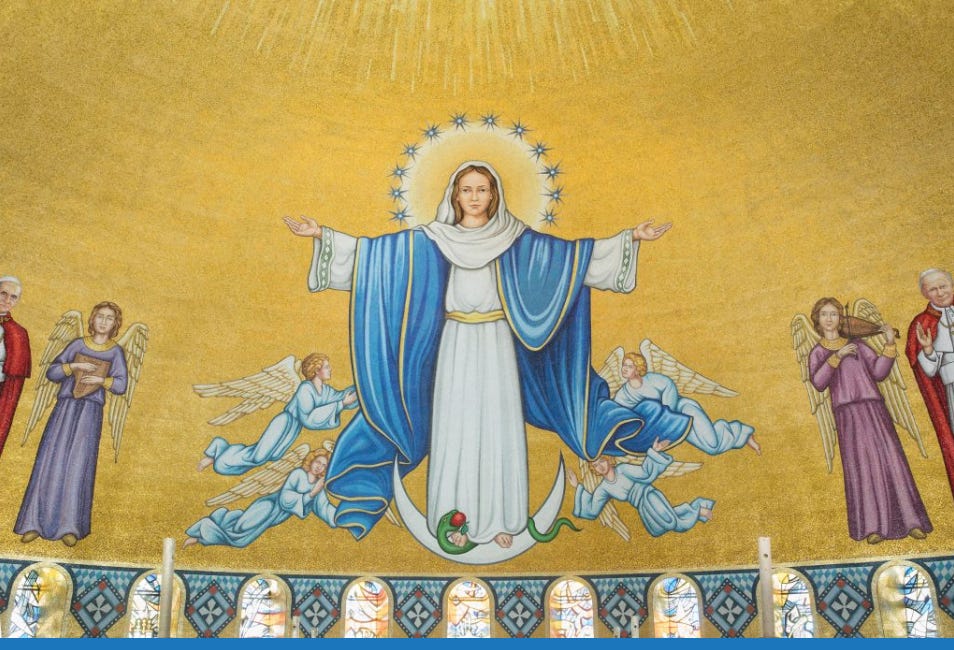
The following is an account taken from Butler’s Lives of the Saints compiled between 1756-1759.
By the bull Ineffabilis Deus of December 8, 1854, Pope Pius IX, by an exercise of his supreme pontifical power of infallible teaching, pronounced and defined it to be:
“a doctrine revealed by God and therefore to be believed firmly and constantly by all the faithful that the Blessed Virgin Mary in the first instant of her conception was, by an unique grace and privilege of Almighty God in view of the merits of Jesus Christ the Saviour of the human race, preserved exempt from all stain of original sin.”
That is to say that her soul at the first moment of its creation and infusion into her body was clothed in sanctifying grace, which to every other child of Adam is only given in the first instance after birth and, since Christ, at baptism (though it is generally held that Jeremias and St John Baptist received it before birth, but not at conception); the stain of original sin was not removed but excluded from her soul. For two hundred and fifty years before this solemn definition the doctrine of the Immaculate Conception had been universally believed in the Church (it was, of course, implicit in the deposit of faith from the beginning) and public teaching to the contrary was forbidden; but it was not “of faith” (it had somewhat the same position as the doctrine of the Assumption of our Lady held until 1950). It is therefore found that Alban Butler writes on this day under the heading simply of the “Conception of the Blessed Virgin Mary”, and says that “it is the most generally received belief, though not defined as an article of faith, that in her very conception she was immaculate. Many prelates and a great number of Catholic universities have declared themselves in strong terms in favour of this doctrine; and several popes have severely forbidden any one to impugn or to dispute or write against it. Nevertheless, it is forbidden to rank it among articles of faith defined by the Church, or to censure those who ‘privately hold the contrary’.” But, he goes on, it is sufficient for us, who desire as dutiful sons of the Church to follow her direction in all such points, that she manifestly favours this opinion. . . . “The very respect which we owe to the Mother of God and the honour due to her divine Son incline us to believe this privilege most suitable to her state of spotless holiness.” Since Pius IX spoke in 1854 the reservations mentioned by Butler have ceased to exist and every Catholic is bound to believe by divine faith that the doctrine of the Immaculate Conception is true.
A liturgical feast commemorating the conception of our Lady by the power of her father in the womb of her mother (without any reference to Mary’s sinlessness) seems to have been originally celebrated in Palestine; and there is much reason to believe that the idea of this conception feast for our Lady was suggested by the earlier existence of a conception feast for St John Baptist, which is found at the beginning of the seventh century. For a long time the expression ‘Conception of Mary’ was taken to mean the conception of our incarnate Lord within her womb by the power of the Holy Ghost (which we celebrate on the feast of the Annunciation), and consequently the new feast referred to was called the Conception of (or by) St Anne. In the ninth century it was imported to southern Italy and Sicily from Constantinople, still called the Conception of St Anne† and with no idea of the immaculate conception.
The first clear evidences of a feast of the Conception of our Lady, and under that name, in the West come from England, at Winchester, Canterbury and Exeter just before the Norman Conquest. This was identified with December 8, and when we remember that in Jerusalem and Constantinople, and also in Naples, December 9 was the day assigned for this observance it seems probable that the determining influence came from the East.
In England, again as in the East, the observance began in the first instance, its first two mentions are found in calendars of the abbey called the monastery, at Winchester. It met with opposition as an innovation. But a disciple of St Anselm, the monk Eadmer, wrote an important treatise on our Lady’s conception, and the archbishop’s nephew, another Anselm, introduced the feast of the Conception into his own abbey at Bury St Edmunds. It was soon taken up by Saint Albans, Reading, Gloucester and other others. Some monks of Westminster, where the prior, Osbert of Clare, favoured the feast, challenged its lawfulness, but it was approved by a synod in London in 1129. At the same time the feast began to spread in Normandy, though whether it was first brought there from England or from southern Italy, then in Norman occupation, is not clear.
The adoption of the feast in the cathedral church of Lyons, about the year 1140, was the occasion of a protest by St Bernard which precipitated a theological controversy that was to last for three hundred years, the point at issue being the moment at which the sanctification of Mary took place. But however the controversy fluctuated from one to another of its several sides, the observance of the feast of the Conception of our Lady steadily progressed. In 1263 it was adopted by the whole Order of Friars Minor, who became the great defenders of the Immaculate Conception, whereas the Dominican theologians generally opposed it. But in spite of its popularity in England, Canterbury did not adopt the feast until 1328, and it was not till 1476 that the Franciscan pope, Sixtus IV, officially adopted it for the Roman church. The feast was still of the Conception of the Immaculate One rather than of the Immaculate Conception as we understand it, though, as Butler pertinently notes, the sanctification of our Lady rather than her bare conception is the object of the Church’s devotion. But in 1661 Pope Alexander VII declared that the feast celebrated the immunity of our Lady from original sin in the first moment of the creation of her soul and its infusion into her body, i.e. the moment of “passive conception” in the sense of the Catholic doctrine. In 1708 Pope Clement XI imposed the festival on the whole Western church as a feast of precept.
After the solemn definition of the dogma in 1854 the name of the feast was altered to the Immaculate Conception of the Blessed Virgin Mary, and nine years later a new Mass and Office in accordance therewith was prescribed. Since then, and indeed for some time before, the veneration of our Lady as immaculately conceived has become one of the most popular aspects of Marian devotion. Of the eighteen dioceses of England and Wales, ten have our Lady as conceived sinless for their principal patron, and she was declared patroness of the United States under this title by the first Council of Baltimore eight years before the definition. Hundreds of churches throughout the world are dedicated to God in honour of our Lady so regarded.
There is, of course, an immense literature connected with the doctrine of the Immaculate Conception and with its liturgical celebration.
It is a quite understandable error among non-Catholics not informed on the matter that the expression Immaculate Conception refers to the virginal conception of our Lord.
† The feast has maintained this name in the East and even the Orthodox Byzantines call it officially the “Child-begetting of the holy Anne, mother of the Mother of God ”, and keep it on December 9, the original Eastern date. But, of course, it is for them now the same feast as our Immaculate Conception. The dissident Eastern churches have no official teaching about the doctrine: some theologians have repudiated it, others have taught it. The people probably believe it, at least implicitly. The original Russian sect of Old Believers is said to have professed it formally. The calendar of the Anglican Book of Common Prayer still has the “Conception of the Virgin Mary” on December 8.
I love the details on Our Lady's Immaculate Conception from the visions of Blessed Anne Emmerich. O Maria, concepta sine peccato, ora pro nobis qui ad te confugimus.