


There is a photograph doing the rounds which, we are told, changes everything.
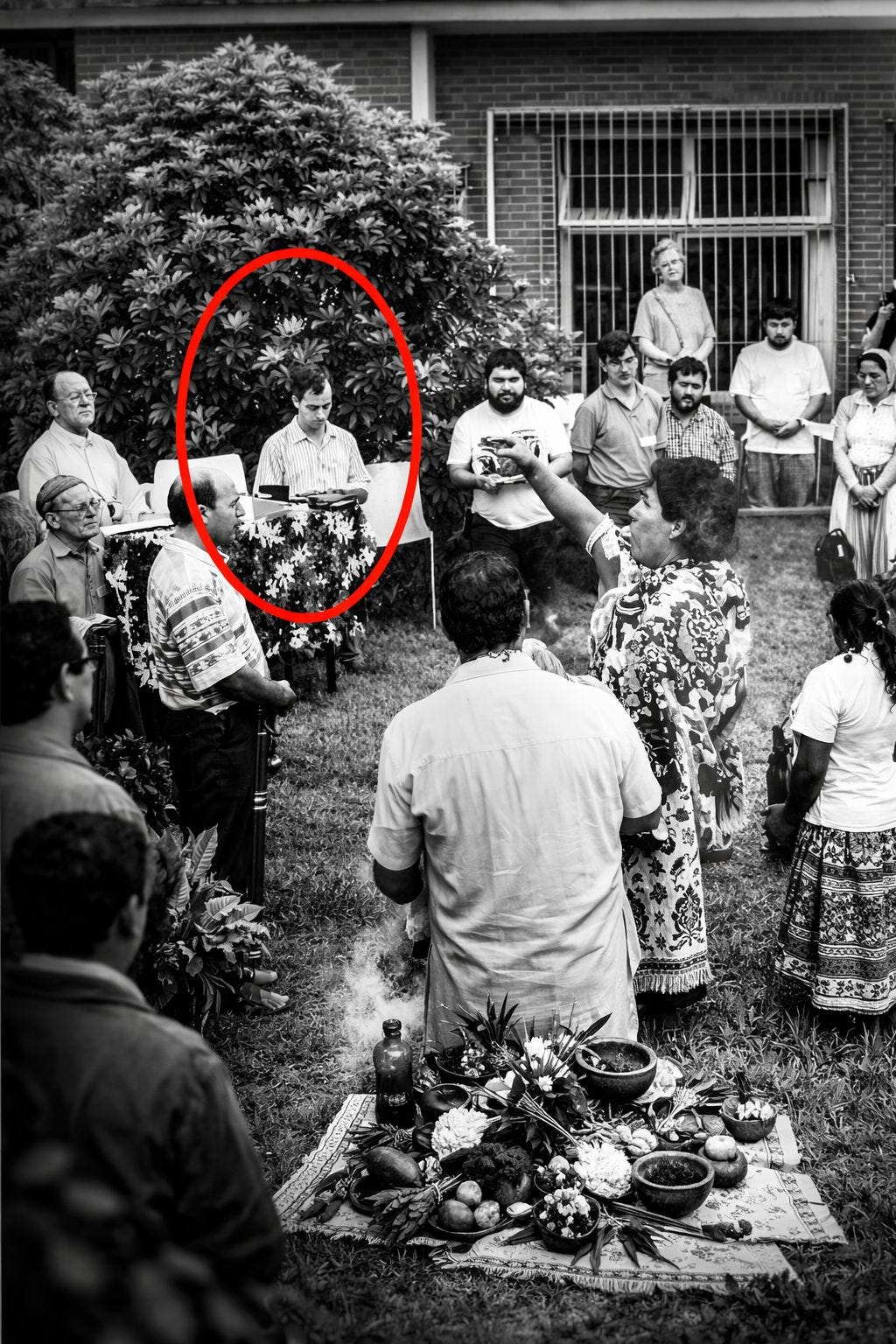
Taken at a 1995 symposium in Brazil, it appears to show Robert Prevost, now Pope Leo XIV, present at what is described as a “Pachamama rite”. The implication is immediate and explosive and, for some, the case is already closed. The verdict has been reached. The conclusion is certain.
But that certainty is precisely the problem.
Because what we actually have is not a confession, not a statement of belief, not even a clear account of what took place. We have a photograph, a caption, and a series of interpretations layered on top of both. Certainly that is enough to raise questions, but is it really enough to settle them?
Irrespective, within a matter of hours those questions have been converted into accusations. Presence has become participation. Participation has become worship. Worship has become idolatry. The distinctions have collapsed and with them, any sense of proportion. This is not how serious Catholics should think.
None of this means the story is trivial. It isn’t. Given the wounds opened by the Pachamama controversy during the Amazon Synod, even the appearance of something similar in the past is deeply concerning. It raises not only a question about an isolated event, but something more serious: that a man who now occupies the highest office in the Catholic Church may, at some point, have considered it appropriate to be present at such a ritual. If that were the case, it suggests that a certain theological attitude, one that is at least open to ambiguity on the boundary between inculturation and syncretism, may have reached very high levels in the life of the Church.
That is not a trivial concern. It goes directly to the clarity with which the First Commandment is understood and upheld. And it is precisely why this cannot simply be waved away or ignored. Ideally, it would be addressed directly. A clear and unambiguous rejection of any form of idol worship, coupled with an explanation of the context of this event, would do much to settle the matter and restore confidence.
At the same time, it is important to understand the setting in which such events occurred. In parts of South America, particularly in the 1980s and 1990s, there were sustained efforts within missionary and theological circles to engage indigenous cultures more deeply. What was often called “inculturation” sometimes involved attending or observing local rituals in an attempt to understand them, to purify what could be purified, and ultimately to evangelise more effectively. It is at least possible that Prevost’s presence, if accurately reported, was shaped by that mindset. He may have believed, rightly or wrongly, that proximity and engagement were the best way to bring the Gospel to those cultures.
That possibility does not remove the concern. In fact, it sharpens it. Because it highlights how easily good intentions can blur into theological confusion if the boundaries are not clearly maintained. But concern is not the same as panic, and it is certainly not the same as certainty.
At present, we simply do not know what Prevost believed he was participating in, what the event was understood to be, or whether this was treated as anthropology, symbolism, or worship. Those distinctions are not technicalities. They are the entire issue.
To ignore them is not zeal for the truth. It is a refusal to think carefully.