


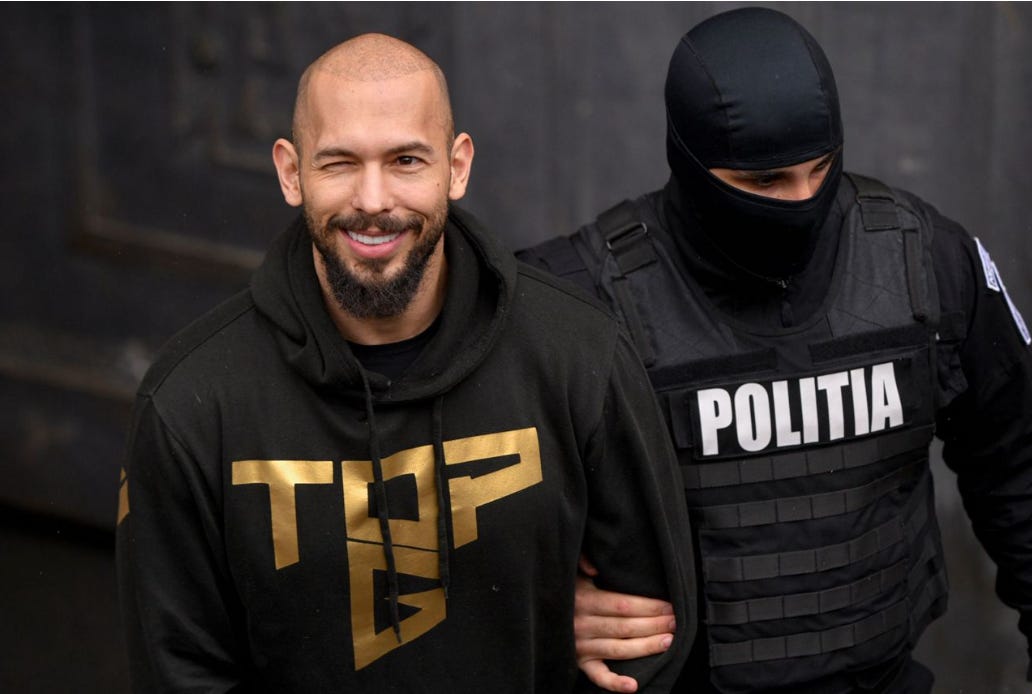
This time last year, Daily Wire host Matt Walsh clashed with Andrew Tate over marriage. Walsh thinks that Marriage is for keeps, and Tate thinks that Marriage is for wimps.
“The smartest move on the chessboard for a man now” Tate says “is to get rich and have as many children as he wants with as many women as he wants”
I have no doubt that Andrew Tate devotees are struck by what they see as an original voice crying heroically in a wasteland destroyed by feminists. But as Mr Ecclesiastes said:
“What has been, is what will be,
and what has been done, is what will be done;
there is nothing new under the sun.” Ecclesiastes 1:9
And so it is that Mr Tate is simply a modern day Machiavelli with muscles. While the ancients; Plato, Aristotle and then Aquinas saw a connection between being good and being successful, Machiavelli saw a contradiction between the two.
It is hard to find a thinker as influential as Machiavelli, who has been so despised, and yet Tate channels him. Don’t underestimate Tate, he is a thinker “You’re gonna love apples” he opines “if you can’t buy bananas”. That one he gives for free! For a deeper insight into his philosophy it would be a lot cheaper to purchase Machiavelli’s ‘The Prince’ (available from all good bookshops and Waterstones) than to sign up for Tate’s online coaching.
Peter Kreeft reminds us that Machiavelli teaches how to be successful rather than moral. Powerful rather than good. Everything he says in The Prince follows logically from 3 assumptions. Firstly, He assumes that reality doesn’t include ideals, goods or values. Reality consists only of material facts. He was implicitly a materialist.
Secondly, man is by nature wicked, selfish, competitive and immoral. For it follows that if only matter is real, then what is real in man is only matter, and matter is essentially competitive. The more food you eat, the less food there is for me to eat, the more money I give to you, the less I have for myself. Only spirit transcends this law.
If spiritual things like love, truth and beauty are real, they can be given away without losing anything. Money, power, territory, and fame diminish when shared, while spiritual goods multiply when shared. But if spiritual goods are not objectively real, if all that’s objectively real in man is matter, then any two men are always fundamentally competitive, and life becomes a chessboard.
Thirdly, there can be a formula for success because there are only two variables – virtu (power – the ability to compel objective reality to obey your will) and fortuna (luck, chance – things that cannot be controlled). His formula for success is the maximisation of Virtu and the minimisation of Fortuna. This is implicitly the metaphysics of atheism. Tate claims he is a Muslim. Either way, it ain’t Christian.
‘Politics’ Machiavelli said, ‘is the art of the possible’. When the gap between the ideal and the real is too great, lower your ideals! For Machiavelli, ideals are to be judged by how practical they are, how they have worked in the past, and according to him;
‘All unarmed prophets have failed, and all armed prophets have succeeded’.
For the ancients, ideals were the standards for the real, but Machiavelli reverses this – ideals are to be judged by how practical they are. Honour is not an objective ideal to attain, but a thing to attain only to the extent that it furthers earthly success.
“The fact is that a man who wants to act virtuously in every way, necessarily comes to grief among so many who are not virtuous, therefore if a prince wants to maintain his rule, he must learn how not to be virtuous” (The Prince)
Machiavelli instructs a man in vice, emphasising the maintainance of rule over the practive of virtue. Princes, he claims, should only honour their word when it works, and by works he means leads to earthly success;
“everyone realises how praiseworthy it is for a prince to honour his word…nevertheless, contemporary experience shows that princes who have achieved great things have been those who have given their word lightly, who have known how to trick men with their cunning, and have overcome those abiding by honest principles, therefore a prudent ruler should not honour his word when it places him at a disadvantage”
In other words, because men are wretched creatures who would not keep their word to you, you need not keep your word to them. Like Milton’s Satan he concludes ‘evil be thou my good’.
Similarly, Tate whines about the state of the world and the people in it;
“Any man with a brain doesn’t hand over keys to his castle to…over emotional unchecked females. The world’s changed…telling men to just get married, and just be loyal, gets men wrecked. Own your empire and women will respect you…no woman can steal my hundreds of millions…marriage is suicide. If you can’t change the game, WIN the game”.
This philosophy, like Machiavelli’s 500 years before him, makes morality dependent on other people’s morality. How good or evil other people are becomes your standard. No matter how high and hard Tate can kick that sounds pretty wimpy to me.
Both Tate and Machiavelli advise their audience that if they want to be successful, they need to wimp out of ideals and let others set the standard, be Pontius Pilate instead of Jesus. And why? To survive, to attain success.
One of these two had more influence on history than any man who ever lived (despite being unarmed, tortured, then killed) and one became a byword for ‘cop-out’. One lived and died in obedience to rightful authority, to high ideals, the other blew in the wind. Who was more powerful?
Well that depends.
