


There are many voices out there currently who are asking you to abandon the Church, to join the SSPX or the Orthodox or other Sedevacantist groups. It seems that, for many, this is a moment in history when it seems almost impossible to resist the conclusion that the Church has entered the Great Apostasy foretold in Scripture.
You may well be scratching your head reading this and wondering what on earth I am talking about. If that’s you - great! You probably don’t need to read any further, good on you! Keep up the good work, stay close to Jesus! But if you are one of our readers whose timeline is full of voices shouting that the end of the Catholic Church is now, you might find this helpful.
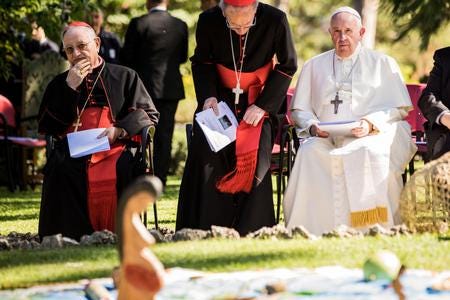
For some the evidence appears overwhelming. We have witnessed the sexual abuse crisis expose profound moral corruption within the clergy and episcopate on a scale that has shattered confidence in the Church’s leadership. We have seen bishops and even cardinals publicly contradict settled Catholic teaching on questions of marriage, sexuality and the uniqueness of Christ. Under Pope Francis, the Pachamama ceremony in the Vatican Gardens became, for many, a symbol of theological confusion and ecclesial disorientation. Even now, bishops continue to be appointed who have openly questioned or undermined elements of Catholic doctrine while faithful clergy often appear to be overlooked or marginalised. To many observers, these are not isolated failures but symptoms of a Church in terminal decline.
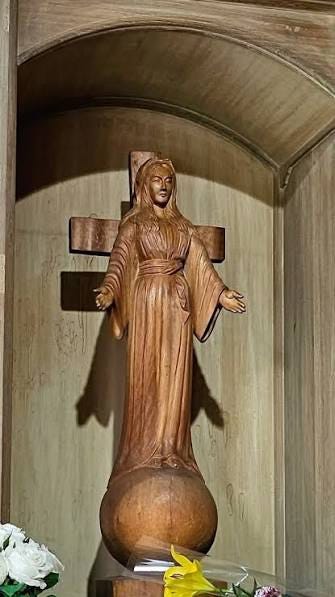
It is therefore unsurprising that many have turned to the great Marian apparitions for confirmation. The messages of Fatima, Akita and La Salette are frequently cited as prophetic explanations of the crisis before our eyes. Particular emphasis is placed upon the words attributed to Our Lady of Akita that “the work of the devil will infiltrate even into the Church in such a way that one will see cardinals opposing cardinals and bishops against other bishops.” Faced with such an extraordinarily accurate description of the present ecclesiastical division, it is understandable why many conclude that these prophecies are being fulfilled in our own day. Combine this with St Paul’s warning that there will be a great falling away before the return of Christ, the conclusion can appear almost irresistible. Yet this is precisely the point at which Catholic theology demands the greatest discipline.
Private revelation, however worthy of belief, can never become the lens through which the definitive revelation of Christ is interpreted. The Church has always taught that approved apparitions may assist the faithful but add nothing to the Deposit of Faith. Their purpose is not to revise the Gospel nor to supersede the promises of Christ. What this means is that public revelation judges private revelation, never the reverse. To put it another way, we must read the apparitions through the lens of the Gospel, never the other way around.
One striking feature of every approved Marian apparition is the consistency of Our Lady’s response to ecclesial crisis. She warns of sin, infidelity and the need for conversion with extraordinary seriousness. She speaks of suffering within the Church, of persecution and even of grave failures among her shepherds, yet nowhere in any approved apparition does she instruct the faithful to abandon communion with Peter, to establish a parallel ecclesial structure or to seek refuge outside the visible Church. Her appeal is always the same. Pray, do penance, return to Christ, remain faithful. This isn’t simply an incidental observation but one entirely consistent with Catholic theology. Since private revelation cannot add to, correct or supersede the definitive revelation entrusted to the Church, it could hardly authenticate itself by encouraging separation from the very Church that Christ promised the gates of hell would never overcome. Even when she warns of corruption within the hierarchy, the response she asks for is ALWAYS fidelity rather than separation.
There is another element to this that I think deserves equal attention. It strikes me as blindingly obvious (and yet consistently overlooked) that we human beings naturally compress history into the brief span of their own lives. We instinctively assume that the crises we witness must be uniquely decisive because they fill the horizon of our experience, yet the reality is that the Church has endured two thousand years of upheaval. Christians living through Nero’s persecutions, the Arian crisis, the collapse of the Roman Empire, the Great Western Schism and the Protestant Reformation all had compelling reasons to believe they were witnessing the final collapse of the Church. Many undoubtedly believed they were living through the Great Apostasy itself. They were sincere, they were frightened…They were wrong.
Looking back over sixteen centuries we can see that St. Augustine recognised this tendency. Preaching as the Vandals closed in on Hippo and the Roman world appeared to be disintegrating around him, he rebuked those who lamented that they lived in uniquely terrible times. “We are the times,” he declared. “Such as we are, such are the times.” His point was not that the age was unimportant but that Christians are called to sanctify their own generation rather than speculate endlessly about its place in salvation history.