


Written by Emily Bennett for Catholic Unscripted
I first discovered Bad Bunny on a recent trip to Chile. His beats were addictive, his rhythms…persuasive. As a Brit raised on the finest of national dance traditions; screwing invisible lightbulbs and patting invisible dogs, I felt utterly out of my depth when thrown into the world of gyrating reggaeton. Cultural whiplash would be an understatement.
But time does what it always does. I loosened up. I added a bit of Latin flair to my lightbulbs and dog pats, and by the end of two months Nueva Yol was looping relentlessly in my head.
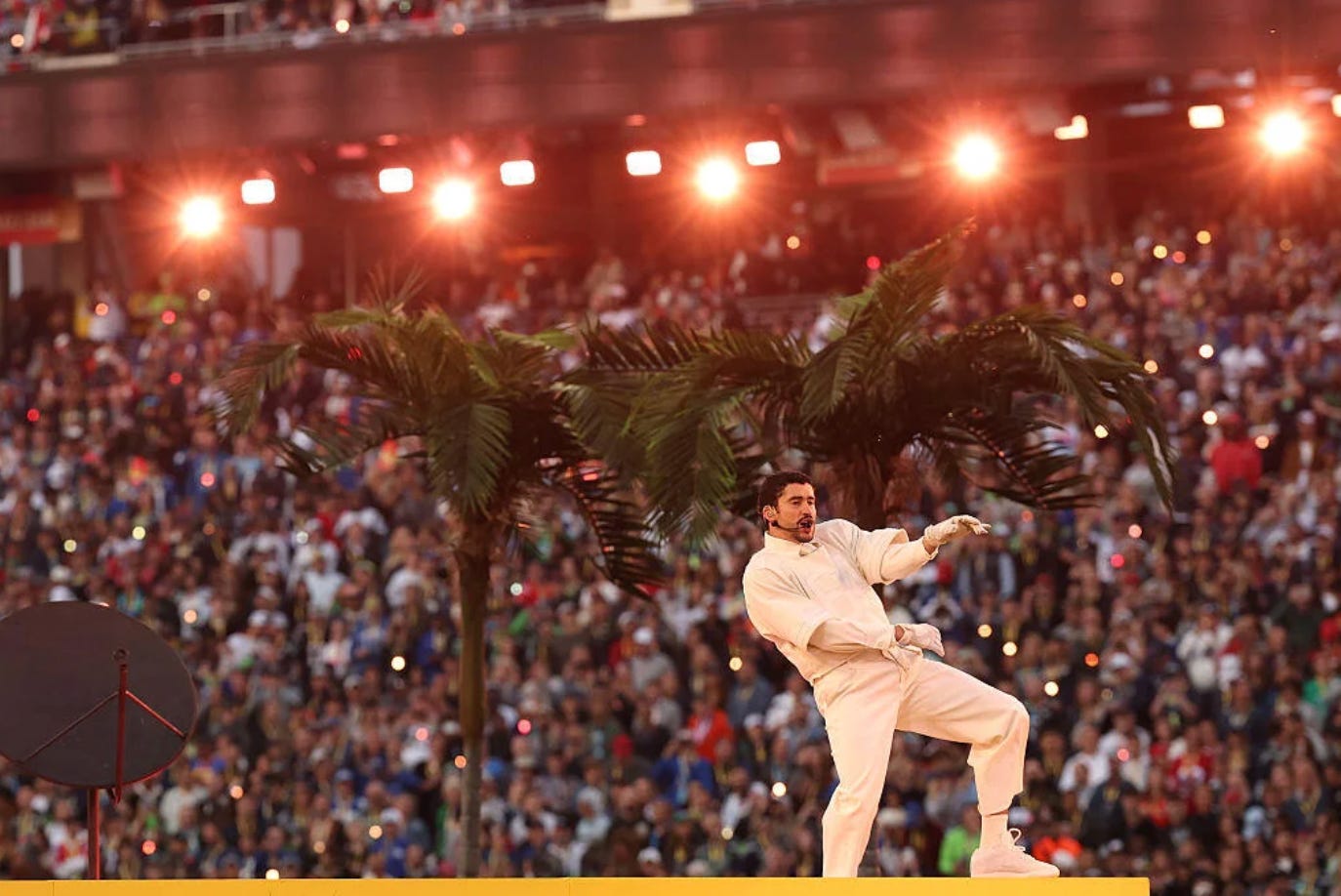
So when Bad Bunny appeared at the Super Bowl half-time show, I was genuinely excited. Those songs carried memories: friendships formed in another hemisphere, long nights, warmth, laughter in Spanish I only half understood. Then came the phrase splashed across the stage and echoed across social media:
‘The only thing more powerful than hate is love.’
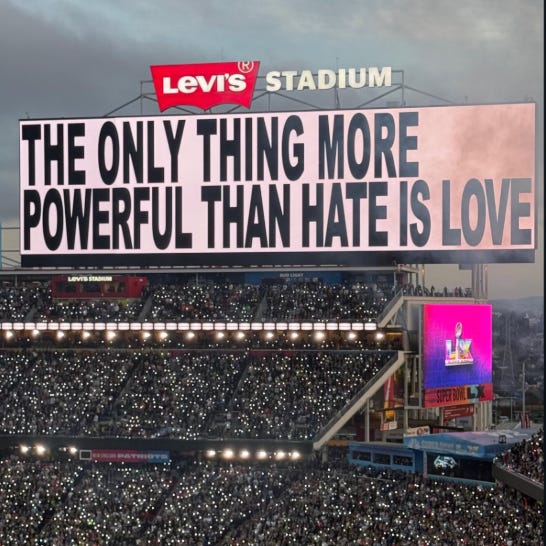
It’s a sentiment few would dare challenge. And yet, rather than resolving the problem of hate, it raised a more urgent question: what kind of love are we talking about, and who is teaching us how to live it?
Bad Bunny’s music gives us one answer. Love is human, intense, expressive and sexual. Rooted in desire, affirmation and freedom from restraint, it is something to be experienced rather than ordered, consumed rather than given. Lust is crowned as liberation. Love is measured by access, not sacrifice, by feeling rather than fidelity. The self sits comfortably at the centre, and love exists to serve it.
You have to admire the confidence. To step onto a Super Bowl stage and position oneself as a global authority on love is no small thing.
If love is defined as self-expression, intense, emotional and self-directed, what hope does it really have of conquering hate? This version of love avoids sacrifice. It resists discipline. It recoils at the suggestion that love might require obedience or restraint. Far from overcoming hate, it breeds it. A love centred on the self eventually turns inward, and what begins as liberation ends in rivalry and resentment.
Forgive me, Bad Bunny, but this syllabus feels thin.
It is, then, a great blessing that, as Catholics, we encounter love differently.
Love is not merely an emotion or impulse. It is sacrificial, ordered and enduring. It has a shape because it has a source.
That is not a slogan. It is a claim about reality. Love does not begin with us. It begins with Him who is Love itself and who created us out of love, for love. Our desire for love is good, but it is not self-sufficient. If we detach love from God, we do not refine it; we reduce it. We redirect it towards ourselves rather than towards its source.
The early Christians used the word agape for this love. Not appetite. Not romance. Not intensity. Agape is self-giving love that seeks the good of the other even when it costs something. It is the love that kneels to wash feet, forgives enemies and remains faithful when feelings fade.
And its clearest expression is not poetic. It is brutal.

