


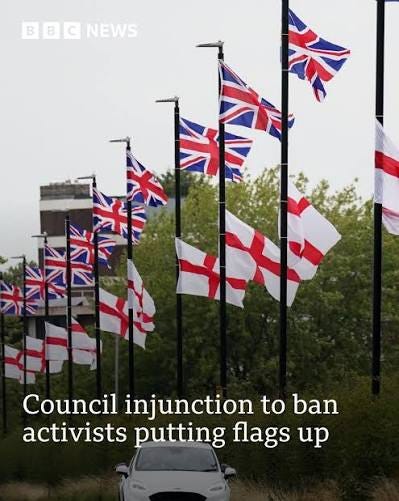
Birmingham City Council has made a serious mistake. For more than a year, Union Flags and St George’s Crosses have been appearing in increasing numbers across Birmingham, part of a grassroots phenomenon which began in the south of the city before spreading across the country. Birmingham City Council has therefore had plenty of time to decide what these flags mean, what the people putting them up are trying to say, and how political leadership ought to respond. Its answer has been removal, enforcement and now an application to the High Court for an injunction against unauthorised flags attached to public infrastructure.
The council insists that it has not banned either flag, and strictly speaking that is true. The Union Flag still flies outside the Council House, nobody is being forbidden from flying St George’s Cross from his own home, and the proposed injunction concerns unauthorised attachments to lampposts and other highway infrastructure. Yet politics cannot be reduced to the drafting of an injunction, something can be legally defensible and politically disastrous at precisely the same time.
And you would hope someone at Birmingham Council would have the political intelligence to understand what ordinary people and what they see is much simpler. They see English and British flags going up and council employees taking them down. They hear their local authority talking about “increased tensions” and “community cohesion”, and they see the council going to the High Court to prevent those flags being put back. It should surprise nobody that the resulting photographs and videos race across social media accompanied by the considerably less nuanced message that Birmingham has banned the British flag.
That claim is not literally true, but neither is the official response that this is merely a neutral question of street furniture remotely adequate to the political reality. Birmingham itself has acknowledged that the controversy concerns flags, objections to their presence and community tensions. The nationality of the flags is therefore not an incidental detail which disappears simply because lawyers can formulate the injunction in neutral language.
This is where Birmingham has displayed an extraordinary failure of political imagination. The blindingly obvious response was not to fight the flags, but to embrace them. The council could have told its citizens that it understood what many of them were trying to say. Birmingham is an English city in the United Kingdom, the St George’s Cross and Union Flag are the inheritance of all its citizens, and the council is proud to see them flown. It could simultaneously have explained that climbing lampposts and attaching unauthorised objects to public infrastructure creates legitimate safety and maintenance problems and announced that the council itself would install national flags prominently and safely at suitable locations throughout the city.
Imagine the effect.
The council would have removed much of the grievance at a stroke. It would have deprived more extreme activists of the ability to present themselves as the sole defenders of English identity. It would have told Birmingham’s Muslim, Sikh, Hindu, Christian, Jewish and secular citizens that the national flag belongs equally to every one of them. It would have asserted that nobody, whether an ethnic nationalist on the right or an identity politician on the left, possesses the right to appropriate the flag as the emblem of one racial or political faction. Above all, it would have listened.
Instead, Birmingham has treated a problem of national belonging as a problem of public-order management.
Birmingham’s response cannot be separated from the political atmosphere in which this dispute has unfolded, already poisoned by an increasingly destructive binary. On one side is a rapidly growing narrative according to which the British state has become actively hostile to its own people. Its proponents see asylum seekers being accommodated at public expense while British citizens struggle with housing, public services and taxation; they see minority identities celebrated while expressions of Englishness are regarded with suspicion; they hear continual official enthusiasm for diversity while being increasingly uncertain whether the country regards their own inherited culture as something worth preserving. Now, they say, the authorities are literally taking our flags down.
At the opposite pole lies an equally corrosive refusal to recognise that any legitimate grievance might lie beneath these perceptions. Britain has not banned its flag; asylum seekers do not simply receive preferential access to the ordinary benefits system; immigration has enriched the country; multiculturalism has succeeded in innumerable individual lives and communities. Anyone suggesting otherwise is immediately dismissed as ignorant, xenophobic, racist or “far right”.
Between these two narratives lies a vast territory in which most of the truth resides, but our political culture is rapidly losing the ability to inhabit it.
Social media rewards outrage rather than qualification. “Birmingham seeks a High Court injunction concerning unauthorised attachments to public infrastructure” will never travel as quickly as “BIRMINGHAM BANS THE ENGLISH FLAG”. Yet institutions make matters worse when they imagine that correcting the technical inaccuracy disposes of the grievance which made the exaggeration believable in the first place.
Tell a man who has waited years for social housing that asylum seekers accommodated in a hotel have not technically jumped the council-house queue, and you may have corrected his understanding of the administrative system without answering the political question troubling him. Tell somebody watching a council contractor remove a St George’s Cross that there is no ban because the action concerns an unauthorised attachment to highway infrastructure, and again you may be legally correct while completely failing to understand what he thinks he is witnessing.
He does not feel corrected. He feels that the political establishment is refusing to acknowledge what is in front of his eyes.
