


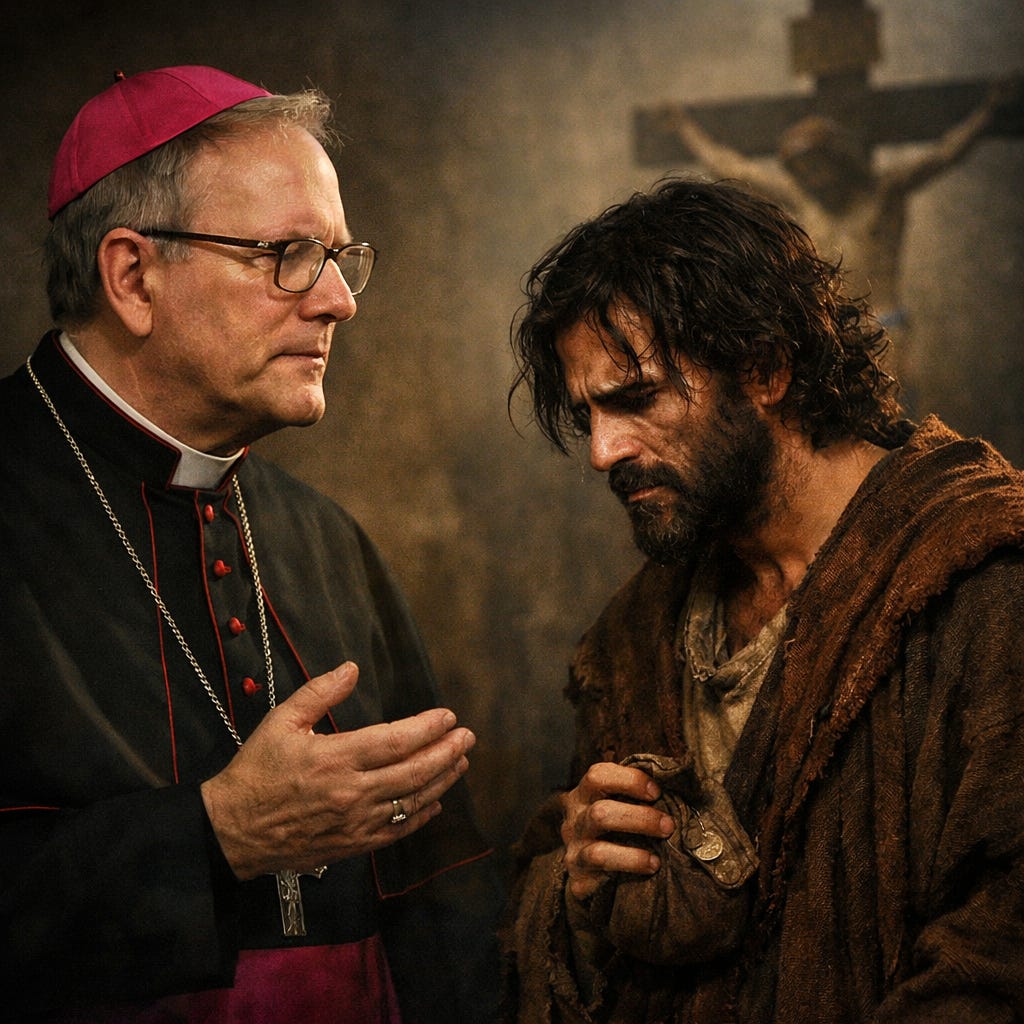
I am a big Bishop Barron fan. I have met him in person twice. I love his engagement with the culture. His method has brought the Gospel to so many and his perspective is to do that through the transcendentals of goodness, beauty and truth, which I think really works.
He is catching a lot of heat at the moment and in a way, I suppose this is an inevitable part of putting his head above the parapet and taking the Catholic faith to the world in a way that few have the courage to do.
Bishop Barron is not a marginal figure whose words can be dismissed as idiosyncratic. He is one of the most effective Catholic communicators of the modern era, with a global media apostolate, millions of followers, bestselling books and a proven ability to bring the intellectual tradition of the Church into the public square. I think whenever we speak about something he has said we need those facts to be at the forefront of our minds. However it is precisely for this reason that questions about emphasis and judgement in his work matter. Look I am not suggesting for a second that I have the mental capacity to take on Bishop Barron. I know I don’t. But as someone who genuinely loves and admires his work, I think I have a valid case for asking some questions.
There is a particular moment in Shakespeare when the audience begins to suspect that a character’s denial reveals more than it conceals. “The lady doth protest too much, methinks.” It is not that the protest is insincere. It is that its very insistence betrays an anxiety about what lies beneath. That line has been echoing in my mind as I read Bishop Robert Barron’s recent reflections on Judas.
Once again, he returns to the now familiar territory inspired by Hans Urs von Balthasar: we must not say that all are saved, but we may hope that all are saved. Bishop Barron is careful, as always, to distance himself from universalism. Hell is real. Damnation is possible. The tradition speaks with sobering clarity. And yet, having conceded all of this, he proceeds to draw the reader back toward the same horizon of hope, even for Judas himself.
It is difficult to understand why he would return to this particular topic which brought him so much controversy in the past. Indeed he even states as much in his article:
“Now I know (please don't send me letters of complaint) that we cannot embrace a simple-minded universalism, which says that we are perfectly confident that all people will be saved. We do indeed have to admit to the very real possibility of an eternal rejection of God.”
Bishop Barron knows he is touching on a controversial subject: To suggest that Judas is saved runs sharply against both the plain sense of Scripture and the consistent witness of Tradition. Christ’s own words, that it would have been better for that man never to have been born, are difficult (impossible?) to reconcile with any eventual beatitude, for eternal life, even after purification, would still render existence an ultimate good. The Gospel portrayal of Judas does not culminate in repentance grounded in hope, but in despair, a turning inward that refuses mercy rather than entrusting itself to it. For this reason the Fathers, the scholastics and the ordinary preaching of the Church have overwhelmingly treated him not as an open question but as a warning of real loss.
To recast him as a plausible object of salvation, even cautiously, risks more than a speculative shift. It alters the moral imagination. If even Judas is likely saved, then the force of Christ’s warnings is diminished, the urgency of conversion is softened and the line between hope and presumption begins to blur. What is presented as an expansion of mercy can, in practice, become an erosion of seriousness about sin, judgement and the eternal stakes of human freedom.
Formally, the good bishop has asserted nothing objectionable. But theology is not only a matter of formal propositions. It is also a matter of emphasis, imagination and pastoral weight. What we return to again and again begins to shape what people believe, even when we insist that we are not saying it.
The question, then, is not whether Barron is a universalist. He is not. The question is whether his repeated return to this theme participates in a wider drift within the Church, one that has profound consequences.
It is impossible to understand the present moment without recognising that we are living through what can only be described as an epidemic of universalist tendencies. Not doctrinal universalism, in most cases, but something more subtle and perhaps more dangerous. A practical universalism. A pastoral universalism. A cultural assumption that, in the end, things will work out for everyone. This assumption rarely announces itself openly. It does not deny hell. It simply renders it remote, theoretical and increasingly implausible. It reshapes the imagination of the faithful so that the warnings of Christ begin to feel like exaggerated rhetoric rather than existential truth.
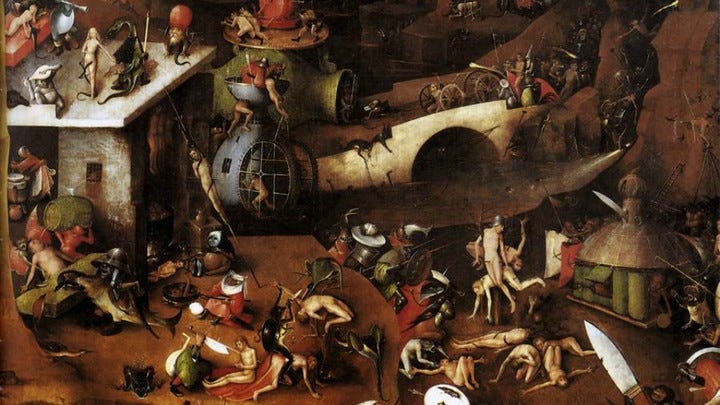
I think Bishop Barron’s reflections must be read within this context. When he raises the possibility that even Judas might have repented in his final moments, he is not inventing a new theological claim. He is drawing upon a line of speculation that has always existed at the margins of the tradition. The difficulty is not that such speculation is strictly forbidden. The difficulty is what happens when it becomes a focal point of pastoral reflection. For the weight of the tradition does not rest on such speculation.
When the weight of Christ’s words is acknowledged only to be set aside in favour of hopeful conjecture, something shifts. The centre of gravity moves. What was once marginal becomes prominent. What was once a warning becomes a question. And what was once a question begins, quietly, to function as an expectation.