


Truth, Theology and the Crisis of Confidence at the DDF
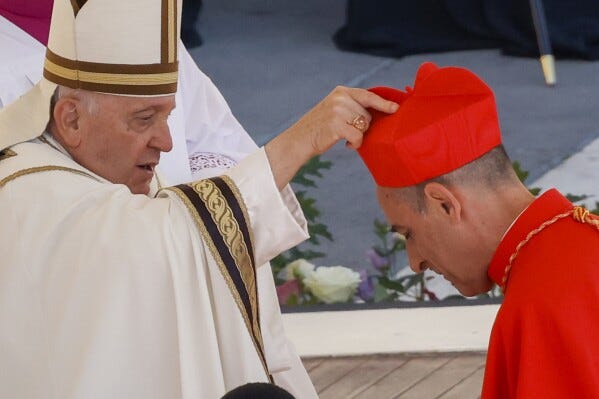
As we saw yesterday, the publication of Una Caro and its early reception raised questions about emphasis, process and prudence within the Dicastery for the Doctrine of the Faith. Those questions have deepened with the release of Diane Montagna’s recent interview with Cardinal Víctor Manuel Fernández, which sheds further light on the theological instincts and governing style of the man entrusted with guarding the Church’s doctrinal integrity. The interview, offered in the wake of Mater Populi Fidelis, does not merely clarify the dicastery’s position on Marian titles. It exposes larger structural concerns about theological method, the exercise of doctrinal authority and the future credibility of the doctrinal office itself.
Cardinal Fernández’s theological approach did not emerge suddenly. Long before his appointment as prefect, he had already attracted serious controversy for the method and content of his work. He was a close collaborator of Jorge Mario Bergoglio in Argentina and later a principal drafter of Amoris Laetitia. That exhortation, the justification for which may have been pastorally motivated, created a global theological storm because it sought to leave open the possibility of Communion for the divorced and civilly remarried without firm commitment to the universal moral norms articulated by Veritatis Splendor and the perennial tradition. Many faithful Catholics saw in Fernández’s influence a deliberate attempt to shift doctrine through ambiguous pastoral language, rather than by engaging in transparent theological reasoning. More troublingly, some of his writings prior to becoming a bishop were criticised for methodological looseness, lack of engagement with the tradition and even for containing ideas judged pastorally harmful by the very dicastery he now leads.
These earlier disputes were not incidental. They formed a pattern of theological method marked by two consistent tendencies: an emphasis on affective pastoral language over conceptual precision and a willingness to sidestep the classical doctrinal tradition when it appeared to impede pastoral rhetoric. Such tendencies may be personally appealing or even occasionally illuminating, but they are poorly suited for the office long held by Ratzinger, Ottaviani and figures whose doctrinal work reflected the precision and metaphysical clarity defended by Garrigou-Lagrange. The prefect of the DDF is not primarily a pastoral poet; he is a guardian of truth, a custodian of doctrine, and a servant of the deposit of faith.
Montagna’s interview throws this contrast into sharp relief. When Fernández explains that the Marian title Co-Redemptrix is now “off limits” for official documents but still permissible in private devotion among “friends,” he reveals not merely a pastoral instinct but a methodological instability with real doctrinal consequences. The problem is sharpened by the fact that this title has been used, prudently and reverently, by previous popes, saints, and authoritative theologians, including St. John Paul II, Pius XII, and St. Teresa of Calcutta. To declare such a term unacceptable at the level of the Church’s universal teaching while simultaneously permitting it privately creates a bifurcated theology that cannot be coherently sustained. A term cannot be both theologically unfitting for the faithful as a whole and yet harmless or orthodox for a subset behind closed doors. This approach invites confusion about what is true, what is fitting, and what is merely being suppressed for administrative or political reasons. And it exposes the deeper issue not primarily of Marian doctrine but of theological method itself: by what principles does the prefect determine whether a long-received title is to be clarified, refined, restricted, or effectively abolished? What historical and doctrinal expertise is being consulted? What risks to the faithful are being weighed? From the interview, none of these fundamental questions receives a clear or even minimally adequate answer.
