


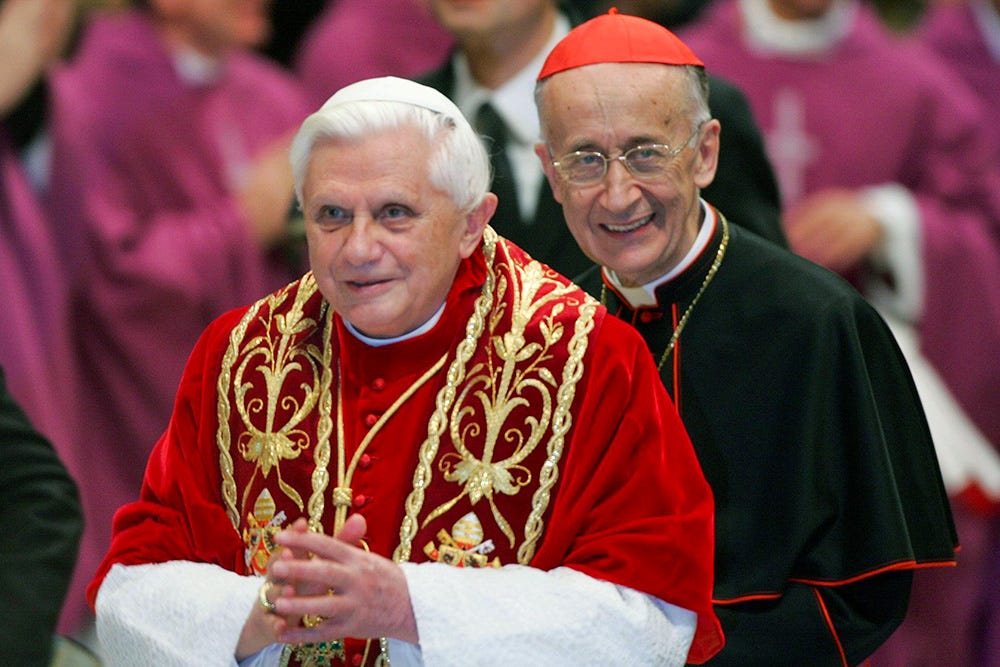
At the recent funeral of Cardinal Camillo Camillo Ruini the Pope presided calling him “a wise and dilligent shepherd”. He died in Rome on Tuesday at the age of 95.
The publication of the full spiritual testament of Cardinal Ruini has revealed far more than the final reflections of one of the most influential churchmen of modern Italy. It has offered an unexpectedly candid glimpse into the mind of a man who stood at the centre of ecclesiastical life during the pontificates of St John Paul II and Benedict XVI and who, while expressing filial loyalty towards Pope Francis, quietly acknowledged a profound unease regarding the direction in which the Church had travelled. And it is really quite beautiful in all its aspects.
Pope Leo XIV in his funeral homily, drew attention to the cardinal’s spiritual testament. Yet it was not the Vatican that released the complete text. That task fell to the traditionalist publication Messa in Latino, which stated that it was publishing the document in full precisely to ensure that it would not be “cut” or amended. According to reports subsequently published by Ad Vaticanum, individuals close to the cardinal were concerned that some passages, particularly those relating to the aftermath of the Second Vatican Council and to Pope Francis, might never see the light of day.
Such concerns themselves reveal something of the atmosphere which has characterised recent years. For the testament of Camillo Ruini is remarkable not because it contains a direct criticism of Pope Francis, still less because it advances some ideological programme, but because it embodies something increasingly rare in contemporary ecclesiastical discourse. It is the voice of a senior churchman speaking with honesty, humility and spiritual sobriety.
Throughout the text, Ruini’s overwhelming tone is one of gratitude and repentance. He thanks God for the gift of faith, for the priesthood, for his family, friends and collaborators, and for the many years granted to him in service of the Church. He confesses his sins, laments the poverty of his faith and repeatedly asks forgiveness from those whom he may have wounded by what he describes as his own “substantial harshness”. The entire document breathes the atmosphere of a soul preparing itself for judgement rather than attempting to shape its own legacy.
Yet it is impossible to ignore the ecclesial reflections which emerge naturally from this examination of conscience. Ruini’s account of the Second Vatican Council is particularly revealing. He gives thanks for having lived through the Council and for helping to implement its teachings in Reggio Emilia. At the same time, he thanks God for having given him “the clarity and strength to oppose the distortions that followed the Council”. This sentence is of considerable significance because it reveals the hermeneutic which guided Ruini’s entire ecclesiastical career. He was neither a reactionary opponent of Vatican II nor an advocate of the endless experimentation which so often followed in its wake. He belonged instead to that generation represented by John Paul II and Benedict XVI, which sought to distinguish the Council itself from the post-conciliar upheavals carried out in its name.
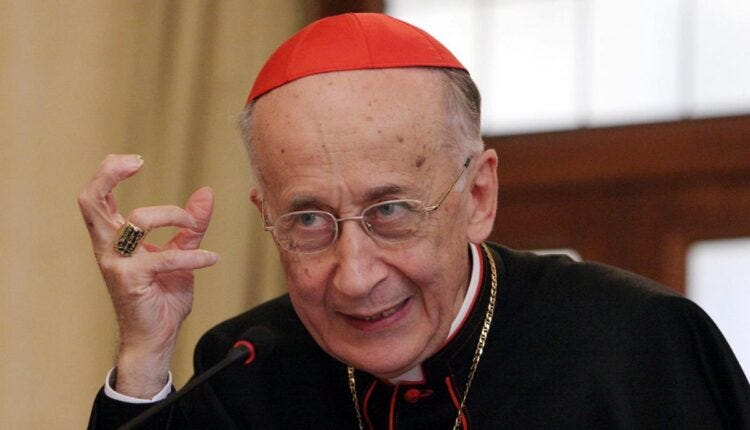
This same interpretive framework sheds light on his final remarks concerning Pope Francis. Ruini recalls that he rejoiced at Jorge Mario Bergoglio’s election and immediately sought to support him. Even in his last years he remained grateful for what he calls Francis’ “extraordinary missionary and evangelising zeal”. There is no trace of bitterness or personal grievance. Yet the following words possess an unmistakable gravity.
“I must confess that I find myself in a state of unease, not for personal reasons, certainly, but because I struggle to understand certain directions that seem to me to reopen wounds which, after the Council, had only with difficulty been healed.”