


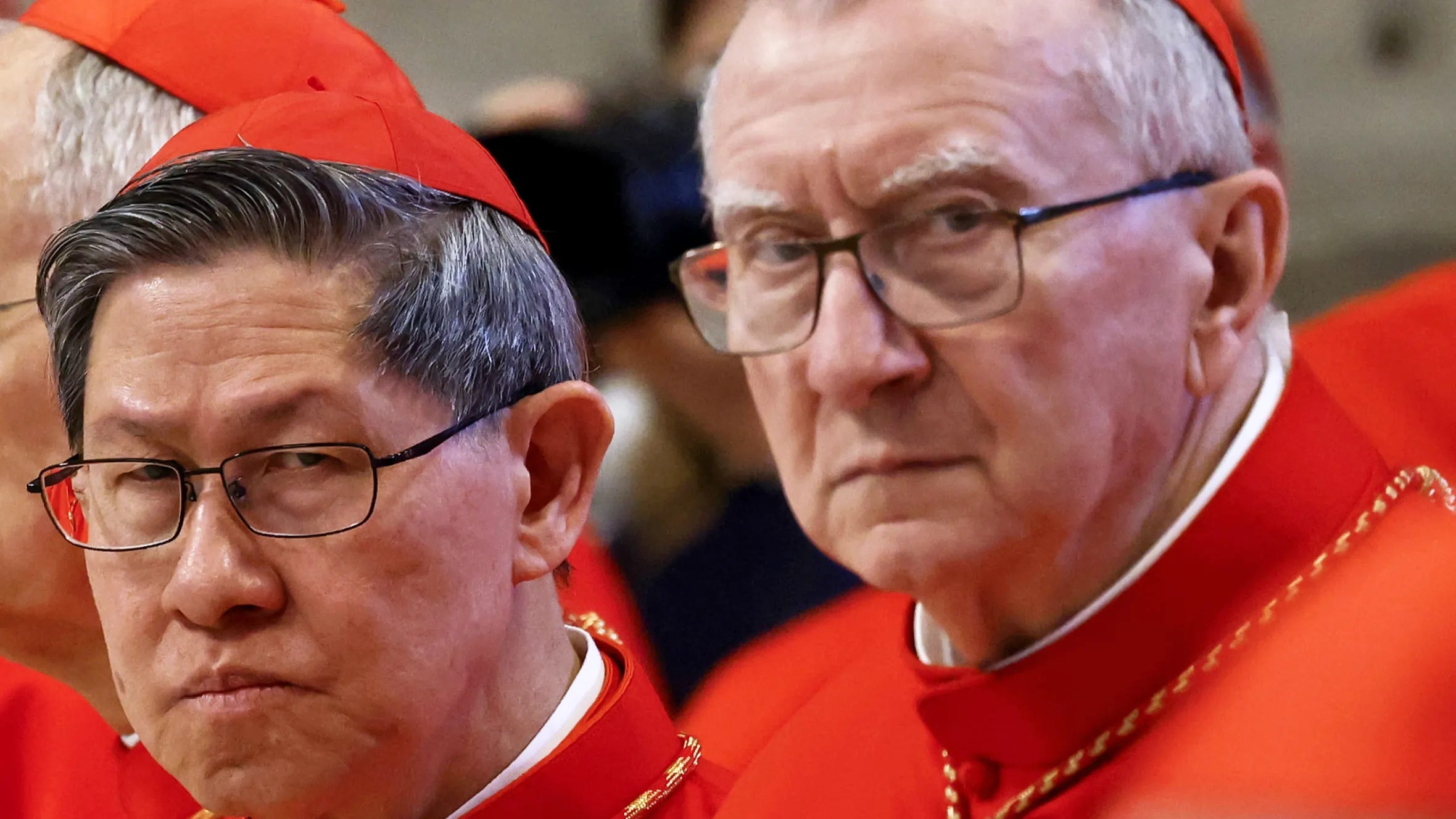
Cardinal Luis Antonio Tagle’s election as Dean of the College of Cardinals has become one of the most intriguing developments of Pope Leo XIV’s young pontificate. What initially appeared to be a significant, but largely routine, change in the Church’s senior leadership has acquired unexpected importance following the Holy Father’s surgery for lung cancer. Now, new reporting from Rome suggests that Tagle’s elevation may tell us something important about the distribution of influence within the Vatican itself.
In an article published in Il Giornale on 18 October, Vatican correspondent Nico Spuntoni examines the controversy surrounding Cardinal Pietro Parolin, the Secretary of State, whose suggestion that Pope Leo might need to “recalibrate” his pontificate provoked considerable discomfort within the Curia. Parolin subsequently explained that he was referring to the possibility of adjusting the Pope’s demanding travel schedule, particularly his forthcoming apostolic journey to Latin America. Given the seriousness of Leo’s operation, this was a perfectly reasonable practical concern, although the expression itself was unfortunate. There is a considerable difference between suggesting that a Pope might need to reconsider his engagements and suggesting that his pontificate might require recalibration. But Spuntoni’s article, subsequently translated into English by Diane Montagna, suggests that the controversy goes rather deeper than one poorly chosen expression.
According to his reporting, Parolin has already experienced several disappointments under Leo XIV, including disagreements over Vatican property, the decision to send Archbishop Paul Richard Gallagher on a sensitive diplomatic mission to Moscow and, most interestingly of all, the election of Cardinal Tagle as Dean of the College of Cardinals. It is this last development that deserves particularly close attention.
The cardinal who was not chosen
On the 9th October, Pope Leo approved the election of Cardinal Tagle who is 69, as the first Asian Dean of the College of Cardinals, succeeding the 92-year-old Cardinal Giovanni Battista Re. Pope Leo is 71, so the two men are of a very similar age. The election of Tagle was conducted by the cardinal bishops, in accordance with the Church’s law, and confirmed by the Pope. It is important to mention this distinction because the Dean is not simply appointed at the personal discretion of the Roman Pontiff. It also reveals that Tagle is popular with the Cardinals.
What Spuntoni now reports, however, is that Parolin had himself aspired to the position, apparently as early as 2025, and that his candidacy encountered resistance. According to an unnamed source cited by Spuntoni, the outgoing Dean, Cardinal Re, communicated a preference from higher authority that the new Dean should be under eighty years of age, which is perfectly understandable, Cardinal Re had been able to preside over the general congregations preceding the 2025 conclave, but because of his age he could not enter the Sistine Chapel as an elector. Indeed, it was Cardinal Parolin who presided over that conclave as the senior cardinal bishop eligible to vote an important detail which is worth remembering.
Parolin had already exercised one of the most solemn responsibilities associated with the leadership of the College of Cardinals. He had presided over the election which gave the Church Pope Leo XIV. At 71, he also satisfied the reported preference for a Dean under eighty. Yet Spuntoni’s source claims that when Parolin was considered, the objection was raised that he already had too many commitments. This is curious, because Cardinal Tagle himself occupies an important position within the Roman Curia as pro-prefect of the Dicastery for Evangelisation. If the account is accurate, the explanation offered for setting Parolin aside seems, at the very least, open to question.
It is important to be careful here. Spuntoni’s account relies upon an unnamed source, and we do not know who expressed the objection to Parolin, whether it reflected the Pope’s personal wishes, or whether other considerations influenced the election.
There is, however, some relevant background. During the sede vacante following Pope Francis’ death, Parolin’s apparent position as a leading candidate for the papacy had already attracted criticism from fellow cardinals. Christopher White, writing in the National Catholic Reporter, reported that his celebration of Mass in St Peter’s Square on 27 April had left several cardinal-electors distinctly unimpressed, with some suggesting that he had effectively “failed the audition” for the papacy. There were also reports of considerable irritation among Polish prelates at his failure to mention either St John Paul II or St Faustina during that Divine Mercy Sunday celebration. These criticism do not establish that Parolin presumed he would become Pope and the manoeuvring surrounding a conclave makes it especially important to distinguish legitimate reservations from attempts to undermine a prominent candidate, but they suggest that Parolin’s position within the College of Cardinals was perhaps considerably less secure than his prominence as Secretary of State might have suggested.
Against this background, Spuntoni’s latest revelation acquires additional significance. The man who presided over the conclave which elected Leo XIV and who had himself been considered a serious candidate for the papacy, has now reportedly been passed over for the office that would ordinarily place its holder at the centre of the next papal election. That doesn’t establish a political defeat, still less a deliberate attempt by Pope Leo to marginalise him. But it raises an intriguing possibility: that the reservations about Parolin which surfaced during the last sede vacante have continued to influence his standing within the Church’s senior leadership.
Why Tagle matters
Cardinal Tagle is no obscure Vatican functionary suddenly thrust into prominence by circumstance. The former Archbishop of Manila is one of the most recognisable and prominent figures in the universal Church, and his international standing extends considerably beyond Rome. He has long been associated with the missionary and pastoral priorities of Pope Francis and has occupied a prominent role in the Church’s evangelising structures. He was also widely discussed as a possible candidate for the papacy before the 2025 conclave and was considered one of the leading contenders alongside Cardinal Parolin himself. There is also a deeply personal and symbolic dimension to Tagle’s relationship with Leo XIV. The two men had worked closely together in the Roman Curia since 2023, and during the conclave Tagle found himself sitting beside Cardinal Robert Prevost as the votes accumulated in his favour. In a moving account subsequently given to Vatican News, Tagle recalled watching Prevost alternating between smiles and deep breaths, describing his reaction as one of “holy resignation and holy fear”. Tagle silently prayed for him, recognising that something profoundly sacred was taking place. “Let holy silence envelope Jesus and Peter”, he recalled thinking as the cardinals greeted their newly elected Pope.
Just ten days later, at the inauguration of Leo’s Petrine ministry, it was Cardinal Tagle who placed the Fisherman’s Ring upon the new Pope’s finger. This is a striking sequence of events: the cardinal who sat beside Prevost as he confronted the extraordinary burden of the papacy was subsequently entrusted with a central ceremonial role in its inauguration, and has now become Dean of the College of Cardinals. None of this proves that Tagle enjoys particular political favour with Leo, but it does hint strongly in that direction and certainly gives their relationship a personal and spiritual depth which should not be overlooked. Tagle’s election as Dean now gives that prominence an additional institutional dimension.
Under the arrangements established by Pope Francis in 2019, the Dean serves a five-year term, renewable if necessary. Because Tagle is considerably younger than eighty, he would ordinarily be eligible to preside over a future conclave should the Apostolic See become vacant during his term and before he reaches the electoral age limit, but the importance of his position must not be exaggerated. Canon 352 describes the Dean as first among equals. He presides over the College of Cardinals but exercises no governing authority over his fellow cardinals. He has no automatic authority over the Roman Curia and no jurisdiction to exercise the powers of the Pope. This is a fundamental distinction, especially given the extraordinary circumstances of the past week.
On 14 October, Cardinal Tagle presided over the Mass in St Peter’s Square marking the tenth anniversary of Amoris Laetitia, while Pope Leo recovered in hospital. He read the homily prepared by the Holy Father, giving visible expression to the continuity of the Church’s public worship during the Pope’s temporary absence. The continuity was reassuring but we shouldn’t mistake it for a transfer of papal authority. Tagle was acting on the Pope’s behalf in a particular liturgical celebration, not assuming the government of the universal Church and therein lies the deeper ecclesiological significance of these developments.
Influence is not authority
As we discussed when Tagle’s election was first announced, canon law acknowledges the possibility of an entirely impeded Roman See but provides no comprehensive mechanism for determining permanent papal incapacity or transferring the Pope’s unique jurisdiction in such circumstances. That remains an unresolved difficulty, one made increasingly relevant by advances in modern medicine. It is essential, however, not to confuse a genuine canonical problem with the Holy Father’s present medical circumstances. Pope Leo has undergone successful surgery, has returned to the Vatican and, at today’s Angelus, announced that he will gradually resume his activities. His recovery is a cause of considerable gratitude and there is no justification for treating the Church as though it were preparing for an imminent vacancy of the Apostolic See, so the significance of Tagle’s election lies elsewhere. It invites us to distinguish between three forms of ecclesiastical prominence: the practical influence exercised by those who govern alongside the Pope, the institutional responsibilities of those who serve the College of Cardinals, and the unique authority entrusted to the Roman Pontiff himself, these are all related, but they are not interchangeable.
Is Leo quietly reshaping the Vatican?
Spuntoni’s reporting suggests that the relationship between Leo XIV and Parolin may subject to some friction. He points to instances in which Parolin’s preferences reportedly failed to prevail and, rather interestingly, suggests that the Secretary of State’s prominence in public discussions has become a source of irritation among some Vatican officials. It is possible that we are witnessing a gradual reduction in Parolin’s influence, but there are reasons to resist an overly dramatic interpretation.
