


Catholic Education Leaders Unite Around Seven Principles for the Renewal of Catholic Schools
A significant new initiative calling for the renewal of authentically Catholic education has emerged from a gathering of bishops, academics and educational leaders in the United States earlier this summer.
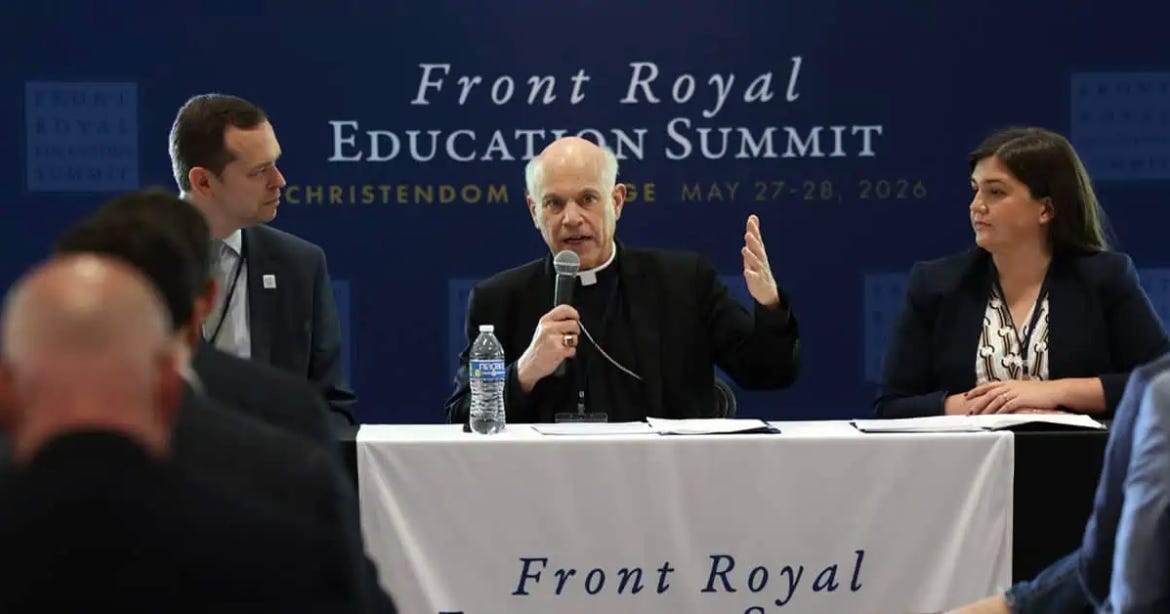
The inaugural Front Royal Education Summit, held at Christendom College in Virginia on 27–28 May, brought together Catholic bishops, school leaders, university academics, diocesan superintendents and representatives of Catholic educational organisations to consider how Catholic schools can recover a clearer understanding of their purpose and identity.
The result was the Front Royal Statement: Seven Cardinal Principles of Catholic Elementary and Secondary Education — a document intended to provide a common foundation for the growing movement seeking to renew Catholic education.
At the heart of the statement is a proposition which would once have been considered self-evident in Catholic education but which has become increasingly counter-cultural: the ultimate purpose of education is supernatural.
Catholic education, the statement argues, cannot simply be a secular education with religious studies, Mass and prayer added to it. Its purpose is the formation of the whole human person — mind, body and soul — ultimately ordered towards God.
That distinction has considerable implications for what happens inside a Catholic school.
Rather than judging education primarily by examination results, university admissions, employability or other measurable outcomes, the Front Royal Statement places intellectual formation within a much larger understanding of the human person. Academic excellence remains important, but it is not the final end of education.
The question is not simply, What will this child achieve? but What kind of person is this child becoming?
Recovering a Catholic vision of education
The statement draws upon the Church’s long intellectual and educational tradition while addressing practical questions facing Catholic schools today.
These include the proper roles and responsibilities of parents, teachers, priests and bishops; the formation and retention of teachers; the development of curricula; and the creation of a genuinely Catholic culture within schools.
This last point is particularly significant.
For decades, Catholic schools in much of the Western world have faced the danger of becoming increasingly difficult to distinguish from their secular counterparts. A school may retain a Catholic name, religious symbols and occasional liturgical celebrations while adopting essentially the same assumptions about the human person, morality and the purpose of education as the surrounding culture.
The Front Royal initiative represents an attempt to reverse that trajectory by returning to first principles.
Elisabeth Sullivan of the Institute for Catholic Liberal Education warned that contemporary education can easily become dominated by practical considerations and measurable outcomes. The Christian understanding of education, by contrast, begins with the child’s relationship with God and seeks the formation of the entire person.
That conviction shaped the summit itself.
Rather than functioning simply as another academic conference, organisers conceived the gathering as a working meeting in which those involved in Catholic educational renewal could establish greater cooperation and a clearer common vision.
Discussions ranged across theology, philosophy, curriculum, teacher formation, institutional identity and the relationship between faith and reason.
Bishops and educators come together
Among those taking part were Archbishop Salvatore Cordileone of San Francisco, Bishop Thomas Daly of Spokane, Bishop Earl Fernandes of Columbus and Bishop Thomas John Paprocki of Springfield, Illinois.
They were joined by representatives from a number of prominent Catholic institutions, including Christendom College, The Catholic University of America, Benedictine College, Belmont Abbey College, the University of Dallas and the Augustine Institute.
Educational organisations represented included the Institute for Catholic Liberal Education, the Chesterton Schools Network and Catholic Education Partners.
Christendom College President George Harne described the present moment as one of considerable cultural and educational confusion, arguing that the renewal of Catholic schooling requires more than isolated examples of excellent institutions. What is needed, he suggested, is a shared vision grounded in the Church’s intellectual, spiritual and educational inheritance.
That may prove to be the most important aspect of the Front Royal Statement.
Sixty years after Land O’ Lakes
The timing is particularly striking.
The summit took place almost sixty years after the 1967 Land O’ Lakes Statement, a document which became highly influential in discussions surrounding the identity and direction of Catholic higher education in the United States.
The new Front Royal Statement emerges in a very different cultural moment — one in which questions about the nature of the human person, the authority of parents, sexual morality, religious freedom and the purpose of education have become increasingly contested.
Against that background, the Front Royal Statement is not merely a proposal for improving Catholic schools.
It represents an attempt to recover a fundamentally Catholic answer to the question: What is education for?
For the Catholic tradition, education cannot ultimately be separated from truth, virtue or man’s final end. A child is not merely a future worker, consumer or university applicant, but a person created in the image of God and called to eternal life.
If the movement represented at Front Royal succeeds in placing that conviction once again at the heart of Catholic schooling, the consequences could extend far beyond the classrooms of the United States.
The renewal of Catholic education may depend less upon inventing something new than upon recovering something the Church already knew.
It doesn't matter really what the church recovers if most working families can't afford the tuition. Today in my Diocese (Brooklyn) it costs $5600.00 a year for each child, which is unaffordable, so most people send their children to the godless/woke/LGBT Public Schools.
What the church needs to recover is a way of making catholic education "FREE" for all children of Catholics. I'm afraid nothing else will save catholic education.
So, how can those of us with an educational career background help?