

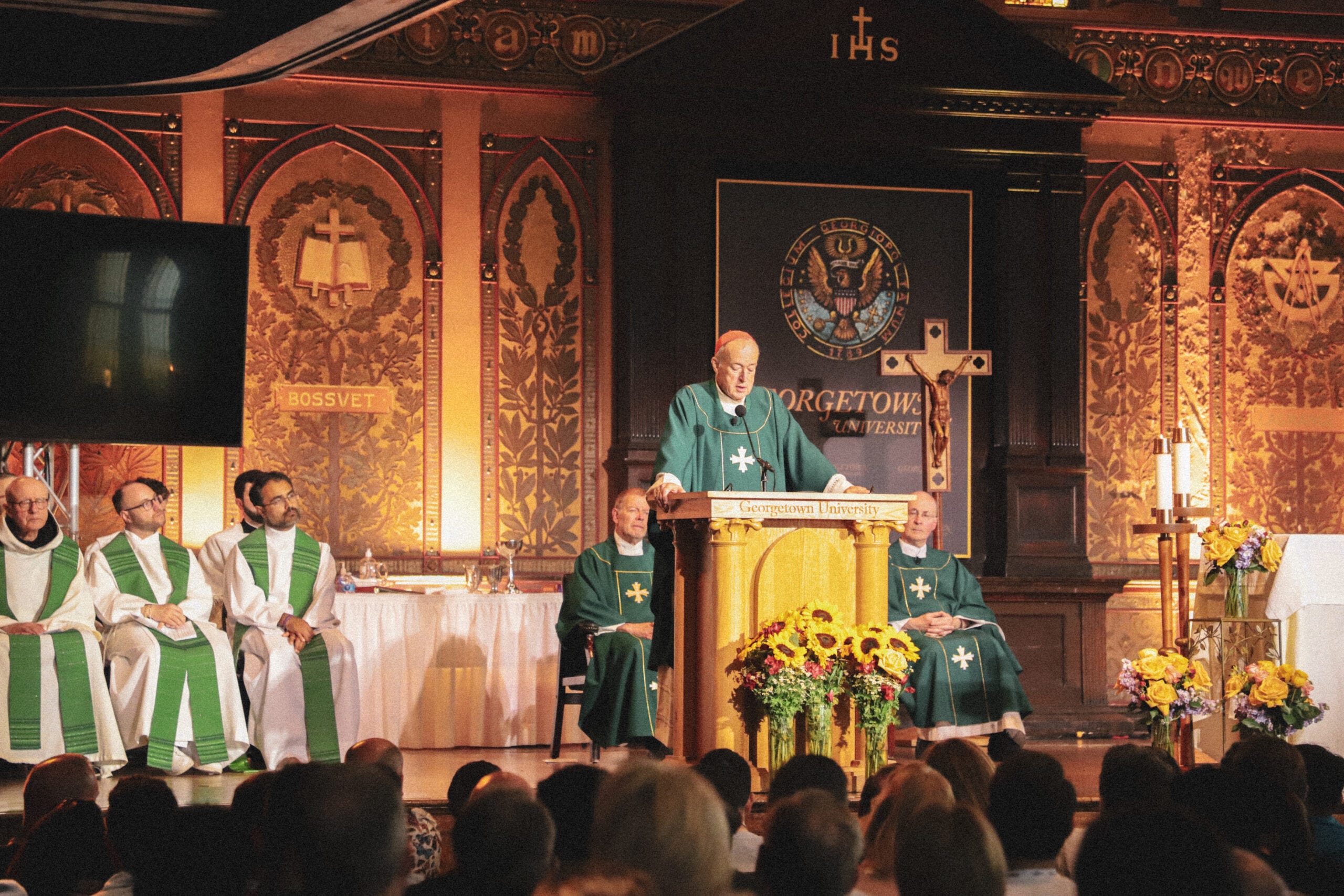
By Deacon Stephen Morgan, Rector and Professor at the University of St. Joseph, Macao, China.
Cardinal Robert McElroy’s homily to the 2026 Outreach conference deserves serious attention. It is not merely another intervention in the Church’s continuing debates about sexuality, pastoral practice and inclusion. It is a concise statement of a wider theological method that has become increasingly influential in certain ecclesial circles. Its significance lies less in what it says explicitly than in the assumptions that structure its argument.
The homily is carefully crafted. McElroy speaks warmly of holiness, redemption, integrity, chastity and the rejection of sin. He explicitly rejects the notion that mercy makes sin irrelevant. Much of this is unobjectionable. Indeed, faithful Catholics should welcome any renewed emphasis on God’s mercy and the universal call to holiness. Yet the homily also contains a series of claims which, when taken together, point towards a conception of doctrine and pastoral practice that sits uneasily with the Catholic tradition as articulated by Paul VI, John Paul II and Benedict XVI.
The central issue is not whether doctrine develops. It does. The central issue is whether development can become reversal.
The most memorable phrase in the homily is also its most problematic. “Mercy is God’s first word to us.” The statement is rhetorically effective. It captures something important about God’s initiative in salvation. Yet it is neither scripturally precise nor theologically adequate.
The first word God speaks in Scripture is not mercy but creation: “Let there be light” (Gen. 1:3). More importantly, throughout the biblical narrative mercy is never detached from truth, holiness and judgment. Adam and Eve encounter God’s judgment before they receive the promise of redemption. Israel repeatedly experiences both divine mercy and divine correction. The prophets speak of forgiveness, but always in conjunction with repentance and conversion.
The same pattern appears in the New Testament. John the Baptist begins his ministry with the call to repentance. Christ does the same. “Repent, and believe in the Gospel” (Mark 1:15) is the inaugural proclamation of Jesus’ public ministry. Peter’s first sermon at Pentecost culminates in the same demand. Mercy enters the Christian life through the gateway of conversion.
This point is not a minor one. It stands at the heart of the Catholic understanding of redemption. Mercy does not abolish truth. Mercy presupposes truth. Mercy addresses a condition that requires healing. If there is no sin, there is no need for mercy. If there is no objective moral order, mercy becomes little more than affirmation.
Joseph Ratzinger devoted much of his theological career to resisting precisely this separation of mercy from truth. In Caritas in Veritate, Benedict XVI wrote that “without truth, charity degenerates into sentimentality” (Caritas in Veritate, §3). Love becomes detached from reality. It loses substance. It becomes vulnerable to manipulation by cultural fashion and subjective preference.
The same is true of mercy. Mercy without truth becomes sentimentality. It ceases to call men and women to conversion. It ceases to challenge the structures of sin. It ceases to transform. It merely confirms.
Ratzinger returned repeatedly to this theme. In Truth and Tolerance, he argued that Christian charity depends upon confidence that truth exists and can be known. Once truth becomes subordinate to experience, mercy loses its Christian character and becomes indistinguishable from mere affirmation. Such an approach may appear compassionate, but it ultimately deprives the sinner of the very gift he most needs: liberation through truth.
This tension emerges again when McElroy describes mercy as “the ambient culture of the church.” The phrase is attractive. It sounds pastoral. Yet it risks placing mercy in a position traditionally occupied by a richer constellation of realities.
The Church has understood herself as the Body of Christ, the sacrament of salvation, the communion of saints and the guardian of divine revelation. Mercy belongs within that identity. It is indispensable to it. But the Church’s life is also constituted by truth, worship, justice, holiness, repentance and charity. These realities are not competitors. They are mutually dependent.
A Church defined principally by mercy soon becomes uncomfortable with judgment. A Church uncomfortable with judgment becomes suspicious of doctrine. A Church suspicious of doctrine eventually becomes embarrassed by Christ’s moral demands. This is not a hypothetical concern. It is a pattern repeatedly visible in the history of modern Christianity. Liberal Protestantism did not begin by rejecting doctrine outright. It began by subordinating doctrine to pastoral and cultural concerns. Once that process commenced, doctrinal revision became increasingly difficult to resist.
The most significant section of McElroy’s homily concerns neither mercy nor holiness but the Church’s relationship with the LGBT community.
He speaks of a Church that has “frequently wounded the LGBT community through judgmentalism and exclusion.” Every Catholic should acknowledge that genuine wounds have occurred. Cruelty, ridicule, discrimination and neglect are incompatible with the Gospel.
Yet the crucial question remains unanswered. What exactly does McElroy mean by “judgmentalism”?
Does he refer to failures of charity? If so, few would disagree.
Or does the term include the Church’s teaching itself?
The ambiguity matters because contemporary ecclesiastical debates frequently depend upon precisely such ambiguities. The language of pastoral failure gradually merges with the language of doctrinal disagreement. Opposition to cruelty becomes opposition to doctrine. The implication, often left unstated, is that the Church’s principal wound is not her failure to live according to her teaching but the teaching itself.
This suspicion becomes stronger when McElroy identifies recent developments as “rich seeds for the unfolding of the Gospel.” The phrase immediately raises a theological question. What exactly is unfolding?
Catholics have always believed that the Church’s understanding of revelation unfolds over time. Newman devoted an entire book to explaining how this occurs. Yet development is not an unlimited concept. Not every change constitutes development. Some changes are corruptions. Some are reversals. Some are contradictions.
The decisive question is whether McElroy is describing a deeper pastoral application of existing doctrine or suggesting that doctrine itself is undergoing transformation.