


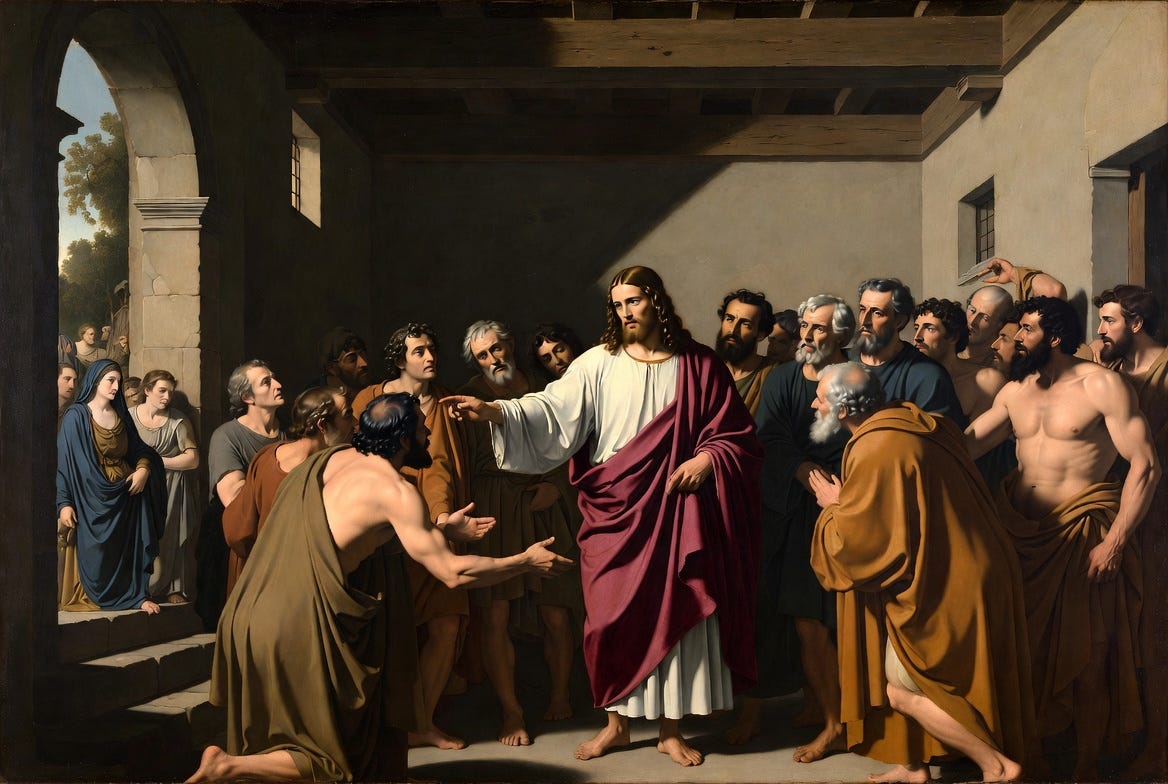
Today the Gospel reading is Matthew 12:46-50, the Gospel acclamation is John 14:23, the Responsorial Psalm is PS 85 (84):2-4. 5-6. 7-8. Response 8a, and the first reading is Micah 7:14-15, 18-20.
I always find this Gospel quite difficult to stand alone - it is one of those challenging Gospels that could easily be taken the wrong way which means I find it particularly fascinating! The plain sense of the text seems to that Jesus is somehow denegrating His family. Indeed, many Protestant denominations do take it exactly that way and see it as Jesus rejecting His own Mother! Since the Reformers rejected doctrines such as the Immaculate Conception, the Assumption, Marian intercession and devotion to Mary (although Luther himself retained a much higher Marian theology than many later Protestants), Protestants have developed a hermeneutic of suspicion and subsequently developed a tendency to look for texts that appear to "put Mary in her place." Matthew 12 and Luke 11 naturally become favourite proof texts.
Why does the Church give us this Gospel to reflect on today and is it really, as it seems, in isolation?
This is one of those passages that certainly is easy to misunderstand, if read on its own, but once you read the passage in the context of the whole of Scripture, the Fathers, and the Church’s theological reflection, you realise that Jesus is not denigrating His Mother, in fact, you arrive at something almost opposite. Jesus is explaining the true reason why His mother is blessed. The Catholic understanding isn’t an attempt to “explain away” an embarrassing text. Rather, it asks the question that the Ethiopian eunuch asks Philip in Acts 8:
“How can I [understand], unless someone guides me?”
That beautifully illustrates the Catholic claim about the Church’s teaching office. Scripture is inspired, but it was entrusted to the Church. The same Holy Spirit who inspired the Scriptures also guides the Church in their authentic interpretation. This is reflected in the Church’s understanding of the relationship between Scripture, Tradition, and the Magisterium. The Second Vatican Council teaches in Dei Verbum (§10) that:
“The task of authentically interpreting the word of God... has been entrusted exclusively to the living teaching office of the Church.”
That doesn’t mean individual Christians cannot read Scripture, they absolutely should. It means that no Christian reads in isolation from the Church that preserved, canonised, proclaimed and reflected on these texts over two millennia. It is for this reason that the Church has not presented this Gospel story to us in isolation today. The key to today’s liturgy is that the Church expects us to interpret the Gospel through the lens of the other readings. The lectionary is almost always thematic during Ordinary Time.
The apparent harshness of Matthew 12:46-50 dissolves when you read it alongside Micah and Psalm 85. The first reading from Micah ends one of the most beautiful prophecies in the Old Testament:
“Who is a God like you, taking fault away, pardoning crime... You will again have compassion on us... You will show faithfulness to Jacob and mercy to Abraham.”
The emphasis is on God’s covenant faithfulness. God has chosen a family —Israel, not because of blood alone but because of covenant fidelity. Membership of God’s people is not a privilege of blood, ultimately determined by faithfulness to God. Jesus is now revealing the fulfilment of that covenant. When He says,
“Who is my mother? Who are my brothers?... Whoever does the will of my Father in heaven is my brother and sister and mother,”
He is not rejecting His natural family. He is redefining the boundaries of God’s covenant family. That is exactly what Micah had been anticipating. God’s mercy was never meant to terminate in ethnic descent but to create a people bound together by obedience and faith. The Responsorial Psalm reinforces this beautifully:
“Lord, let us see your kindness,
and grant us your salvation.”
The Psalm speaks repeatedly of God restoring His people, forgiving their sins, and bringing peace. Again, the emphasis is covenant restoration rather than biology. This also explains why the Gospel Acclamation is John 14:23:
“If anyone loves me, he will keep my word, and my Father will love him, and we shall come to him.”
Notice the connection. Matthew says:
“Whoever does the will of my Father...”
John says:
“If anyone loves me, he will keep my word...”
Doing the Father’s will is what makes someone part of Christ’s family. The Church is inviting us to see these readings as one continuous revelation. And there is another layer that is often missed: Matthew has already carefully established that Jesus perfectly fulfils the commandment to honour His father and mother. He has defended the Fourth Commandment against the Pharisees (Matthew 15), He obeyed Mary and Joseph at Nazareth, and from the Cross He entrusted Mary to John. So today’s Gospel cannot possibly mean that family relationships no longer matter, instead, Jesus is teaching something profoundly Jewish. In the Old Testament, belonging to Israel was principally a matter of birth, in the New Covenant, belonging to God’s people is principally a matter of grace and obedience; the Church becomes the new family of God. This is one of Matthew’s major themes. Earlier Jesus had already said:
“Many will come from east and west and sit at table with Abraham...” (Matthew 8:11)
The family is expanding beyond natural descent, but there is also a Marian dimension. Ironically, no one fulfils today’s Gospel better than Mary herself. Incredibly and counter intuitively in many ways, Protestants have historically thought Jesus is somehow diminishing Mary here. I was surprised, when I was part of the Baptist Bible Study Group that they literally had no developed Christology because of the dominance of this hermeneutic of suspicion. The Catholic tradition has always read it in precisely the opposite way. Why is Mary His mother? Certainly because she gave Him birth. But even more fundamentally because she perfectly did the will of the Father. St Augustine famously wrote:
“Mary was more blessed in receiving the faith of Christ than in conceiving the flesh of Christ.”
Likewise, St Luke records Jesus responding to a woman who cried:
“Blessed is the womb that bore you!”
He replies:
“Rather, blessed are those who hear the word of God and keep it.” (Luke 11:27-28)
Again, this is not a correction of Mary—it is a description of exactly why Mary is blessed; she is the first and greatest disciple. So in today’s Gospel, Mary is not excluded from the circle Jesus draws with His hand, she stands at its very centre.
So why does the Church give us this reading today? I think the answer is that today’s liturgy is about identity. Micah asks: Who belongs to God’s merciful covenant? The Psalm asks: Who will receive God’s salvation? The Gospel answers: Those who do the Father’s will. Jesus is not saying, “My earthly family means nothing.” He is saying, “Through me, everyone who obeys the Father can become part of my family.” When you think about it, that would have been a breath-taking claim to His first hearers. It means that the intimacy with God enjoyed by Mary, Joseph, the Apostles, and Israel itself is now offered to every believer. The covenant family has become universal…not by bloodline, but by grace, faith, and obedience.
Think how many misunderstandings could be avoided if Christians of all stripes stopped falling into the trap of taking verses out of context and realized the necessity of knowledgeable teachers.
Even when I was a Protestant, I never saw this Gospel as a denigration of Mary! But thank you for so clearly and beautifully stating the true interpretation of our Blessed Lord's words. Alleluia!