


I thought that there was something quietly arresting in the recent reflection delivered by Pope Leo XIV at the Rosary Vigil for Peace. It does not rely on rhetorical flourish or political positioning. It does not attempt to dazzle. Instead, it proceeds with a kind of moral steadiness that feels, in the present climate, almost disorienting in its restraint. One senses immediately that this is not an intervention designed to win an argument but to reframe the ground upon which argument itself takes place.
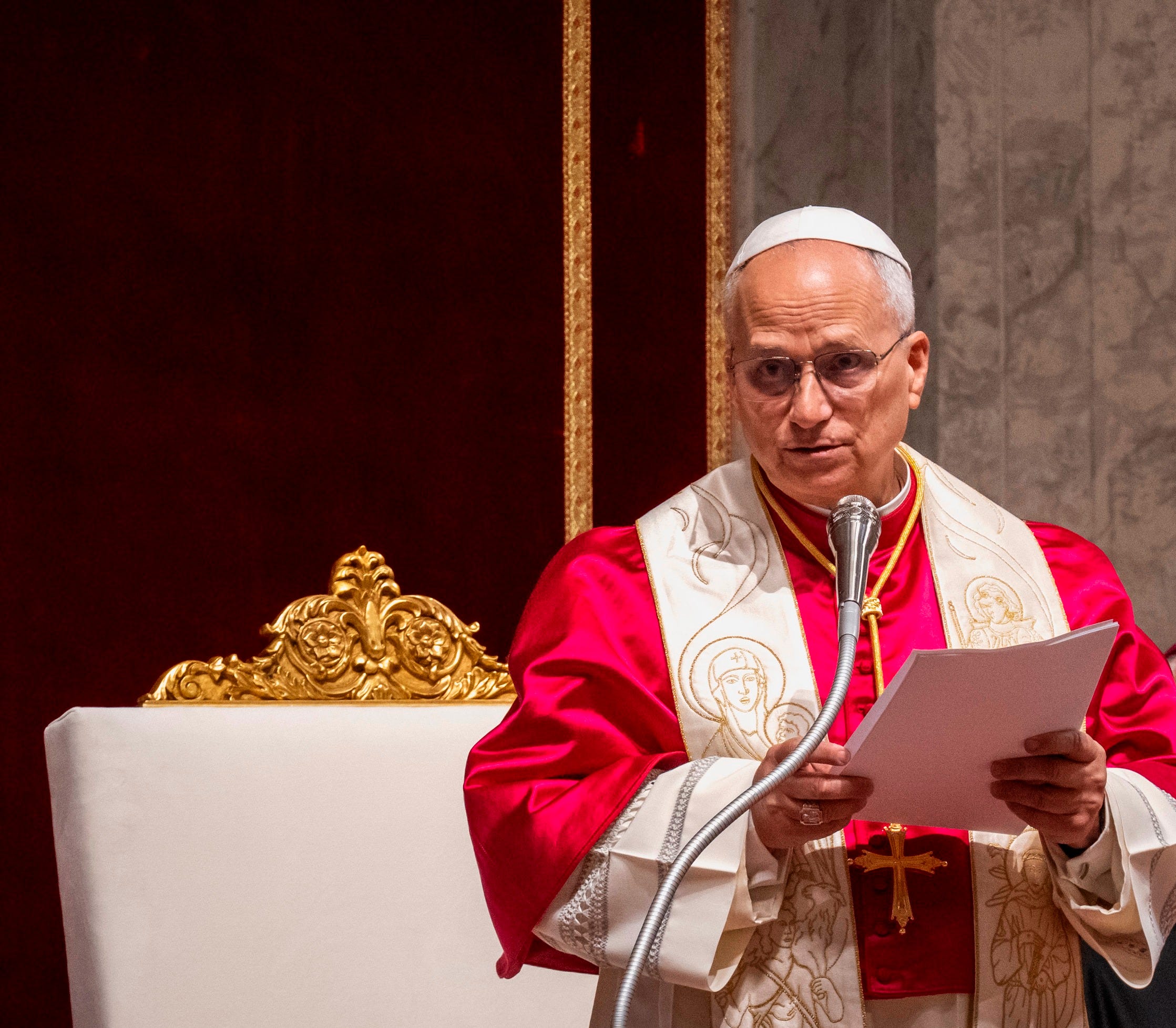
The structure of the homily is deceptively simple: “War divides; hope unites. Arrogance tramples… love lifts up. Idolatry blinds… the living God enlightens.” Yes these are poetic contrasts, but, moreover, they are theological claims about the ordering of human action and desire. What is being proposed here is recognisably Augustinian, an implicit retrieval of the distinction drawn by St. Augustine between the City of Man and the City of God, not as competing political entities but as rival orientations of the human heart. War, in this account, is not first a failure of diplomacy or strategy but a manifestation of disordered love, a turning away from the good that binds and toward the power that fragments.
This becomes clearer in what is perhaps the most striking line of the homily. “Even the holy Name of God… is being dragged into discourses of death.” The force of this observation lies in its refusal to treat religion as a neutral or merely symbolic element within political life. The Pope is not simply criticising the misuse of religious language. He is identifying a deeper corruption, namely the transformation of God into an instrument of human will. In classical theological terms, this is not an excess of piety but a form of idolatry. The living God is replaced by a projection that legitimises violence, and in that replacement something essential is lost, not only in the realm of doctrine but in the moral imagination that sustains political action.
It is in this light that the claim that “prayer is not escape… but a transformative response to evil” must be read. The sentence functions as a quiet repudiation of two persistent distortions. On one side lies the temptation to withdraw from the world, to treat prayer as a refuge from responsibility. On the other lies the temptation to collapse the spiritual into the political, to make faith serve as a justificatory language for decisions already made. The homily refuses both options. Prayer is presented not as evasion but as engagement, though engagement of a particular kind, one that seeks to reconfigure the agent before it seeks to reconfigure the world.
When the Pope goes on to say “Enough of war… True strength is shown in serving life,” the risk is that the statement will be heard as a generalised moralism, admirable in sentiment but lacking in substance. Yet within the Catholic tradition this is neither novel nor simplistic. From St. Thomas Aquinas onwards, the just war framework has insisted that the use of force, even when permitted, is always bounded by moral conditions that prevent it from becoming an intrinsic good. War may be tolerated, but it is never celebrated. It remains, even at its most justified, a sign of a deeper disorder. In this sense, Leo’s formulation is less a departure from tradition than a reaffirmation of its most demanding elements.
