


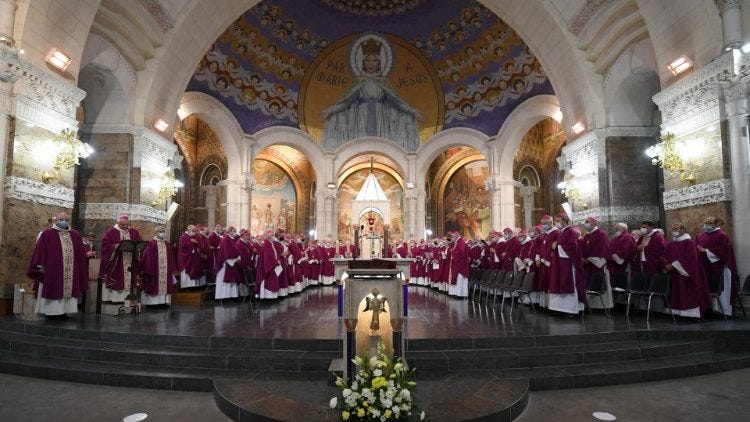
There are moments when a short Vatican message tells you more about the direction of travel than a major document. Pope Leo XIV’s intervention at the recent assembly of the French bishops is one of those moments. It has been reported, understandably, as a softening in tone towards Catholics attached to the older liturgical forms. Whilst I do not think that that reading is wrong, I do think it is incomplete. What is beginning to take shape is something more deliberate and, in its own way, more consequential.
The context matters. The French bishops gathered with a dedicated session on liturgy, with the question already framed as a live pastoral and ecclesial issue rather than a settled matter. Cardinal Aveline (someone who has consistently affirmed the authority of Vatican II and the post-conciliar liturgical reform as normative) made clear in his opening address that this was not to be treated as a one-off discussion, but as something that would need to be carried forward over successive assemblies. He also connected the conversation to the forthcoming consistory in Rome. That is an important detail because it places what might otherwise appear to be a national concern within a wider horizon of Roman deliberation.
Into that setting comes Leo’s message, conveyed through Cardinal Parolin, which speaks of a “painful wound” and asks for concrete ways of ensuring a generous inclusion of those attached to the Vetus Ordo (literally, the old rite). The language is measured, but it is not casual. It recognises that these communities are not diminishing into irrelevance. On the contrary, their continued presence, and in some places their growth, has become part of the pastoral landscape that bishops must reckon with. The request for concrete solutions carries weight because it assumes that the existing arrangements have not resolved the difficulty.
This is where the significance of France comes into focus.
