


Written by Dr. Anthony McCarthy
It’s not every day that a declaration from the Chair of the British Medical Association Medical Ethics Committee reminds one of existentialism – especially in its Sartrean form.
First, some background. Dr Andrew Green told a Health Committee at Stormontin 2025 that, “medicine is no longer practiced in a paternalistic fashion, it’s the doctor’s task to illuminate the paths that patients can then choose to follow…”
He went on to say, citing a BMA safeguarding toolkit, that “Competent adults retain the right to make decisions about how they wish to direct their lives. Neglecting or violating these decision-making rights, even where the intention is to protect the individual, can itself be a form of abuse.”
Such words are, on the face of it, unobjectionable. After all, who could be against ‘autonomy’ and the respect that should go with it? And who could be in favour of ‘paternalism’, which infantilises us patients and thereby affronts our dignity – with the latter surely bound up in some way with the fact we are autonomous beings?
Yet before embracing such views wholesale, it is useful to look at how far Dr Green himself is prepared to take them. He recently defended in print the decision of his Committee to issue startling guidance – about which more below – on ‘caring’ for patients wanting to kill themselves by stopping eating and drinking: patients who may or may not be dying, or even ill, but are certainly intending to end their own lives.
Suicide, that is, a deliberate act to destroy permanently one’s own life and health, is in Green’s view no longer necessarily something for doctors to oppose vigorously and counsel against – indeed, to do so will perhaps constitute, in the words he quotes above, “a form of abuse.” As long ago as 2021, the British Medical Association dropped its official opposition to legislation in favour of assisted suicide via use of lethal drugs (often euphemistically termed ‘assisted dying’) and adopted a ‘neutral’ stance. Should Parliament decide one day to legalise assisted suicide, as it very nearly did this year, the BMA would seemingly accommodate this decision. Such a change in medical practice would, of course, change the very meaning of medicine and extirpate a keyprohibition of the Oath which gave birth to medicine as a profession.
That ‘neutral’ stance married to a view of autonomy which presumptively favours autonomous decisions regardless of the values they may undermine runs through the BMA guidance on the practice known as ‘Voluntarily Stopping Eating and Drinking’ (VSED).
In my article I looked at some of the grotesquery contained within the BMA Guidance, which Dr Green utterly failed to address in his response. My purpose here is to examine the philosophical assumptions that pave the way to such insidious advice to doctors.
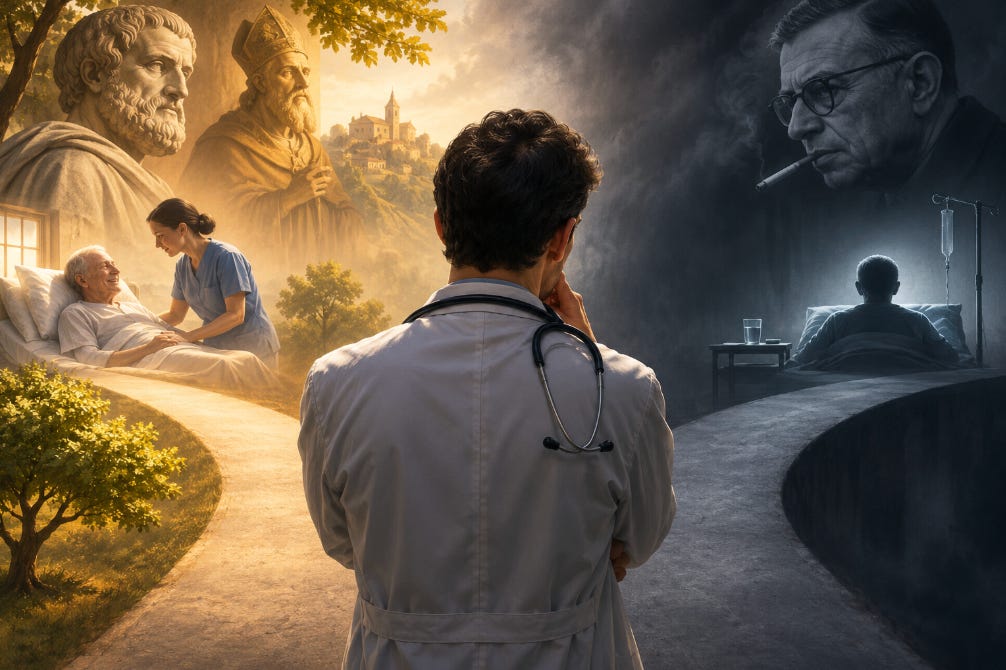
The word ‘autonomy’ notoriously encompasses a wide range of meanings. It may mean something like ‘free will’, the faculty of spontaneous choosing which distinguishes us from animals. Yet autonomy can also mean something more substantive, more akin to ‘rational self-control’, in other words the ability to resist urges or impulses. For Aristotle, this kind of freedom is associated with the virtuous man habitually oriented to choosing the good, understood in terms of human flourishing.
St Augustine for his part talks of freedom in terms of release from the bondage of sin. He wisely pronounced, in regard to liberty, that a man has as many masters as he has vices. In other words, self-control – and for him, God’s grace – are needed so that we may be freed from the “vice-like” grip of self-destructive habits. The person is seen as directed toward spiritual ends, with liberty understood in terms of natural law – constrained by a divine order which can be apprehended naturally.
That view of the world can be contrasted with a newer dispensation which tends to dismiss emotions such as shame or guilt as themselves enemies of “freedom” and self-realisation. Such a view has been particularly dominant in the sexual realm. The person, on this picture, is understood in terms of preference-satisfaction and emancipation from what is believed to be unduly ‘constraining’.
The most extreme version of such a view is arguably that propounded by Jean-Paul Sartre. For him, even considerations of prudence and rationality are to be seen as undue ‘constraints’ on our free choice, let alone any awe-inducing injunction from above. Rather, the supreme value becomes ‘authenticity’ understood without reference to rationality or immutable principles. Quite why this particular value, that of impeccant freedom, should trump all others is not clear. On what moral grounds is ‘inauthenticity’ to be condemned, given that our freely chosen acts often reflect our grasp of values which are not our own whimsical or spontaneous creations?
The over-emphasis on freedom seen as lack of constraint comes at a very great cost. For it neglects the very reality of all other values. By sanctifying choice it de-sanctifies the ordinary world of value, which no longer makes any serious claim on us.
Such views have acted as a yeast in our society over a very long period of time, supported by economic and political assumptions. You can see the results everywhere. Look at the media coverage of the recent Russell Brand rape trial and you will see that sexual ethics is largely confined to questions of whether free consent has been obtained. Other values associated with sexual activity tend to disappear from view, at least where they can’t be utilised selectively to punish yesterday’s degenerate icon. But if you minimise all other values atstake, don’t be surprised if those in the grip of multiple vices viewed indulgently by the media and their peers are not formed in such a way as to be especially careful even about consent.
Self-proclaimed liberal polities which exoterically reject the idea that they exist to make people virtuous should not be surprised by such an outcome. Having relentlessly promoted a culture of vice, under the cover of sexual ‘autonomy’, such polities scramble to assert inconsistently on certain forms of virtuous behaviour, provided that those forms do not in any way threaten the ‘new dispensation’ that they themselves imposed.
That autonomy uber alles has become increasingly the mantra of our medical institutions is perhaps more shocking, given medicine’s long tradition of respect for the inherent value of the person’s living body – his or her life and health. For by taking a neutral stance on the question of assisted suicide the BMA made clear that helping someone deliberately destroy their own life and health was not seen as antithetical to the practice of medicine. As well as undermining medicine, this emphasis on a haughty and unmoored autonomy drains away the moral weight of any situation, thereby eliminating the very ductility in responding to moral reality which autonomy requires.
And, just as Jean-Paul Sartre ended up supporting the most totalitarian ideologies as a result of his existentialism, so those who emphasise ‘autonomy’ above all things end up issuing Guidance to medical staff which tells them how to help patients prepare for suicide by, for example, reducing their caloric intake as a prelude to dehydrating and starving themselves to death. Refusal to violate certain values (and indeed one’s own caring instincts as a doctor) is now viewedas abuse of the only remaining value, namely ‘autonomy’ – even if that ‘autonomy’ is aimed precisely at the destruction of the value of one’s own life. A warped understanding of the value of autonomy results in the dissolution ofmany values, including autonomy in its highest form: one guided by the very objective human goods from which the value of autonomy ultimately derives.
Dr Anthony McCarthy is Director of the Bios Centre. The Centre has just released a Conscientious Objection Toolkit for healthcare professionals which can be accessed here.
One would expect the health profession to espouse autonomy only in as far as it is rational in terms of directed towards a healthy outcome. Is the very idea of what is healthy now in question?
How do they square this with their incessant promotion of vaccines and pharmaceuticals for all and sundry and their suppression of knowledge about other approaches? The medical profession seems to be riddled with pschopaths and the diabolically afflicted, or perhaps controlled by such individuals.