


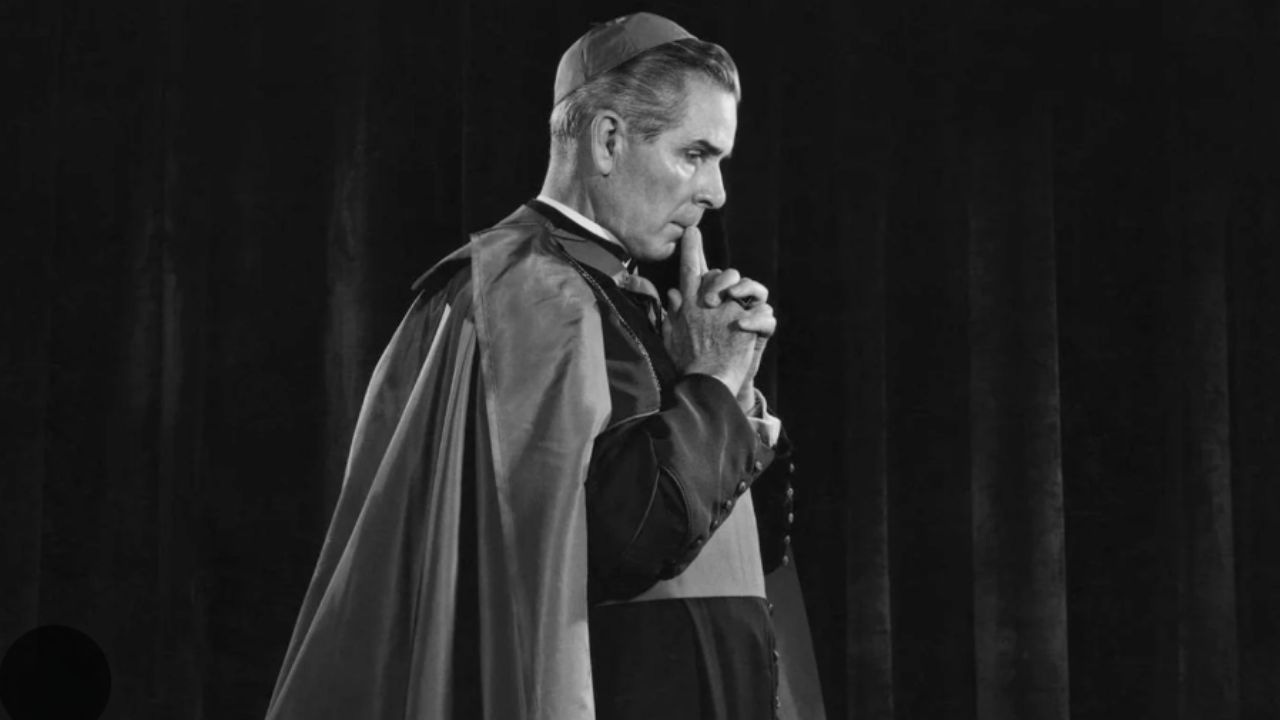
Few figures in 20th-century Catholicism captured both the mind and the heart like Archbishop Fulton J. Sheen. A priest, philosopher, writer, preacher, televangelist and beloved pastor, Sheen combined deep theological insight, relentless courage in proclaiming the Gospel, and a warm, winsome humour that drew millions into a greater love of Christ and His Church.
His great love of the Irish endeared him to many this side of the pond.
“The Irishman enjoys life, I repeat, because he lives in a bigger universe than anyone else. He lives in the universe of eternity as well as of time”
but he also spoke prophetically about what we can now see is the chastisement of a people who have turned away from God; “If God makes those whom He loves suffer” Sheen said “oh how he must love the Irish!”.
His ability to explore the hard teachings in a way that made them luminous, not oppressive, meant that not just Catholics, but Protestants, sceptics, agnostics, even Hollywood celebrities stopped what they were doing to listen to Archbishop Sheen speak about God, sin, suffering, love, and eternity. Actor Martin Sheen (Ramon Estévez) even adopted his stage name as a tribute to him.
Sheen (Fulton, not Martin) never diluted the Gospel, nor tried to soften the hard teachings. Compare this to the lukewarm ramblings of Bishop Paul McAleenan on Migrants, and Climate catastrophist Bishop John Arnold busy trying to limit global warming to (checks latest arbitrary figure) 1.5 degrees while giving an account of the despair that is within him. Which ‘up and coming’ young actor is going to adopt the name Arnold after sitting through these insufferable videos?
No one watching Sheen’s videos at the time, or listening since, could accuse him with being in lockstep with the government or of echoing UN talking points. He spoke about politics and public life only insofar as they intersected with moral and spiritual truth, especially when political ideologies or systems threatened human dignity or the teaching of the Church. People were, and remain, hungry for this teaching, a teaching that they cannot find elsewhere.
Sheen never avoided talking about sin and eternal damnation. He confronted these issues with clarity and compassion, but was equally adept at defusing tension with a joke or a gentle turn of phrase.
What made Fulton Sheen’s preaching effective was not just eloquent speech, but authentic conviction rooted in personal intimacy with Christ. That ability to make eternal things accessible without trivialising them is precisely what the New Evangelisation calls for, and what we see too little of today.
In an age where many Bishops shy away from bold proclamation of truth, and prefer to walk the more comfortable path, disturbing no one and thus leaving them where they are, Sheen’s example remains both inspiring and challenging.
In a recent inteerviw with katholisch.de the pastoral theologian Klaus Vellguth presented synodality as the ‘only imaginable future for the church’, saying that defining and defending Truth is Outdated and Orthodoxy is Religious Mania.
Fulton Sheen’s upcoming beatification reminds us that this is not true.