


Something rather revealing happened this week in the continuing story of the waste of time and resources we know as the Synod on Synodality. Two interventions appeared which, when placed alongside one another, expose a question that has hovered over the synodal project almost from its beginning.
The first came from Sr Nathalie Becquart, Undersecretary of the General Secretariat of the Synod and one of the most prominent advocates of synodality in the universal Church. In a post published by the official Synod account, Becquart sought to clarify one of the most confusing elements of the whole project — what does synodality actually mean? She made the point that synodality is not simply another programme to be implemented, another ecclesiastical project imposed from above, but a way of being Church. It is about listening, discernment, participation and learning to walk together under the guidance of the Holy Spirit. This statement was promoted on social media by the Official Vatican account of the General Secretariat of the Synod.
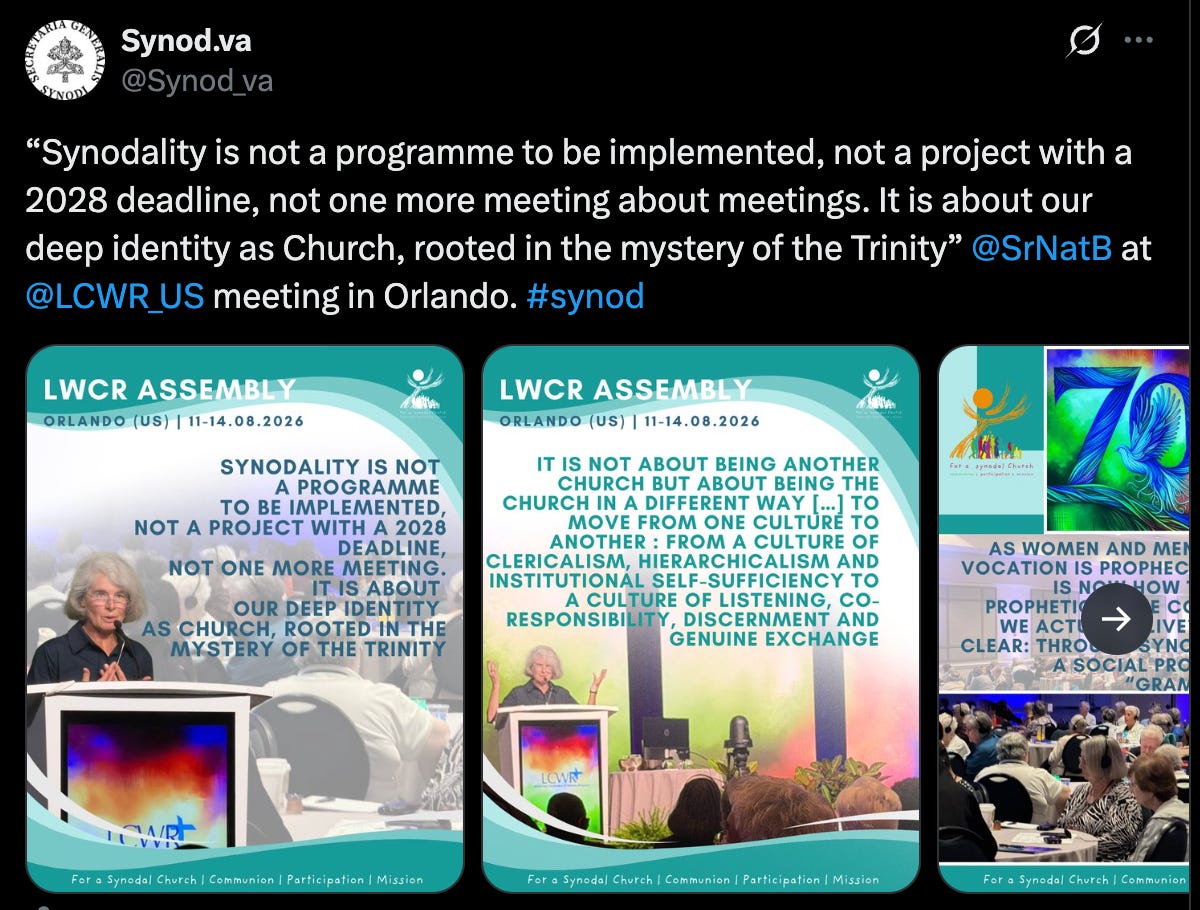
I think the idea is to build an attractive theological intuition here: The Church is not a corporation and the Gospel is not a management strategy, Catholicism cannot be reduced to pastoral plans, diocesan initiatives, committees, working groups and documents. If this is what Becquart means when she resists the idea of synodality as a programme, then you could argue she is correct. The difficulty is that the institution for which she works has spent the last several years speaking explicitly about implementing synodality.
The General Secretariat itself describes the present period as the “implementation phase” of the Synod. There are pathways for implementation, synodal teams responsible for implementation, diocesan and national processes of implementation, evaluation assemblies and an ecclesial assembly planned for Rome in 2028. Becquart herself has previously spoken quite unambiguously about the need “to already implement synodality everywhere, at all levels of the Church”, while explaining that the Church is now engaged in “putting into practice the fruit of the Synod”.
Does this amount to a direct self-contradiction? Becquart perhaps might reasonably argue that synodality itself is a spiritual and ecclesial disposition while structures and processes are being implemented to enable the Church to live that disposition more fully. Yet this also creates a rather obvious question. If something possesses an implementation phase, implementation guidelines, implementation teams, an implementation timetable, evaluation procedures and a concluding international assembly, at what point are Catholics permitted to call it a programme?
It was therefore striking that, almost simultaneously, Bishop Rob Mutsaerts, Auxiliary Bishop of ’s-Hertogenbosch in the Netherlands, published an open letter asking Pope Leo XIV to consider the fruits of the Synod on Synodality.
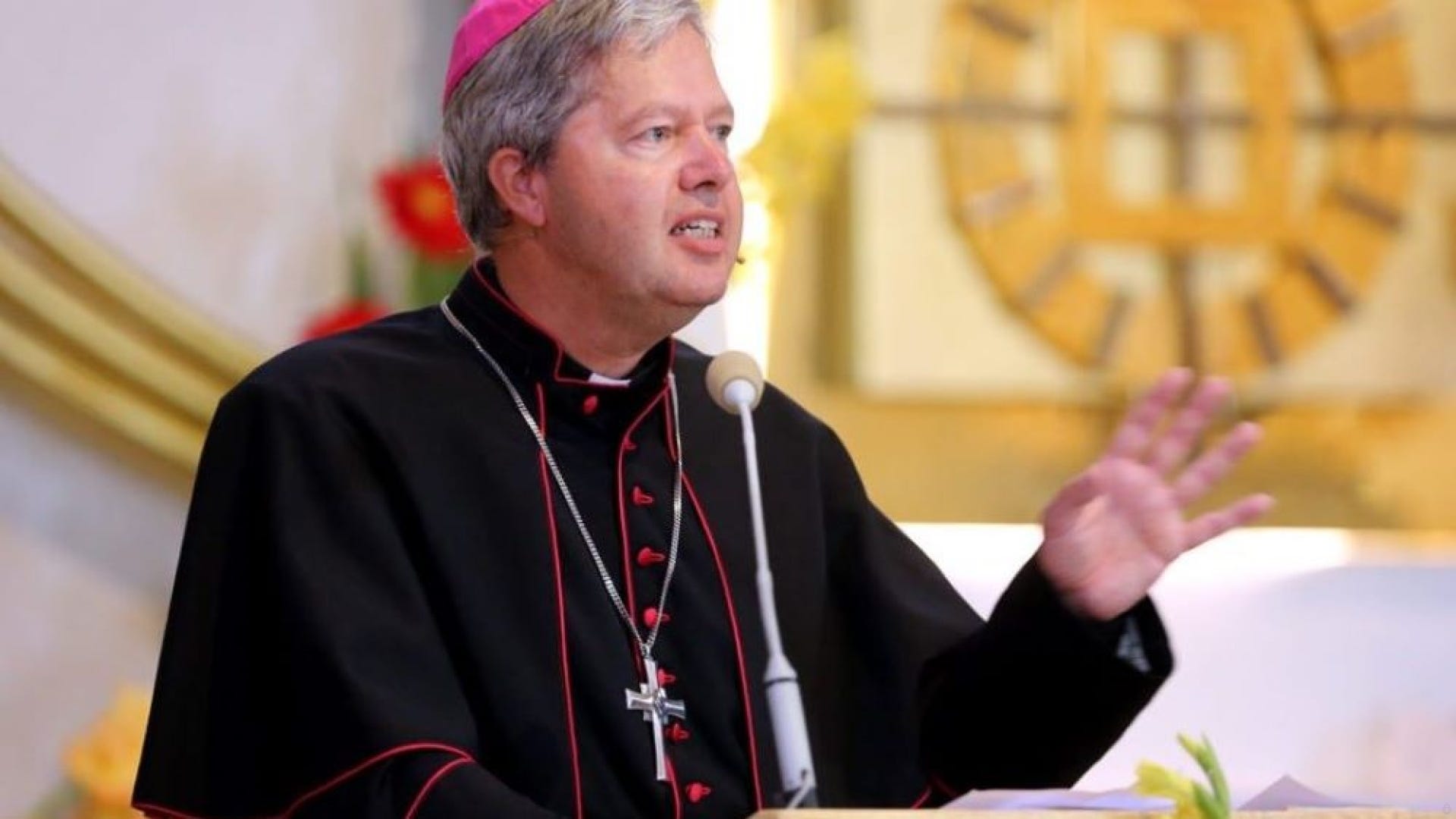
Mutsaerts approaches the question from an entirely different direction, but his criticism lands precisely upon the ambiguity exposed by Becquart’s comment. He does not primarily ask whether synodality has been implemented successfully but whether it has made the Church more successful in accomplishing the mission for which Christ established her. “Has faith become stronger?” he asks. “Has Christ been proclaimed more clearly? Have more people come to conversion?” These are devastatingly simple questions because they shift the criterion of success away from the synodal process itself.
Mutsaerts asks whether Sunday Mass attendance has increased, whether vocations have grown, whether catechesis has improved and whether Catholics have acquired a deeper reverence for the Eucharist. Behind all these questions stands the ancient canonical principle, salus animarum suprema lex. The salvation of souls is the supreme law of the Church. That principle ought to be so obvious that it barely requires stating, yet its application to the Synod is surprisingly radical.
The Church has now invested several years (and goodness knows how much money) in listening sessions, diocesan consultations, continental assemblies, synthesis reports, study groups, expert meetings, conversations in the Spirit and an increasingly sophisticated vocabulary of participation, accompaniment and discernment. None of those things is necessarily objectionable, some may potentially be extremely valuable...I doubt it….But they may be! Eventually, however a Catholic is entitled to ask what all this activity has produced. Mutsaerts identifies the danger with considerable precision when he observes that the classical synod was a means, whereas contemporary synodal discourse risks making synodality an end in itself; I think that may be the most important criticism of the entire project.
A synod traditionally exists in order to accomplish something. Bishops gather to deliberate upon a doctrinal, disciplinary or pastoral problem confronting the Church. They discern, decide, teach and then return to the work of evangelisation. The synodal process has a destination beyond itself. What happens, however, when the principal fruit of a Synod on Synodality is more synodality? The danger is a kind of ecclesiastical circularity. The Church must become more synodal, so synodal structures are created to facilitate synodality. Their success is measured by the extent to which those structures have made the Church more synodal, which produces further synodal structures designed to deepen the experience of synodality. The process continually validates its own continuation. In the Church of England, it has become a means to use constant discussion to undermine settled teaching.