



I remember sitting on the floor of the assembly hall at school during wet-weather breaks, as Miss Jubber wheeled out the school television, opened the casing doors and fumbled about with buttons she didn’t quite know how to operate, before finally pressing play on a programme called How We Used to Live. It was a British educational series which traced the daily lives, struggles and changing fortunes of fictional Yorkshire families in and around the equally fictional town of Bradley. Across its various series, it took us through different periods of British social history, from Tudor times and the Victorian era through to the twentieth century.
It was the 1980s when we watched this, and everything seemed amusingly old-fashioned compared with the times in which we then lived. We had microwaves and BMX bikes! We were modern!
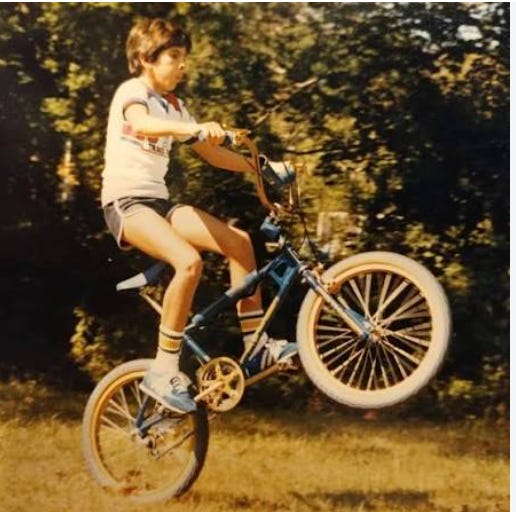
But inevitably, what seemed so advanced then appears quaint and outdated now. I think I belong to the last generation to have reached adulthood entirely internet-free. As students, we relied on physical libraries to research our dissertations, and it wasn’t until 1997 that we began emailing. I was 20 then.
There was something rather wonderful about the limitations of that world, although I doubt we recognised it at the time. If you wanted to know something, you had to go and find it out. If you wanted to speak to someone, you had to telephone them or arrange to meet. And if someone wasn’t available, well, they simply weren’t available. You tried again another time. Photographs were tangible and precious. There might only be that one curled photograph of you opening your Christmas present in 1984, capturing the look on your face when you saw that you had finally recieved your own pair of Pixie boots (albeit from Stevenage indoor market). Now you have 45,000 photographs floating around a cloud that you never look at.
There is no doubt that the intention behind many of the technological advancements since that time has been to make life easier, quicker and more efficient. Machines would do things in seconds that previously took hours, thus freeing up human beings to enjoy more leisure time, unburdened by stressful, time-consuming tasks. We would be able to read more, go for walks, eat together, spend time with our children and switch off at five o’clock. Machines would speed up the mundane business of living and allow us to devote ourselves to what we do best: being human.
But that hasn’t happened. In fact, something remarkable has occurred. Instead of machines liberating humans from the tyranny of time, we seem to have surrendered ourselves to the pace of the machines. The machines are becoming more human, while the humans are becoming increasingly machine-like, expected to operate continuously, respond instantaneously and process an apparently limitless quantity of information without interruption.
I see people around me crumbling under the stress of trying to operate at a completely unnatural rate, and I don’t think this is simply a matter of individual weakness or poor time management. The extraordinary prevalence of stress and anxiety in modern Britain suggests that something much larger is going on. Mental Health UK has reported alarmingly high levels of stress and pressure among adults, with huge numbers describing periods in which they feel overwhelmed or unable to cope. It is difficult to look at the conditions under which we now live and work without wondering whether the very technologies which promised to relieve us of our burdens have instead multiplied them.
And I think there is another dimension to this problem, one which particularly affects those of us who were raised in an earlier world and are now trying to navigate this one.
British children of my generation were raised with certain values, either consciously taught or simply imbibed from the Christian waters in which we swam. Polite speech, good manners, reliability, consideration for others and punctuality were foremost among them. You turned up when you said you would, you did what you promised, you apologised when you inconvenienced someone, and you didn’t make your problems everybody else’s. These were not simply arbitrary social conventions but expressions of a particular understanding of our obligations towards one another. They helped to make life civilised, predictable and pleasant. The difficulty is that those same children now find themselves swimming in very different waters, still attempting to apply the social codes they received to circumstances which have changed almost beyond recognition. And when the old expectations become increasingly difficult to meet, the result is a peculiar kind of stress, made worse by the conviction that we are somehow failing when we cannot manage it all.
Where once you could plan ahead, complete the tasks allocated to you and switch off at the end of the working day, you are now expected to be constantly available. We can find ourselves in a strategy similar to that of (M)utually (A)ssured (D)estruction, if everyone else is doing it, you simply have to join in, or else you will be (if not melting among the cockroaches) left behind. Everyone slows down, or no one slows down seems to be where we are at right now, no wonder stress levels are through the roof!
Television has moved from three channels which closed down each night to endless channels on endless platforms offering moving images twenty-four hours a day. Through social media we are aware of what is happening in some distant corner of some distant land and are invited, if not expected, to have an immediate opinion about it. Teachers may wake up to a news event unfolding on another continent, knowing that their pupils will already have encountered it online and must abandon their carefully prepared lessons to manage the fallout. Emails arrive at all hours, telephone calls interrupt meals, WhatsApp groups demand attention, payment links expire, reminders appear, appointments are rearranged and requests accumulate faster than they can possibly be dealt with. Most people are trying to manage this avalanche before they have even had a chance to get to the meat of what they were supposed to be doing that day. The hours disappear, the carefully constructed plans collapse, and by the evening you realise that you have spent the entire day working frantically without achieving a single thing you actually set out to accomplish.
Meanwhile, the world outside our screens has hardly become easier to negotiate. There are more cars on the roads, more people in the queues, increasingly impersonal systems to navigate and a service industry which often appears to have forgotten that it exists to provide a service. The familiar social customs which once helped strangers rub along together are less universally observed, and ordinary courtesy can sometimes seem quaint, even faintly ridiculous. Yet there we are, the children of the 1970s and 80s, still killing ourselves to arrive on time, keep our promises, be polite, be courteous and accommodate everyone else’s demands, even as the circumstances necessary to make all of this possible are steadily disappearing.
Throw into the mix a culture increasingly preoccupied with personal grievances, competing rights and the language of victimhood, and you may begin to feel like the only sane person in an asylum. You are battling a virus, a traffic jam, a malfunctioning website and fourteen unanswered messages in an effort to get to work on time because that’s what you do, while Ollie is taking the afternoon off because Betty from accounts used the wrong pronoun last week. Now you have to do Ollie’s work too.
Perhaps we are all trying to fulfil obligations which have become absurd. We have retained the expectation that a conscientious person should be able to do everything properly, while creating a world in which doing everything properly is increasingly impossible.
This is where I come to the defence of lateness.
I don’t mean the habitual lateness of someone who considers their own time more valuable than everybody else’s, or the casual disregard for other people’s arrangements which is simply bad manners dressed up as spontaneity. I mean the lateness of someone who has done their best, who has made a reasonable plan, who has tried to honour their commitments, but who has discovered that the day contains only twenty-four hours and that being human imposes certain limitations which no amount of technological advancement can overcome. I mean the person who arrives ten minutes late because they stopped to help someone, or because their child needed them, or because they simply refused to drive like a lunatic in order to save five minutes. I mean the person who doesn’t reply to an email until tomorrow because they were having dinner with their family, or who misses a telephone call because they were reading a book, saying their prayers or enjoying a conversation with the person sitting opposite them.
I am all for holding on to tradition and conserving the great things from the past, but we cannot have it both ways. We cannot demand the speed, convenience and endless availability of the modern technological world while expecting ourselves to maintain the unhurried rhythms and social conventions of a world which no longer exists. We can, of course, retreat from modern life altogether, farm our own land, keep cash under the mattress, or better yet barter for the goods and services we need. There is certainly something increasingly attractive about the prospect! But for most of us, who must live and work in the world as it is, there has to be a more sensible accommodation between the demands of modern life and the limitations of human nature.
And perhaps that accommodation begins with recovering a proper understanding of what our obligations actually are. Punctuality is a virtue because it demonstrates consideration for others, not because the clock is a god to which we must sacrifice our peace of mind. Reliability is a virtue because people should be able to trust us, not because we must be available to everybody at every moment. Courtesy is a virtue because it recognises the dignity of the person before us, not because we are obliged to accommodate every unreasonable demand made upon our time. These things are good precisely because they serve human relationships, and when our pursuit of them begins to damage those relationships, or leaves us so exhausted and distracted that we have nothing left to give to the people we love, something has gone badly wrong.
There is a terrible irony in the fact that we have developed machines capable of performing in seconds tasks which once occupied entire days, and yet seem to have less time than ever for the things which make life worth living. We are in danger of becoming extraordinarily efficient at everything except being human. We can communicate instantly with someone on the other side of the world, while finding ourselves too busy to speak properly to the person sitting next to us. We can organise every minute of our lives, but seem increasingly incapable of enjoying any of them.
The Christian understanding of man has always recognised something which our technological age seems determined to forget: that we are creatures, not machines. We have bodies which tire, minds which require rest, souls which need silence, and obligations which cannot always be measured in minutes or managed through an electronic calendar. Even God, in the account of Creation, gave us a day of rest. Not because He needed one, but because we do.
So perhaps we should stop treating every delay as a personal failure, every unanswered message as a moral deficiency and every interruption to our carefully organised schedules as a catastrophe. We should continue to be considerate, to keep our word and to respect the time of others, but we should also recover the freedom to recognise that not everything is urgent, not everyone is entitled to our immediate attention, and not every demand deserves to be met, and then accept the consequneces that follow.
If the machines were supposed to give us more time to be human, then surely the least we can do is insist upon taking some of that time back. And if that means occasionally being late, then so be it. Better to arrive a little late, with our humanity intact, than to spend our lives arriving punctually at every appointment while missing the point of life altogether.
And on that note….is that the time? I gotta run.