


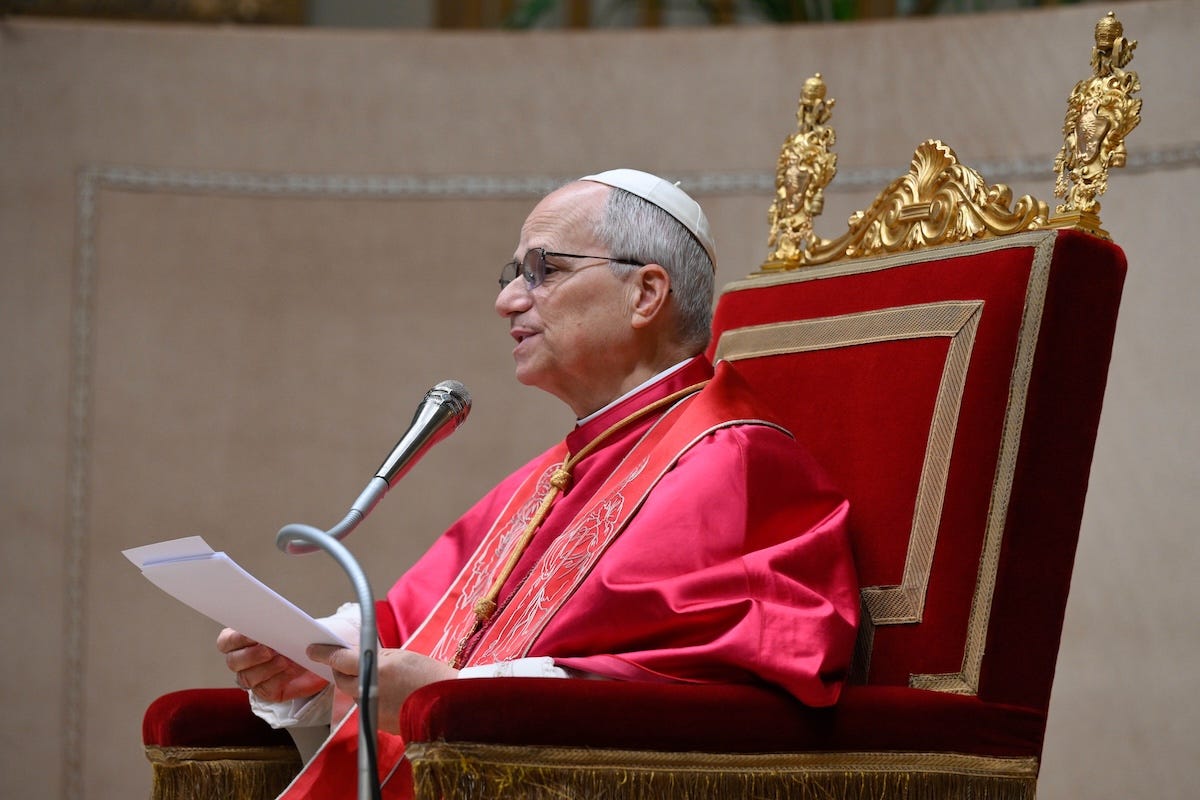
Pope Leo XIV made a remarkable address to the diplomatic corps yesterday which has been widely praised.
His address constitutes an excellent articulation of Catholic teaching, engaging both eternal truths and the urgent realities of our fractured world. In tone, substance, and doctrinal clarity it stands as a deeply orthodox intervention at the beginning of a new year and in the wake of his first consistory, offering a vision grounded in the Church’s perennial wisdom rather than in the ideological drift that marked much of the previous pontificate. The address is rooted firmly in the Christian intellectual tradition, notably drawing on Saint Augustine’s City of God to illuminate contemporary crises of war, language, conscience, and rights. Leo XIV insists, in continuity with the Church’s magisterium, that Christians live fully in the earthly city while orienting their hearts towards the heavenly city, thus practising a communio that does not discard the supernatural foundation of moral and political truths.
This Augustinian vision is not a decorative citation but the conceptual backbone of the address. Leo XIV insists that political, cultural, and diplomatic life becomes disordered when the transcendent horizon is denied, and that societies which recognise only the earthly city ultimately hollow out the moral resources required for peace and justice. In invoking Augustine in this way, the Pope places himself firmly within the communio tradition, resisting the concilium impulse to treat doctrine as provisional or negotiable in response to cultural pressures.
This framework allows Leo XIV to speak with clarity about war, power, and diplomacy without collapsing into either idealism or realpolitik. He warns that a diplomacy rooted in dialogue and consensus is being displaced by a diplomacy grounded in force, observing that war is once again being treated as a legitimate instrument of policy. The Pope notes with concern that the post-war moral consensus prohibiting the violation of national borders has been steadily eroded, and he calls for peace not as a tactical arrangement but as a moral obligation grounded in justice and the dignity of the human person. In doing so, he rejects both naïve pacifism and militarised nationalism, refusing to sanctify violence under the banner of sovereignty or security.
Equally striking is the Pope’s sustained critique of contemporary cultural pathologies, particularly the corruption of language and the distortion of human rights. Leo XIV observes that language is increasingly deployed as a weapon rather than as a vehicle for truth, a condition that renders genuine dialogue impossible. His concern is not merely rhetorical but philosophical. When words are detached from reality, moral reasoning collapses into power struggles, and law becomes an instrument of ideological enforcement. This diagnosis directly challenges the linguistic manipulation that has become characteristic of modern political discourse, especially where claims of inclusion are used to silence dissent and marginalise Christian witness.