


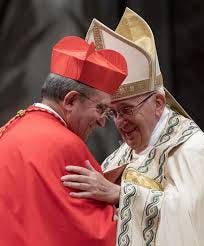
The Vatican has made public today the conclusion reached by the second commission chaired by Cardinal Giuseppe Petrocchi, Archbishop emeritus of L’Aquila, which, at the request of Pope Francis, had examined the possibility of proceeding with the ordination of women as deacons and concluded its work in February. The seven-page report the Cardinal sent to Pope Leo XIV on 18 September is just now being made public at the Pope’s request.
When a Vatican commission, after years of private deliberation, publishes a report concluding that women cannot be admitted to the diaconate, a degree of the sacrament of Holy Orders, the reaction is inevitably twofold: relief among those who read the conclusion as confirmation of an established boundary, and puzzlement among those who ask why the question required a commission at all. The report rules out admitting women to the diaconate as a degree of Orders while carefully noting that “it is not currently possible to formulate a definitive judgment, as in the case of priestly ordination.” This careful equivocation is the formal shape of the paradox that now confronts Catholic ecclesiology and pastoral governance.
This paradox is not rhetorical but real, and it matters. To understand why, it is necessary to return to what the Church has taught decisively on a related question: the reservation of priestly ordination to men. In Ordinatio Sacerdotalis (1994) Pope Saint John Paul II declared, in language meant to remove doubt, that “the Church has no authority whatsoever to confer priestly ordination on women” and that this judgment is to be held definitively by the faithful. The text treated the matter not as a prudential policy or temporary discipline but as one touching the Church’s “divine constitution itself.” In other words, John Paul II invoked the limits of ecclesial authority in order to close the question. If priestly ordination is beyond the Church’s competence to alter, the decision to study anew whether a different degree of the same sacrament might be opened to women is, at the very least, a provocative pastoral gesture.
The historical sequence makes the provocation more than a matter of perception. The modern, institutionalised inquiry into the female diaconate began under Pope Francis. Initial attention, sparked by requests from communities of religious sisters and by historical scholarship, led to the creation of study groups: a commission announced in 2016 and then reconstituted in the later years of Francis’s pontificate. That effort was an attempt to marry historical curiosity with pastoral urgency: could the Church responsibly admit women to a ministerial role that, in some patristic contexts, appears to have had a liturgical shape? That question, posed under Francis, has now reached its public conclusion under Pope Leo. The generational shift from one pontificate to the next is not merely chronological; it discloses how differing theological temperaments shape the horizon of what is considered pastorally or doctrinally plausible.
The explanations offered for undertaking the study can only be considered tenuous, especially when set against the backdrop of the Church’s existing magisterial teaching. The notion that pastoral shortages could justify reopening a question already judged to lie beyond the Church’s authority is, on its face, untenable. No practical inconvenience, however urgent, grants the Church the power to redefine what she has already declared to be rooted in the divine constitution of the sacraments. The appeal to historical ambiguity fares no better. The references to Phoebe in Romans and the ancient evidence for women exercising certain liturgical roles did not suddenly appear in the last decade. They were already studied, weighed and integrated into the magisterial tradition long before. Indeed Ordinatio Sacerdotalis did not innovate: it reaffirmed the teaching of Inter Insigniores, the constant practice of the Church, the Catechism’s clear doctrine and the longstanding theological understanding of apostolic ministry. Magisterial teaching becomes magisterial precisely because it reiterates and safeguards what the Church has already received; it never expands the deposit of faith but deepens the Church’s understanding of what has been handed down. For that reason, the suggestion that new scholarship or pastoral need could place this teaching back into play reveals something of the atmosphere of the previous pontificate, in which procedural experimentation too easily overshadowed doctrinal continuity. Enormous intellectual and financial resources were deployed to scrutinise a question the magisterium had already settled, unsettling the faithful and fostering the illusion that what had been definitively taught might still somehow be revised.
This leads directly into the deeper theological issue. The Catechism teaches that the sacrament of Holy Orders is one and that it is conferred in three degrees: episcopate, presbyterate and diaconate. These are not administrative ranks but sacramental configurations: each degree confers a unique participation in the apostolic mission and a distinct relation to the Church’s sacramental life. The threefold structure has scriptural, patristic and liturgical roots. Bishops are successors of the apostles; priests share in their ministry under episcopal oversight; deacons are ordered to service and participate in the Church’s sacramental action in a distinct but integral manner. The coherence of this triad matters because the sacraments are not separable functions but realities that form the Church from within. To alter one degree is to shift the sacramental grammar of all. Thus the question under study was never merely pastoral or historical; it touched the integrated structure of the sacrament itself.
This sacramental grammar is inseparable from the Church’s understanding of apostolic succession and the visible sign of ministry. If ordination signifies incorporation into the apostolic ministry in a way that confers authority, identity and sacramental capacity, then the identity of those whom the Church admits to that incorporation cannot be reconstructed by convenience. Ordinatio Sacerdotalis insists that with respect to the priesthood that boundary is divine in character: the Church lacks the authority to change it. A commission that treats the diaconate as a potential exception therefore encounters two interlocking difficulties. The first is theological: if Orders is one sacrament whose degrees exist in mutual relation, an affirmative decision regarding the diaconate would have consequences for the other degrees. The second is ecclesiological: the act of studying an impossibility in search of a mechanism for making it possible risks projecting procedural hope where magisterial closure already exists.
