


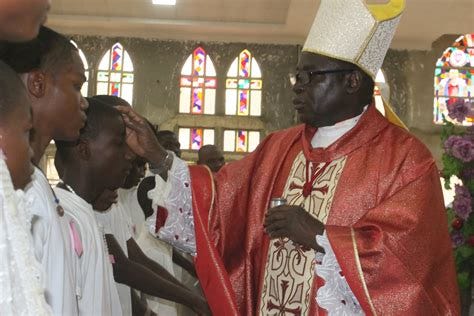
There is something both wonderful and profoundly uncomfortable about the possibility that the people Europe once evangelised may now have to evangelise us. For generations, European missionaries travelled to Africa carrying the Catholic faith to improve the lives of the people there. They built churches, schools, hospitals and seminaries, they baptised, catechised, educated and formed. Many endured extraordinary hardship and some even gave their lives. Today something remarkable is happening in the opposite direction.
African priests increasingly sustain parishes across Britain and Europe as our own vocations disappear. Churches in the West close or amalgamate while seminaries in parts of Africa remain full. Young African Catholics practise their faith in numbers about which most European bishops can only dream.
Against this background, a recent interview with Bishop Mathew Hassan Kukah of Sokoto in Nigeria, published by Catholic World Report, deserves far more attention than I think it has received. Kukah is no provincial churchman looking at the West from a distance. His intellectual formation has taken him from philosophy and theology in Nigeria to peace studies at Bradford, a doctorate at SOAS in London, a Senior Rhodes Fellowship at Oxford and a master's in public policy at Harvard. He has spent much of his life thinking about precisely the questions at the heart of this interview: religion, political power, social conflict and the Church's place in public life.
The statistics nevertheless provide an extraordinary backdrop to what he says. Nigeria is estimated to have around 35 million Catholics, while research cited in the interview puts weekly Mass attendance at an astonishing 94 per cent. Whatever qualifications might be made about individual surveys, there is no serious dispute about the underlying contrast. Catholicism in Nigeria possesses a vitality which Western European Catholicism has largely lost. So Catholic World Report asks Kukah the obvious question: Why?
His answer begins with the missionaries, it was their sacrifices, he says, that laid the solid foundations. Catholic education and healthcare made an enormous contribution, the Church offered a life of virtue which attracted people. This was hugely aided by the first generation of great indigenous African churchmen who subsequently provided examples of extraordinary stature. Then he identifies something which particularly struck me: “the influence of the Church in public life.”
Bishop Kukah understands Catholicism as something which necessarily escapes the walls of the church building, he invokes Christ’s own images stating that the Church is supposed to be light, yeast and a city on a hill. The faith is supposed to change the society into which it is planted. Sadly, I think reading those words in Britain in 2026, they seem almost revolutionary! Why? Because one of the strangest characteristics of contemporary Western Catholicism is that the Church which once possessed sufficient confidence to convert entire cultures can now sometimes appear terrified of upsetting them. This is not to say that our bishops never speak publicly, they certainly do. Nor is it to suggest that the subjects on which they frequently intervene are unimportant. Immigration, poverty, climate change, refugees, war and economic justice are legitimate matters of Catholic social concern and the Church has a rich body of teaching about all of them. The problem is rather the extraordinary selectivity which can sometimes seem to govern episcopal interventions.
Our bishops often appear most comfortable speaking about issues on which the prevailing political and cultural establishment is already broadly sympathetic to what they have to say. They can speak confidently about climate change, migrants and poverty, but the episcopal voice becomes much harder to hear when Catholic teaching collides directly with the moral assumptions of the age. Marriage, sexual morality, the ideological confusion surrounding human identity, the formation of children, abortion and, most urgently at present, assisted suicide.
I have written repeatedly on Catholic Unscripted about the response of the bishops to assisted suicide and fairness requires an important qualification. The Bishops’ Conference has opposed assisted suicide. Cardinal Nichols and other bishops have encouraged Catholics to contact their MPs. Campaigning resources have been produced, the bishops have not literally been silent. But that has never really been my criticism. My question is whether they have spoken with a volume, unanimity and urgency commensurate with the gravity of what Britain is doing.
We are contemplating one of the most profound changes imaginable in the relationship between medicine, law and human life. The state is moving towards establishing circumstances in which intentionally helping someone to die becomes a legally sanctioned activity. This is not a marginal prudential question about tax rates or planning regulations, it touches the commandment against killing, the dignity of the sick and disabled, the vocation of medicine, the protection of the vulnerable and ultimately the Christian understanding of the human person. Where, then, are the pastoral letters from every bishop? Where is the sustained preaching? Where are the media appearances? The public debates? Where is the sense that the entire hierarchy has thrown itself into this battle because something of incalculable importance is at stake?
There have been courageous exceptions, and they deserve recognition, but too often one gets the impression that the institutional response consists of statements uploaded to websites which comparatively few Catholics will ever read. A bishop can technically have spoken while the Church remains culturally inaudible. What makes this particularly interesting is that the absence is increasingly noticed not merely by troublesome Catholics like me. A striking commentary in Scotland’s Herald complained about what it perceived as the Catholic Church’s “vow of silence”. Surely this extraordinary phenomenon itself should make bishops stop and think because it is clear, if it ever needed pointing out that even secular society looks to the Church for moral leadership and when that leadership is absent, it wonders why. Of course, that should not surprise us. Human beings do not cease to require moral truth simply because society becomes more secular. Politicians are constrained by elections, corporations are constrained by markets, journalists by audiences and Universities are increasingly constrained by ideological fashion. The Church is supposed to possess a peculiar freedom from all of this and a bishop should be capable of saying something is true even when saying it will cost him.
Indeed, that is part of the reason episcopal authority once carried such enormous cultural weight. Moral authority is not principally generated by possessing a title, sitting on a committee or issuing a press release. It is generated when people become convinced that you will tell them the truth even when they do not want to hear it and this is where Kukah’s analysis becomes particularly penetrating. Asked what went wrong in Europe, he looks back to the Apostles. These were frightened and largely uneducated men without money, political protection or institutional prestige. They entered a hostile empire armed with nothing except their experience of Christ and confidence in the Holy Spirit. They were persecuted, they hid in catacombs and many were killed, yet Christianity conquered Rome. Kukah then identifies what he believes subsequently weakened the Church’s moral authority: its “warm romance and embrace of secular power.” His conclusion is devastating: