


The publication of Pope Francis’s private diaries has revealed a two-year spiritual crisis involving demonic temptation, his temptation to exercise absolute power & profound desolation. What happens when we place those revelations alongside the events of his pontificate?
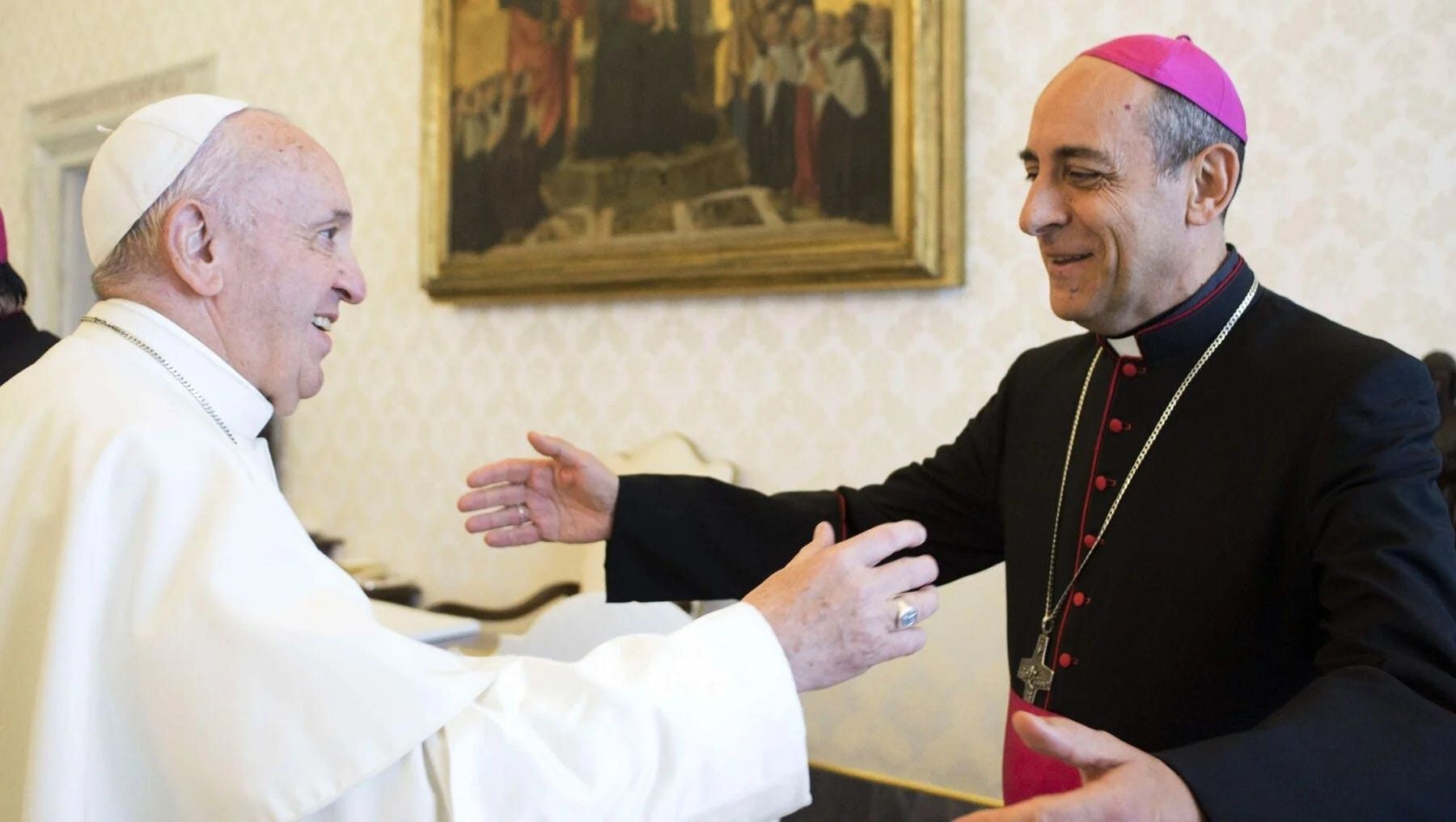
The publication of Pope Francis’s private diaries is unsettling in many different ways. Cardinal Víctor Manuel Fernández, the late pope’s close friend and theological confidant, has presented them as an extraordinary insight into Francis’s spiritual life. They seem to be his attempt to being the cause for canonisation of the controversial pontiff. I have not read the whole thing, I have it on order but it isn’t released to the general public here in the UK until 3rd December. From the snippits published I have read I find myself wondering whether they also illuminate aspects of his pontificate that Fernández would rather we did not examine too closely?
Pope Francis describes terrifying encounters with the devil, a vision of the entrance to hell and, most remarkably, a prolonged spiritual crisis beginning on 24 January 2021 and lasting until 30 December 2022. This crisis was not merely a period of sadness or spiritual dryness. According to Fernández’s account, it was intimately connected with Francis’s exercise of authority, particularly the temptation to control others and to regard himself as capable of resolving everything through his own power. This is certainly evidenced in his pontificate, Francis largely governed through an extraordinary volume of motu proprios (Latin for “on one’s own impulse” or “on one’s own initiative” these are an official document or act issued by an authority of their own accord, without a formal request or external motion. It is a papal rescript or Apostolic Letter personally signed by the pope to set rules, establish bodies, or grant favours. A 2025 canonical study identified 73 of these, issued at almost twice the highest annual rate of his predecessors since Leo XIII. He also created 163 cardinals in ten consistories, profoundly reshaping the College that would elect his successor. There’s an obvious and striking contradiction between a pontificate that endlessly preached synodality, listening and decentralisation, and a governing style so frequently characterised by unilateral decisions and the concentration of authority in Rome. Of course now we know, thanks to dopy Fernández, that he was seeing terrifying visions of hell and the devil through all of this. Pope Francis even described what he understood as a lingering imprint of his encounters with Satan. These are extraordinary admissions from the man entrusted with the governance of the universal Church.
But this all becomes much more interesting when we examine what Francis was actually doing during those years.
The remarkable question of the Mass
Perhaps the most disturbing coincidence for me concerns Francis’s celebration of the Holy Eucharist. You may recall that for much of his pontificate, Francis celebrated daily Mass at Santa Marta, the guesthouse built in 1996 under Pope St. John Paul II to house cardinal electors during papal conclaves and to provide lodging for clergy and officials visiting the Holy See on business. Francis made this his Vatican residence, attempting to suggest this made him more humble than other popes (of course the papal apartments were still there and maintained, this arrangement simply meant the Vatican had to add another expense to accommodate Pope Francis “humility”). These Eucharistic celebrations became a familiar feature of his papacy, with his homilies reported around the world for being frequently uncompromising, sometimes scathing, and repeatedly concerned with rigidity, hypocrisy, spiritual pride, gossip and the activity of the devil.
During the pandemic, the Masses were broadcast daily, potentially providing spiritual consolation to millions of Catholics unable to attend church. Of course, when the Covid pandemic arrived in March 2020, Pope Francis supported the suspension of public Masses as part of the emergency restrictions adopted by the Italian authorities and bishops. The Vatican itself excluded congregations from papal liturgies, including the celebrations of Holy Week. Francis continued offering Mass privately, with the celebrations broadcast from Santa Marta to Catholics deprived of access to their churches. There’s no doubt that it was an extraordinary moment in the Church’s modern history. For months, millions of Catholics were unable to attend Mass or receive Holy Communion. Pope Francis did intervene to preserve access to churches for private prayer in Rome, but, extraordinarily, he accepted the wider suspension of public worship, and the world’s bishops largely followed suite.
Then, in January 2021, he recorded the beginning of his profound spiritual crisis. By July he had issued Traditionis custodes, introducing a very different set of restrictions upon the Church’s liturgical life, and by May 2022, he had ceased personally celebrating the Church’s major public Eucharistic liturgies. Taken together, these developments mark an extraordinary period in the relationship between Francis, the Eucharist and the exercise of papal authority.
Those broadcasts ended on 17 May 2020. The Vatican explained that the arrangement was ending as public worship resumed, but something else happened subsequently. On 15 May 2022, Francis celebrated the canonisation Mass of ten new saints in St Peter’s Square. According to Fr Raymond de Souza’s subsequent examination of his Eucharistic practice, this was the last public Mass at which Francis was himself the principal celebrant.
For the remainder of his pontificate, he continued to attend and preside at public liturgical ceremonies, but the actual celebration of the Eucharist was ordinarily entrusted to another cardinal or bishop. Let’s reflect on that chronology. Francis’s spiritual crisis began in January 2021. By May 2022, he had ceased personally celebrating the Church’s great public Eucharistic liturgies. The Vatican attributed Francis’s withdrawal from personally celebrating public Mass to his deteriorating physical condition, particularly his painful knee problems. His difficulties were genuine, but for Catholics who remembered the final years of St John Paul II, the contrast was extraordinary. We had watched the Polish pope’s body gradually fail him, stooped by Parkinson’s disease, struggling to walk, sometimes barely able to speak, he would cling to his pastoral staff for support. His suffering was painfully visible, yet he remained determined, as far as his failing strength permitted, to fulfil his priestly and liturgical duties before the eyes of the Church. That witness was incredibly moving and inspiring to millions, a man whose body was failing him, but whose vocation remained unmistakably central to his identity. Pope Francis presented a very different picture. By May 2022, he’s completely stopped personally celebrating the Church’s great public Eucharistic liturgies, ordinarily leaving that responsibility to other prelates while he continued to preside. The question of his private celebration of Mass remains unanswered in the available public record and this concerns me as well. Was he even saying Mass at all? If he was saying it privately, why not publicly? This public spectacle disturbed me greatly at the time.
Now let’s consider the timing, we have discovered, thanks to Cardinal Fernández, that this change occurred during a period of profound spiritual desolation, when Francis believed himself to be struggling with demonic temptation and the dangers of exercising excessive power. The change was remarkable, the pope who had made daily Mass such a visible feature of his pontificate no longer said Mass. For a Catholic, this is hardly an insignificant question because the Eucharist is the source and summit of the Christian life. The offering of the Holy Sacrifice is at the heart of the priesthood. I would very much like to understand that period better.
The controversy that began with Amoris Laetitia
Analysis of the chronology actually takes us further back. On 19 March 2016, Francis signed Amoris Laetitia, his apostolic exhortation on marriage and family life, published on 8 April. Its controversial eighth chapter prompted an international dispute about whether Catholics living in irregular marital unions could receive Holy Communion without a commitment to continence. Four cardinals subsequently submitted their famous dubia, requesting clarification of questions touching on fundamental moral and sacramental doctrine, Pope Francis declined to answer them as Fr. Gerald Murray pointed out in our recent interview.
.
What followed next was years of division, with bishops’ conferences interpreting the document differently, people who had heroically refrained from presenting themselves for Holy Communion feeling utterly betrayed and the majority of Catholics left wondering how apparently contradictory pastoral practices could coexist within the same universal Church.
Now consider something newly revealed by the diary.
