


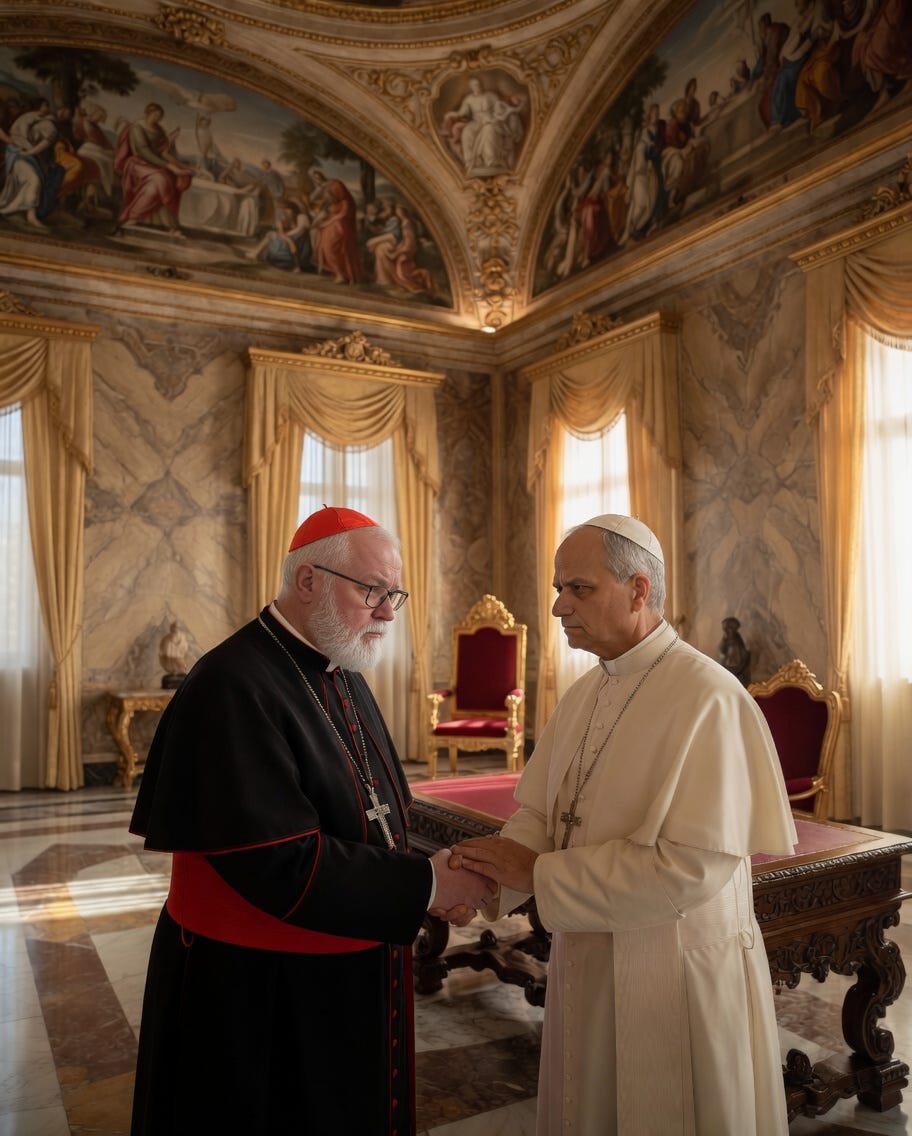
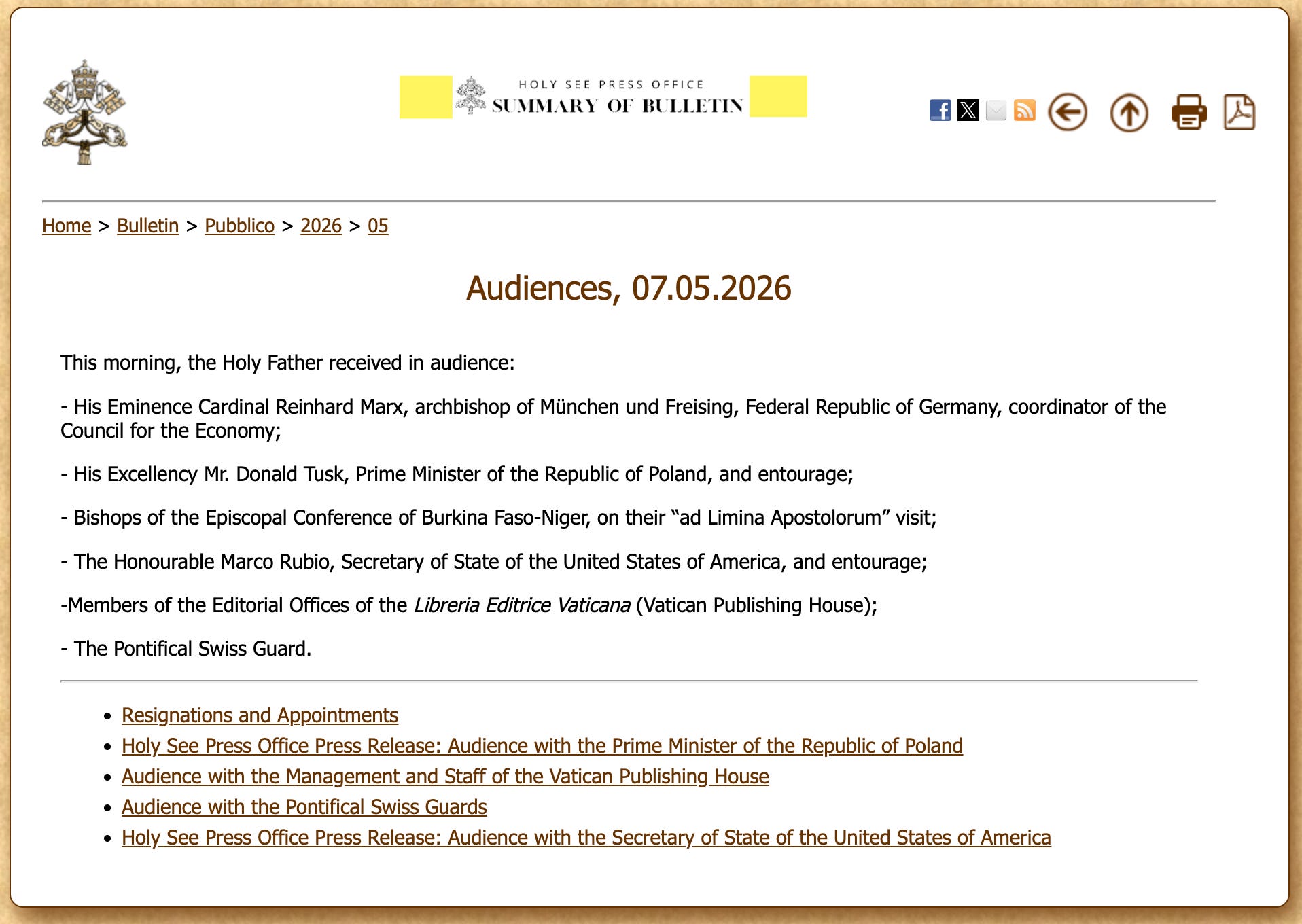
There are moments in the life of the Church when a seemingly routine line in the Vatican Bollettino reveals more than a thousand speeches. A simple administrative notice can become an ecclesial thunderclap. So it may prove with the announcement that Pope Leo XIV received Cardinal Reinhard Marx in audience yesterday morning.
What is particularly notable is that this was not a private meeting. It was not held anonymously and did not take place through through the discreet back channels by which difficult conversations are often hidden from public scrutiny. The meeting was formally listed and deliberately placed on the record. In Rome, such things matter enormously.
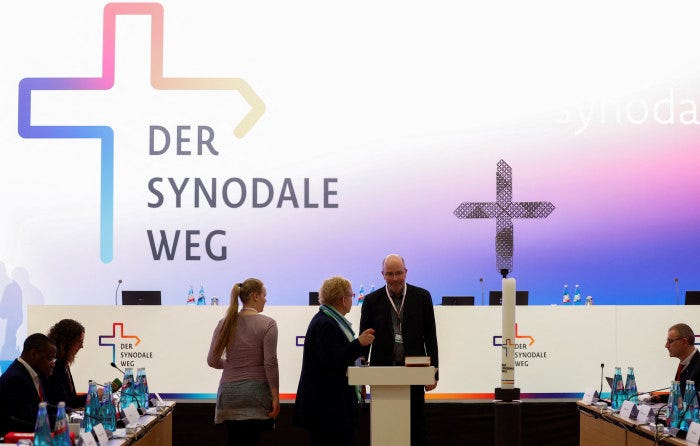
For years the German ecclesial project has advanced with an air of almost unstoppable momentum. Der Synodale Weg, initially presented as a pastoral response to crisis, gradually assumed the character of a parallel magisterium. Questions once considered settled became subjects for “discernment”. Practices previously rejected by Rome returned clothed in softer language and procedural ambiguity. Every Vatican intervention seemed eventually absorbed into a wider culture of managed resistance.
The latest flashpoint has been the increasingly open facilitation of blessings for same sex couples within parts of the German Church, particularly following directives associated with Cardinal Marx’s own Archdiocese of Munich and Freising. This came despite repeated Roman interventions and despite the unresolved tension between such practices and the Church’s perennial moral teaching. Then came the increasingly defiant posture of Bishop Georg Bätzing and others who appeared not merely hesitant toward correction, but determined to continue regardless.
Against this backdrop, Pope Leo XIV’s recent remarks aboard the papal flight assumed unusual significance. They were not revolutionary. Nor were they framed in the fluid and carefully elastic language that has so often characterised ecclesial disputes in recent years. Rather, there was a perceptible firmness, a subtle but unmistakable reassertion of Roman centre and Petrine authority. It was as though the atmosphere itself had changed.
Particularly significant was Leo’s reported insistence that the Holy See had already informed the German bishops that it did not agree with the “formal blessing” of same sex couples or irregular unions beyond what had been permitted under Fiducia Supplicans. That single word, “formal”, carries immense theological and ecclesiological weight.
The distinction may appear technical to outsiders, yet within Catholic sacramental theology it is decisive. There is a profound difference between a spontaneous pastoral encounter with individuals and the establishment of stable ritual forms that appear to confer ecclesial recognition upon objectively irregular relationships. Once a pastoral exception acquires institutional structure, it inevitably begins to reshape doctrine in the imagination of the faithful, regardless of how many disclaimers accompany it. The issue is no longer merely pastoral sensitivity. It becomes a question of what the Church appears publicly to bless.
This is precisely why the present conflict matters so deeply. Germany increasingly seems to interpret Fiducia Supplicans as an opening toward structural recognition and liturgical normalisation. Leo XIV, by contrast, appears determined to contain the document within a much narrower interpretive framework. The disagreement is therefore not simply about sexuality. It is about authority itself. Who determines the limits of legitimate development within the universal Church? Rome, or national ecclesial processes operating under the language of synodality?
Then came the remarkable intervention associated with Cardinal Fernández and the Dicastery for the Doctrine of the Faith. On the 4th of May, a Vatican letter warning against the formalisation of same sex blessing ceremonies within Germany suddenly entered the public domain after tensions had already escalated considerably. The significance lay not merely in the content of the document, but in the timing and manner of its appearance. The letter made clear that Rome did not accept the establishment of stable ritual forms for blessings that would effectively institutionalise objectively irregular unions beyond the narrow pastoral framework envisioned in Fiducia Supplicans. Yet the publication also carried the unmistakable flavour of institutional positioning. One sensed the Curia attempting to establish clearly, both for the Church and for history itself, that Germany had already been warned before crossing further lines. In Vatican politics this matters enormously. Internal correspondence is not always made public. When such documents emerge during moments of escalating ecclesial conflict, it is often because competing centres within the Roman machinery wish to clarify where responsibility truly lies.
And now Marx is summoned.