


My eyes nearly popped out of my head when I saw that Pope Leo had met Cardinal Roger Mahony at the Vatican on 22nd January 2026, calmly posing for photos with the former Archbishop of Los Angeles.
If you don’t know why this might have shocked me. You’re going to find this essay fascinating!
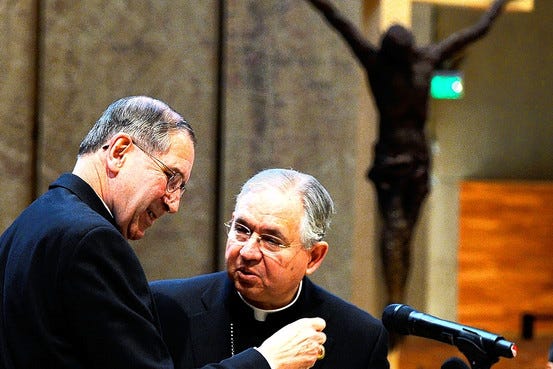
Cardinal Mahony remains one of the most deeply problematic figures in the modern history of the American Church because his failures were not abstract errors of judgment but concrete decisions that exposed children to harm and obstructed justice for victims. As Archbishop of Los Angeles, he presided over a system that consistently privileged institutional self protection over the safeguarding of minors. Court released archdiocesan files demonstrated that credible allegations of sexual abuse were handled internally, that priests accused of serious crimes were moved between parishes, and that law enforcement was deliberately kept at arm’s length. These practices were not peripheral to his leadership but integral to it. The catastrophic human cost of those decisions is reflected in the scale of the settlements paid by the Archdiocese of Los Angeles, amounting to hundreds of millions of dollars and involving more than a thousand survivors. Those figures represent lives damaged, faith shattered, and trust betrayed. To invoke historical context or prevailing norms of the time is morally inadequate. The duty to protect children and to tell the truth about crimes against them is not a recent innovation but a basic demand of justice.
It was precisely this moral reality that compelled Archbishop José Gómez, Mahony’s successor, to act decisively in 2013. Gómez removed Mahony from all public and administrative duties, an action that was extraordinary both in its clarity and in its implications. This was not a symbolic rebuke but an institutional judgment that Mahony’s conduct in handling abuse cases had rendered him unfit for public ecclesial honour. Gómez’s decision implicitly recognised the theological category of scandal, the harm done when the Church’s leaders appear to excuse or conceal grave wrongdoing. It was an attempt, however limited, to restore moral coherence by signalling that episcopal authority does not place one beyond accountability.