


Written for Catholic Unscripted by Anthony McCarthy director of the Bios Centre, www.bioscentre.org who can be contacted at amccarthy@bioscentre.org. He is writing in a personal capacity.
Matthew Parris, that most fluent of English writers, recently informed readers of The Spectator that, “The Catholic Church has always been remarkably relaxed about sin”.
That same institution recently proclaimed St John Henry Newman a Doctor of the Church and named him co-Patron of the Church’s educational mission alongside St Thomas Aquinas.
In his Lectures on Certain Difficulties Felt by Anglicans in Submitting to the Catholic Church, Newman reminded his audience that the Church he had joinedaims:
“not at making a show, but at doing a work. She regards this world, and all that is in it, as a mere shadow, as dust and ashes, compared with the value of a single soul. She holds that, unless she can, in her own way, do good to souls, it is no use her doing anything; she holds that it were better for sun and moon to drop from heaven, for the earth to fail, and for all the many millions who are upon it to die of starvation in extremest agony, so far as temporal affliction goes, than that one soul, I will not say should be lost, but should commit one venial sin, should tell one wilful untruth, though it harmed no-one, or steal one poor farthing without excuse.”
Startling words, but not obviously untrue ones, given the fact that moral evil ison a different plane to mere physical evil which we suffer but do not perpetrate. Socrates himself, whatever his views on suicide, concurred on the principle that it is better to suffer evil than to do it. Physical harm, particularly serious physical harm, matters greatly – but moral harm and wrongdoing matter more. Any approach to morality which seeks to minimise the special censures of conscience and the nature of moral damage cannot but misrepresent moral experience.
‘Firm purpose of amendment’
The Church is not, as Parris suggests, content to absolve sinners without heed to their future actions. A standard ‘act of contrition’ for confession reads,
“O my God, I am heartily sorry for having offended Thee, and I detest all my sins because of thy just punishments, but most of all because they offend Thee, my God, who art all good and deserving of all my love. I firmly resolve with the help of Thy grace to sin no more and to avoid the near occasion of sin. Amen.”
Taking sin seriously is a constant in Catholic teaching, a stance without which the Redemptive Sacrifice of Calvary would make little sense. That redemption is explicitly not the one of political liberation that contemporaries of Christ and many in our time have hoped for. It burdensomely requires, on the part of us sinners, the firmest and most perduring rejection of sin – sin arising from the inherited and tragic wound which orients us towards it, and can risk us losing everything ultimately of value.
For Parris, though, the confessional is merely a “laundry service” over which the Church “holds a monopoly”. Quite why a Church “remarkably relaxed about sin” should require repentance and a firm purpose of amendment as a conditionfor being absolved and (in the case of mortal sin) for receiving the Eucharist and everlasting life is left unexplained.
Parris proceeds to inform us that “calculated to seriously unsettle believers is any move to declassify as sinful what the Church has deemed to be a sin. That people should persist in behaviour deemed sinful is mildly regrettable. But that people should deny this behaviour is even a sin is monstrous.”
Suicide as a right
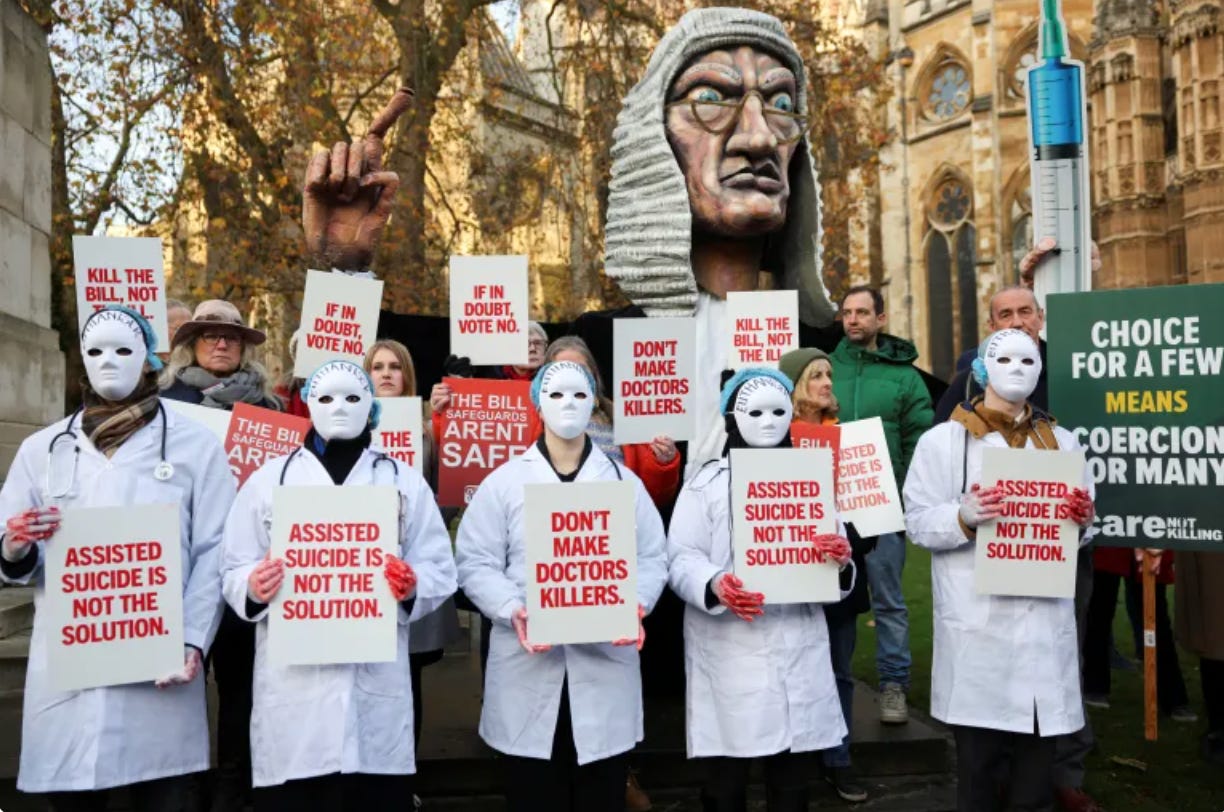
Rightly, Parris judges that the proposed bill to legalise ‘assisted dying’ currently being debated in the House of Lords will amount to the state effectively pronouncing suicide as not merely not morally wrong, but a legal right. After all, this is not like mere decriminalisation of private suicide, involving a ‘stepping back’ from punishing failed suicides. Instead, we are looking at an unmistakeable ‘stepping forward’ to help the suicidal person achieve his aim via a state service. And what becomes a legal right becomes, in a culture grown detached from other sources of morality, a moral right regarding which any opposition becomes presumptively immoral.
It is, perhaps, a testament to the perduring moral taboo surrounding suicide, adding to the horror and grief felt by onlookers, that the framers of the Bill have had to avoid naming openly what it promotes. In debates, we have repeatedly seen the word ‘suicide’ indignantly dismissed by Kim Leadbeater MP and her supporters, even as they seek to amend the 1961 Suicide Act in the Bill they are promoting.
Given this situation, the Church, an institution whose work is the salvation of souls, is naturally deeply concerned about such legislation, precisely because it is not relaxed about sin or sin’s dishonest branding. Just as it is the devil’s
