


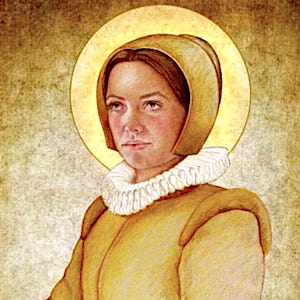
Today in the Diocese of Brentwood we celebrate the Feast of St Anne Line. St Anne Line’s primary feast day is 27 February, the date of her martyrdom. That is her official liturgical memorial as a saint in the Church. She also appears in group commemorations with the other Forty Martyrs of England and Wales.
In contrast, within the Diocese of Brentwood (which covers Essex and East London), St Anne Line has special local significance as she was an Essex-born martyr, historically connected to the region its parishes serve. Multiple parishes and schools in the diocese are dedicated to her, for example, in South Woodford and in Great Dunmow, reflecting regional devotion. Because of this local connection, the bishop and parishes in the Brentwood Diocese choose to celebrate her feast as a patronal or local feast, giving it particular prominence in pastoral life there, even if it’s not universally celebrated in the wider Church calendar. And her story really should stop us in our tracks. Not because it is exotic or particularly extraordinary in a cinematic sense, but because it exposes, with painful clarity, how seriously the Catholic faith once mattered, and how little it often seems to matter now for many.
Anne Line was born into comfort in Elizabethan England. She was born the daughter of William Heigham, a Puritan, in Jenkyn Maldon, Essex. So Anne had security, status, and a future that could have unfolded quietly and safely. Instead, she chose Christ. She converted to the Catholic faith when it was illegal to be Catholic, not illegal in a mild or technical sense, but illegal in a way that carried real consequences. William Heigham was the son of Roger Heigham, MP, a Protestant reformer under Henry VIII. But he disowned her when she married a Catholic, Roger Line. Roger was imprisoned for being a Catholic and was exiled and died in 1594 in Flanders, Belgium. Anne was left widowed, poor, watched, and permanently vulnerable. At that point, she could have retreated, it would have been so easy to do so and many, understandably, did. History would not have judged her harshly.
But she did not retreat. She stepped forward.
Anne became a keeper of safe houses for hunted Catholic priests at a time when harbouring a priest meant death. Not social exclusion, not loss of reputation, not a difficult conversation with ecclesial authorities, but death. She fed priests, hid them, protected them, and made it possible for the sacraments to reach souls who were starving for them. The Mass was not a lifestyle accessory. Confession was not optional. The Eucharist was worth risking everything for. Contrast this to our own bishops closing Churches in COVID.
Her final act was quiet and brave. On Candlemas Day she arranged a secret Mass. The authorities burst in. The priests escaped. Anne did not. She was arrested, tried, and condemned. At her execution in 1601 she did not plead or rage. She forgave. Witnesses spoke of her calm and peace, a woman who was truly free even as the rope was placed around her neck. Her crime was sheltering Christ in His priests. Her punishment was martyrdom.
That is the faith we inherit.
And that is where the contrast becomes uncomfortable.
The martyrs of the English Reformation did not die for “shared values” or “overlapping spiritualities.” They did not suffer so that Catholic distinctives could later be softened, relativised, or apologised for. They died because the Catholic faith made concrete, exclusive claims. Because the Mass was the Sacrifice of Calvary. Because the priesthood was sacramental. Because the Church had authority given by Christ, not delegated by the state or negotiated ecumenically.
What would St Anne Line make of our age?
We live in a time when bishops speak endlessly of dialogue and accompaniment, but hesitate to speak clearly about truth. When ecumenism, once rightly understood as a call to conversion and unity in truth, has hardened into an obsession with not offending separated brethren. When the emphasis falls not on what is true, but on what is agreeable. Not on what saves, but on what reassures.
The irony is stark. After decades of this approach, what progress has actually been made? Anglicanism continues to unravel doctrinally and morally. Methodism follows. Episcopalianism drifts ever further from historic Christianity. Evangelicals do not look at Catholicism and see strength or confidence. They see compromise. They see a Church embarrassed by its own claims.
And meanwhile, Catholics themselves are increasingly unclear about what makes Catholicism Catholic at all.
The martyrs would not recognise this timidity. Not because they were aggressive or triumphalist, but because they believed something was worth dying for. They understood that truth divides before it unites. That unity without truth is not unity at all. That the faith is not ours to edit in order to make it more palatable to the age.
St Anne Line did not die to preserve a brand or maintain institutional relevance. She died because Christ was present in His sacraments and His priests, and because that presence demanded loyalty, even unto death.
Her witness raises an unavoidable question for us. If the faith is no longer worth suffering for, is it because the world has changed, or because we have? If we recoil at the martyrs’ seriousness, is it because they were extreme, or because we have grown comfortable?
Holiness, as Anne Line shows us, is not loud, fashionable, or safe. It is faithful. And fidelity always has a cost.
Pray for us, St Anne Line, that we may recover even a fraction of your courage. Not the courage of nostalgia or anger, but the courage to believe again that what we profess is true, that what we celebrate is real, and that Christ is worth everything.
Thankyou Mark. It seems any Catholic prepared to defend Christ and His Church with their lives, is now written off either as an extremist bigot or mentally incompetent (even within Catholic circles).
Only this week, a conversation between fellow Catholic friends at a shrine dedicated to the Padley Martyrs here in Derbyshire, England, it was posited that: due to deaths on both sides of the Deformation, ecumenism is now the only way forward. Seems it is ok to present reams of historical facts, but God forbid any mention of the Mystery of Faith. I kept quiet, but am pondering on how best to approach this in future conversations without being cancelled. (any advice?).
Ecumenism at all costs is a denial of the Mystical Body of Christ. It fails to seed Saints like Anne Line, and it endangers souls. May she and the Padley Martyrs intercede for all of us that we might be granted the graces to defend the Faith we profess in the Creed each Sunday: with holy courage and sincere humility.
A wonderful example for us all. Can we live up to it. St Anne pray for us.