


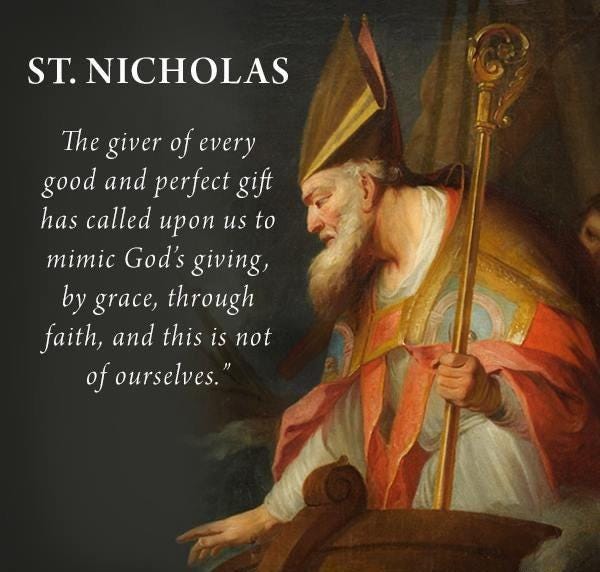
In these modern times the world remembers St Nicholas with sleigh bells, red coats, and commercial cheer. He is a jolly figure, increasingly representing little more to the secular culture than a few days in the year for over-indulgence and frenzied consumerism. But behind that soft cultural silhouette stands a man of astonishing spiritual intensity. He was a bishop whose life reveals what love looks like when it becomes courageous, creative, and utterly unafraid. If we allow him, Nicholas can reawaken in us a Christianity that burns rather than blinks.
Nicholas was orphaned very young, a detail often mentioned only in passing. Yet it shaped everything that came after. Out of the grief of early loss grew an extraordinary tenderness toward anyone who suffered. He inherited wealth, and instead of holding it tightly as security in a world that had already taken so much from him, he began giving it away before he reached adulthood. There was no audience for this charity, no proud display and no desire for recognition. He simply decided that everything he had belonged first to God and then to the poor.
His life asks us difficult questions. What do we do with what we have been given? Have we ever let another person’s suffering interrupt or inconvenience our own carefully arranged lives? Nicholas did exactly that, and more. The famous story of the three daughters shows the kind of love he practiced. Their father, desperate and ashamed, was preparing to sell them into slavery. Nicholas heard of it and acted immediately. He walked there at night, carrying gold so the girls could marry and live freely, and slipped it secretly into their home so the family would be spared both ruin and humiliation. He did not wait for a committee, approval or ideal timing. He responded quickly, creatively and with a heart entirely focused on protecting the vulnerable.
His life shows us that Christian charity is not theoretical. It is swift, practical and ready to risk comfort in order to save another person. When we witness injustice, Nicholas challenges us to examine whether we simply feel sorry or whether we intervene.
Yet Nicholas was not only tender. He was also courageous enough to suffer for the truth. During the persecutions under Diocletian, he was arrested, beaten and imprisoned because he would not compromise the faith. Those who encountered him noted something remarkable. Even in prison, even toward his captors, he remained gentle. The paradox at the centre of Christian holiness appears vividly here. The strongest souls are often the most merciful.
There is another episode in his life that deserves to be remembered. Nicholas once halted an execution by grabbing the sword as it descended upon three innocent men. He stepped between the victims and the authorities, placing his own safety and position at risk. He simply could not remain silent in the face of injustice. When we hesitate to speak truth or fear what it might cost us, Nicholas stands beside us and quietly asks If not you then who?
After the persecutions ended, Nicholas did something almost forgotten. He began paying the debts of prisoners who had been financially ruined, helping them rebuild their lives. He understood that freedom without restoration leaves people in humiliation and despair. It was not enough for him that lives were spared. They needed to be restored with dignity. Mercy for Nicholas was never passive. Mercy healed, lifted and rebuilt.
