


Yesterday, Pope Leo XIV gave an address to the faculty of the Italian Theological Institute of Calabria. This oration offers more than a routine exhortation to academics, taken in continuity with earlier comments on the subject I think it provides a revealing window into the emerging strategy of his pontificate. If we read his remarks in continuity with his earlier speech to clergy and educators, a coherent pattern begins to appear. Leo is attempting to stabilise the Church’s self-understanding after a period of destabilisation.
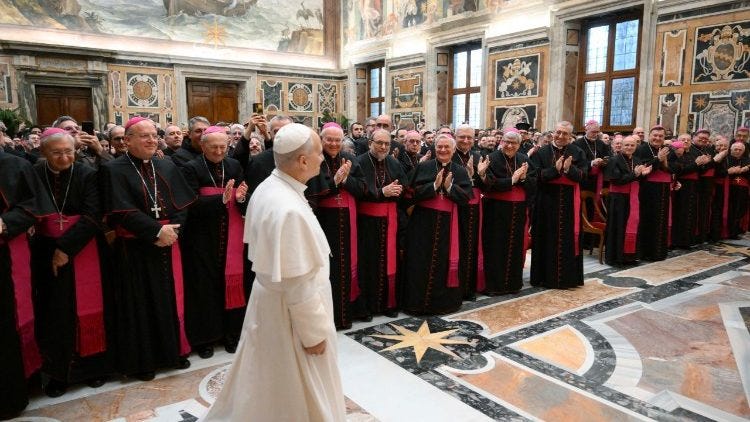
In his address, Pope Leo insisted that theology must serve the mission of the Church. It is not to become an abstract discipline sealed off from the life of faith, nor a laboratory for speculative experimentation. Theology, he argued, must plunge deeply into the mystery of God while remaining outward facing in proclamation. At first glance this may appear conventional. Yet in the current ecclesial climate, it carries strategic significance. Leo is re anchoring theological work within the classical Catholic synthesis of contemplation and mission. He is not presenting theology as a site of creative rupture but as a disciplined participation in the Church’s received faith for the sake of evangelisation.
This emphasis becomes clearer when set alongside his earlier warning to priests against superficial preaching driven by trends or technological shortcuts. In that context he cautioned against substituting novelty for depth and against confusing relevance with authenticity. The same instinct appears in his address to theologians. There is a quiet but unmistakable insistence that the Church does not renew herself by destabilising her doctrinal foundations. She renews herself by drawing more deeply from them.
The contrast with the style of Pope Francis is difficult to ignore. Francis frequently described his desire to create “a mess” in order to shake the Church out of complacency. He employed pastoral provocations, open ended formulations and bold gestures that often generated theological ambiguity. His method was centrifugal. He pushed outward, sometimes at the cost of internal clarity, in the hope that fresh air would invigorate a perceived stagnation.
Leo’s method appears centripetal. Rather than generating creative tension through disruption, he seeks consolidation through coherence. His language about doing theology together does not imply experimentation at the margins. It implies communion within a shared doctrinal horizon. His call to venture into the depths is not an invitation to doctrinal improvisation but to intellectual seriousness. The sea to which he sends theologians is the sea of the Church’s tradition, not the uncharted waters of ideological reconstruction.
For faithful Catholics this distinction is not trivial.