


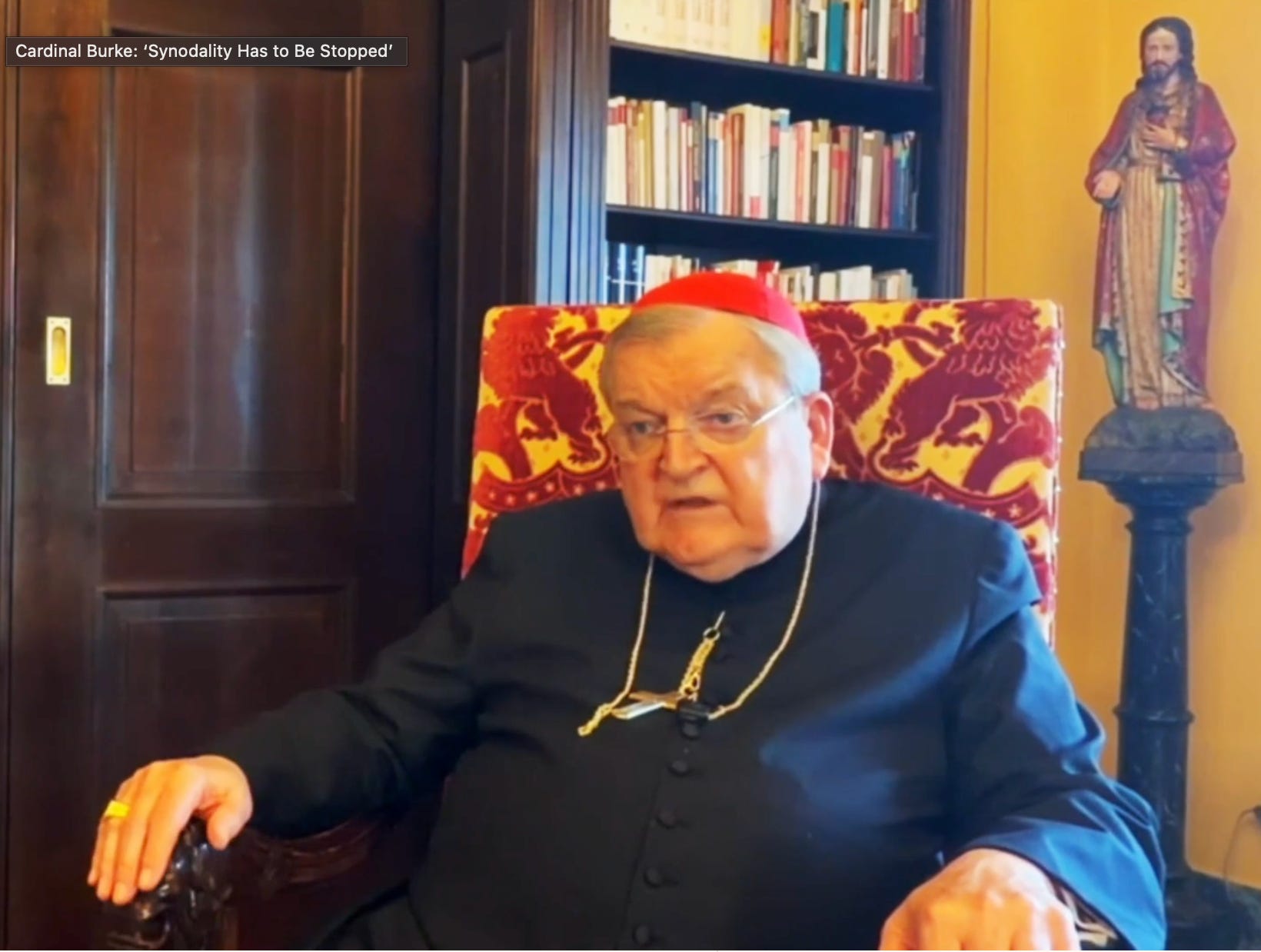
In a new interview with Cardinal Raymond Burke he comments extensively on synodality and I feel very strongly that what he says deserves to be treated as a very serious intervention. Cardinal Burke is asking a question so elementary that its continued lack of a satisfactory answer is itself revealing: what exactly is synodality?
It is important to make clear that his concern is not with synods as such. The Catholic Church has always held councils and synods. Bishops have always consulted priests, religious and the faithful. Nor is Burke objecting to the Christian duties of listening, prayer, discernment or mutual cooperation. His criticism is directed towards the elevation of “synodality” into a defining ecclesiological principle without any sufficiently precise account of what it is, where its authority comes from, what its limits are, or how it relates to the deposit of faith. A synod is an identifiable ecclesial institution. Synodality is an abstraction and, as we have seen over the last decade or so, a remarkably elastic one.
Its elasticity stands in contrast to the precision of Catholic theology and this has enabled the word to acquire an almost talismanic status. It can describe consultation, episcopal collegiality, parish participation, decentralisation, listening to marginalised groups, spiritual discernment, institutional reform and the exercise of papal authority. It can mean the Church listening to the Holy Spirit, the bishops listening to the laity, the laity listening to one another, or Rome devolving decisions to local Churches. At times it appears to mean all these things simultaneously. The more synodality is invoked, the less clearly it seems to be defined.
This was not how Pope Francis originally presented it: In his important address marking the fiftieth anniversary of the establishment of the Synod of Bishops in October 2015, Francis offered what remains perhaps his clearest theological account of the concept. “It is precisely this path of synodality,” he declared, “which God expects of the Church of the third millennium.” (that’s quite a claim!).
He described the synodal Church as a listening Church in which the faithful, the bishops and the Bishop of Rome listen to one another and together listen to the Holy Spirit. He insisted that the process culminates in the Pope, not as the expression of his private convictions, but as the guarantor of the Church’s obedience to God, the Gospel and Tradition. He also affirmed that a synod must always act cum Petro et sub Petro, with Peter and under Peter, precisely as a guarantee of unity.
Taken at face value, much of this is unobjectionable and even attractive. The Church should listen. Bishops should know the lives, sufferings and questions of the people entrusted to them. The Pope should confirm his brethren in the faith rather than rule according to personal preference. Pastoral authority should be exercised as service rather than domination. Consultation should be extensive, prayerful and attentive to the promptings of the Holy Spirit.
The problem lies not principally in this description, but in what synodality has repeatedly produced in practice. Francis went considerably further than advocating consultation. In the same address he called synodality a “constitutive element of the Church” and “the most appropriate interpretive framework for understanding the hierarchical ministry itself”. He spoke of an “entirely synodal Church”, of greater decentralisation, and of a synodal dynamism inspiring “all ecclesial decisions”. These are massive claims. Synodality is no longer merely a method by which bishops consult the faithful, it becomes an interpretive framework through which the Church understands her own constitution, authority and decision-making.
Yet the practical difficulty…Some might say obvious internal incoherence…immediately presents itself. If synodality means listening, to whom is the Church listening and by what criterion are the voices being discerned? Public opinion is not the sensus fidei. The demands most insistently repeated by activists, theologians, lobby groups and professionally selected delegates do not necessarily represent the faith of the baptised. Nor can the Holy Spirit be invoked as an explanation for conclusions that contradict what the Church has consistently taught.
Francis himself acknowledged this danger in 2015. The bishops, he said, must distinguish the authentic faith of the Church from the “changing currents of public opinion”. But it cannot be denied that the subsequent synodal process has repeatedly elevated precisely those currents into the Church’s deliberations.
Questions concerning homosexuality, sexual morality, the ordination of women, gender identity, ecclesial authority and sacramental discipline have been returned to the table as though the Church had never spoken definitively about them. The stated justification is that no one should be afraid of dialogue, that the Spirit may speak through unexpected voices, and that the Church must listen to lived experience. But listening is never presented as a neutral exercise. The issues admitted for reconsideration move overwhelmingly in one direction and synodality rarely seems to reopen questions in order to recover a stricter understanding of Catholic doctrine or discipline. It does not ordinarily invite reconsideration of Communion in the hand, contraception, no-fault annulments, liturgical experimentation, the collapse of clerical discipline or the loss of a clear teaching on the last things. It never speaks of the call to holiness, the importance of devotions or the need for solid catechesis. Instead, it repeatedly generates pressure for accommodation to the moral assumptions of the contemporary West.
Perhaps you could argue that this does not necessarily prove that Pope Francis consciously devised synodality as a dishonest instrument. Motive is difficult to establish and should not be asserted beyond the evidence. Nevertheless, after more than a decade, I think it is reasonable to judge a governing method by its consistent effects. Those effects suggest that synodality has functioned as a mechanism through which settled teaching can be circumvented without being formally denied.
The genius (?!?) of the mechanism is that doctrine need not be changed. It can be repeatedly affirmed even while pastoral practices are authorised that appear to contradict it. This pattern first became unmistakable in Amoris Laetitia. The apostolic exhortation followed two highly contested synods on the family. Catholic doctrine on marriage was formally preserved. Marriage remained indissoluble. Sexual relations outside a valid marriage remained objectively contrary to the moral law. No doctrinal proposition was openly reversed. Yet Chapter Eight introduced a new emphasis upon accompaniment, discernment, mitigating circumstances and gradual integration into the sacramental life of the Church. Francis cautioned against applying general rules mechanically to every concrete situation and stated that discernment could recognise that a person, while living in an objectively sinful situation, might not be subjectively guilty of mortal sin.
Considered in isolation, this reflects established Catholic moral theology. The Church has always distinguished the objective character of an act from the subjective culpability of the person committing it. The innovation lay in the use to which that distinction was put.
Footnote 351 stated that in certain cases the Church’s help could include the sacraments. The document did not define those cases with precision. It did not clearly state whether it referred to divorced and civilly remarried persons continuing sexual relations while receiving Holy Communion. Nor did it restate the discipline articulated by St John Paul II in Familiaris Consortio, according to which those unable to separate for serious reasons could receive the sacraments provided they lived as brother and sister. Instead, the ambiguity was left unresolved and what resulted was different pastoral practices in different jurisdictions.
Different bishops adopted contradictory policies. Some maintained the previous discipline. Others allowed admission to Holy Communion after a process of personal discernment, even where the couple did not undertake to live in continence. In 2023 the Dicastery for the Doctrine of the Faith explicitly stated that Amoris Laetitia had opened the possibility of access to Reconciliation and the Eucharist in particular cases where responsibility and culpability were diminished. The doctrine of indissolubility had not changed. The doctrine concerning adultery had not changed. The Church’s teaching on the worthy reception of Holy Communion had not formally changed. But the discipline which gave those teachings concrete expression had changed.
This is the distinction upon which the entire Francis project repeatedly depends. Doctrine remains verbally intact while pastoral practice is detached from its necessary doctrinal consequences. The result is not merely pastoral flexibility. It is a condition in which the same objective relationship may be treated as an obstacle to Communion in one diocese and no obstacle in another. The supposedly universal moral and sacramental order becomes dependent upon geography, episcopal interpretation and the outcome of an individual discernment process. At that point one must ask what it means to say that the doctrine has remained unchanged. A doctrine whose practical implications may be indefinitely suspended has not been explicitly denied, but neither is it governing the Church’s life.