


Written for Catholic Unscripted by Professor Anthony McCarthy
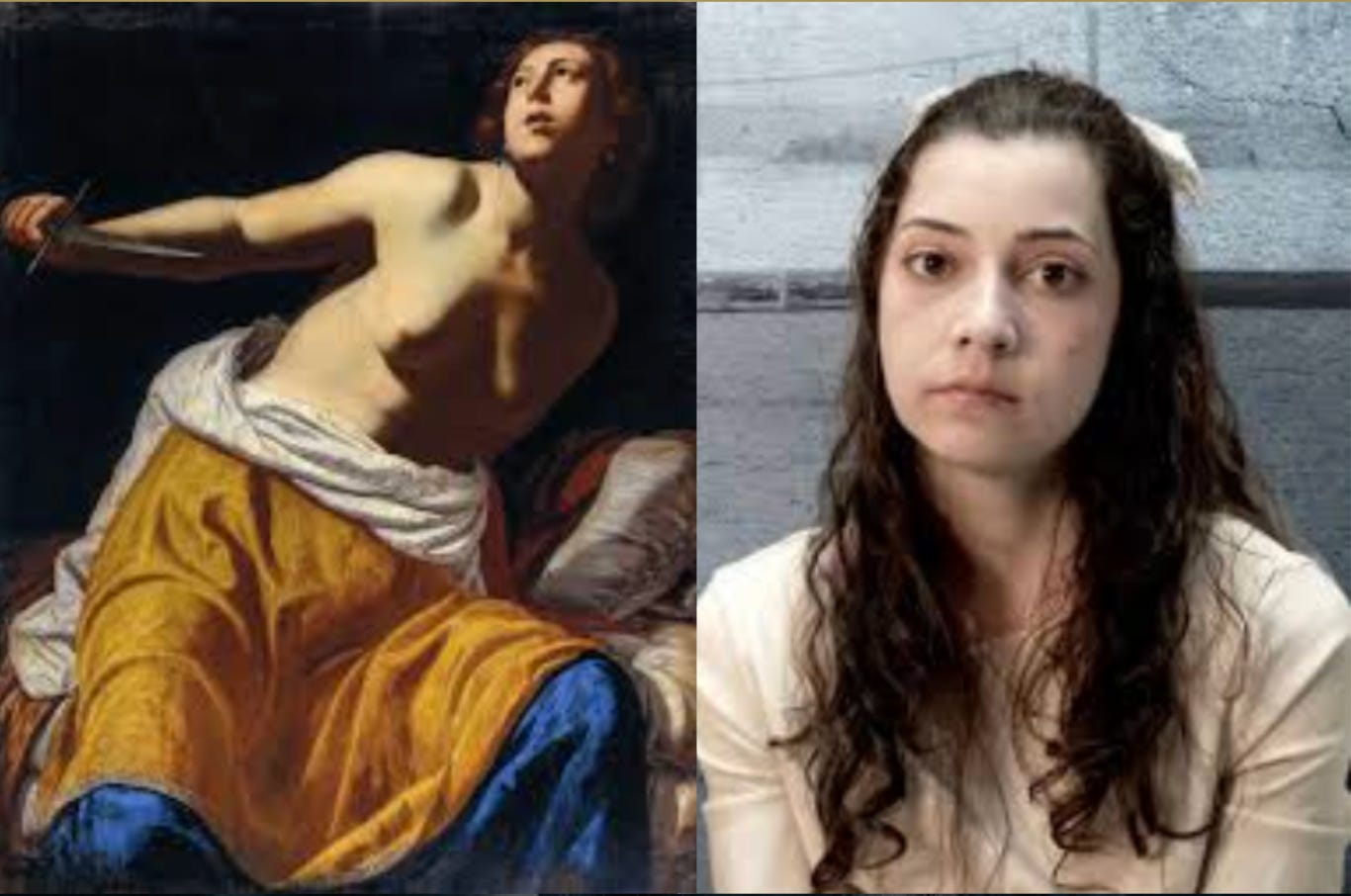
The website of London’s National Gallery informs us that Artemisia Gentileschi’s painting of Lucretia in the act of suicide presents her “not as a victim, but as a woman purposefully in charge of her own destiny.”
The story of Lucretia comes down to us from the Roman historian Livy, who tells of a Roman wife who excelled in castitas (the root of our term chastity, though with wider scope), and who was raped and thereby disgraced by Sextus Tarquinius.
In view of the shame inflicted on her, Lucretia announces, “although I acquit myself of the sin [of unchastity], I do not free myself from the penalty; no unchaste woman shall henceforth live and plead Lucretia’s example” – before plunging a dagger into her heart. The 17th century artist Gentileschi, herself a victim of rape, captures the moment before the dagger reaches its target.
The story and the painting give us a vivid example of a specifically pagan attitude to shame and suicide. Life, for Lucretia, is not to be lived in a state of dishonour and her act of suicide is presented not only as morally appropriate but as a pedagogic act.
The story of Lucretia came to my mind in light of the news that a young woman, Noelia Castillo Ramos, was last week euthanised in Spain. Like Lucretia, she was a victim of rape and had attempted suicide. Unlike Lucretia, she received her death ultimately at the hands of healthcare staff and the State. And as with the National Gallery commentary on Lucretia, some onlookers with twenty-first century sensibilities praised this act as ‘taking control’.
Noelia Castillo was killed under Spain’s Organic Law Regulating Euthanasia which speedily passed in 2021, at a time when Spain was implementing Covid-19 measures. As with the Leadbeater Bill currently being debated in England and Wales, the word ‘suicide’ is not mentioned in the legislation despite its offer of “aid in dying”, though the Spanish legislation allows for both euthanasia and assisted suicide. The Law novelly proposes that subjects have a right to such ‘procedures’ if, as Article 3 stipulates, they are suffering from serious incurable disease or serious chronic disabling conditions.
The Hippocratic Oath regards the deliberate ending of a patient’s life by a doctor as paradigmatically opposed to the virtuous practice of medicine. The Spanish law takes care, in the words of legal scholar Jorge Salina Mengual, to refer to “the context where the act is carried out, and not the exercise of the medical profession, taking into account that euthanasia is a practice that can be carried out by health personnel, not necessarily medical.”
Castillo, 25, was killed at her request at a medical facility in Sant Pere de Ribes in Barcelona province. Her decision was approved by a panel of ‘experts’ who decided that she was in a “serious and incurable condition” accompanied by what they deemed to be “grave, chronic and incapacitating suffering.” Castillo’s earlier suicide attempt, following a gang rape, had left her with spinal injuries causing chronic painand mental distress.
In order for euthanasia to be carried out in Spain, a panel of experts takes it upon itself to decide that life, in certain conditions, can legitimately be terminated. For all the talk of autonomy and ‘taking control’, it is only a certain category of persons that can be killed. And that category of persons is those deemed to be suffering in certain specific ways. In the face of such suffering, the intrinsic value of someone’s life, which in traditional Christian societies ruled out deliberate killing of the innocent, is trumped by the combination of an ‘autonomous’ desire and a panel’s decision to implement that desire. Castillo judged her own life to be unworthy of life and the panel, in effect, affirmed this judgement.
To understand what is truly at stake here, and why this moment matters far beyond one tragic case:
👉 continue reading by becoming a supporter
