


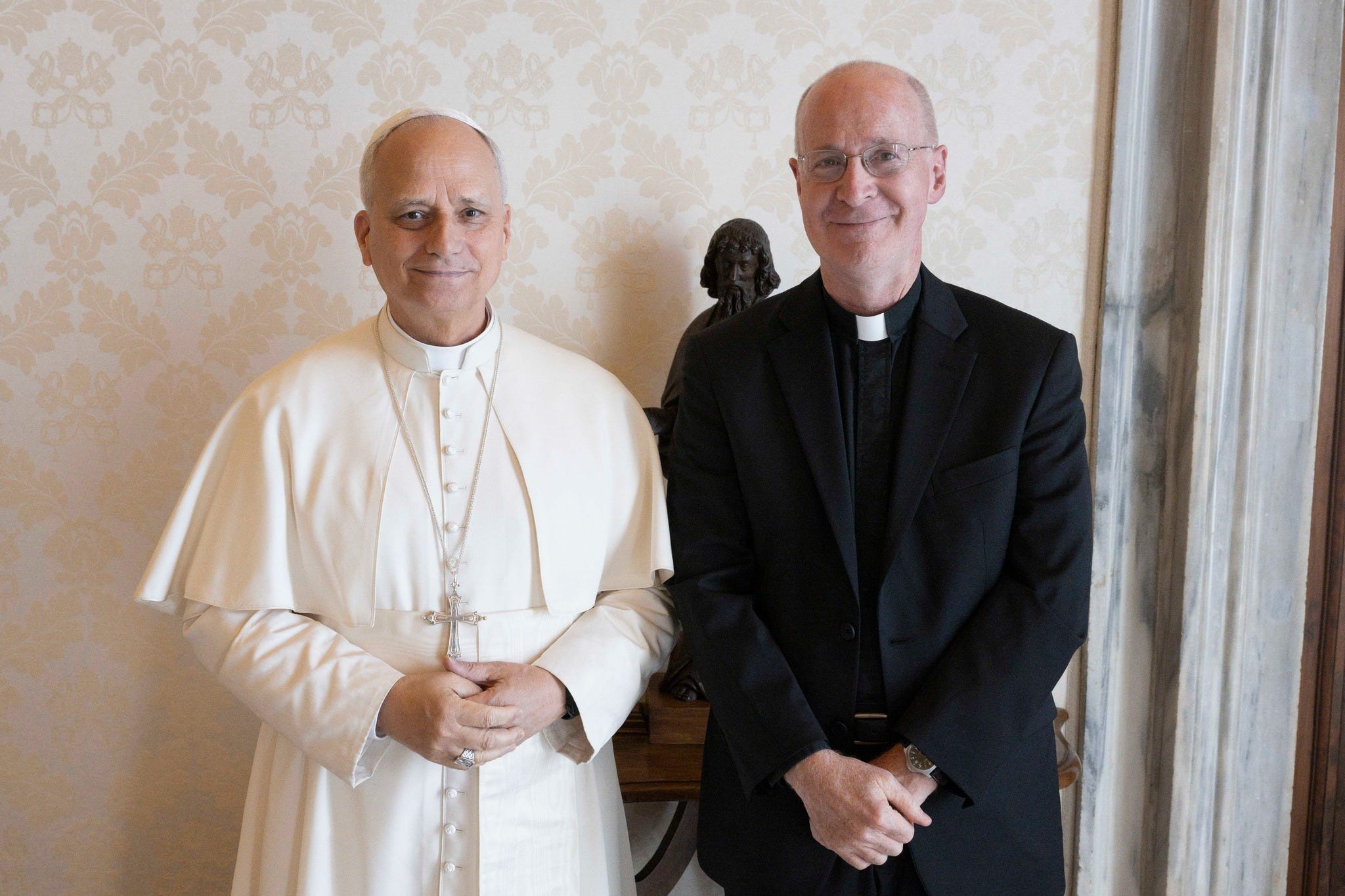
There is something strangely revealing about the comments beneath Father James Martin’s latest Facebook post. On the surface a reader can easily see how the Jesuit priest is attempting something pastoral and conciliatory. Responding to Pope Leo XIV’s recent remarks concerning same sex blessings and the German bishops, Father Martin reassures anxious followers that Fiducia Supplicans “still stands” and that the new Pope is not dismantling the trajectory established under Pope Francis.
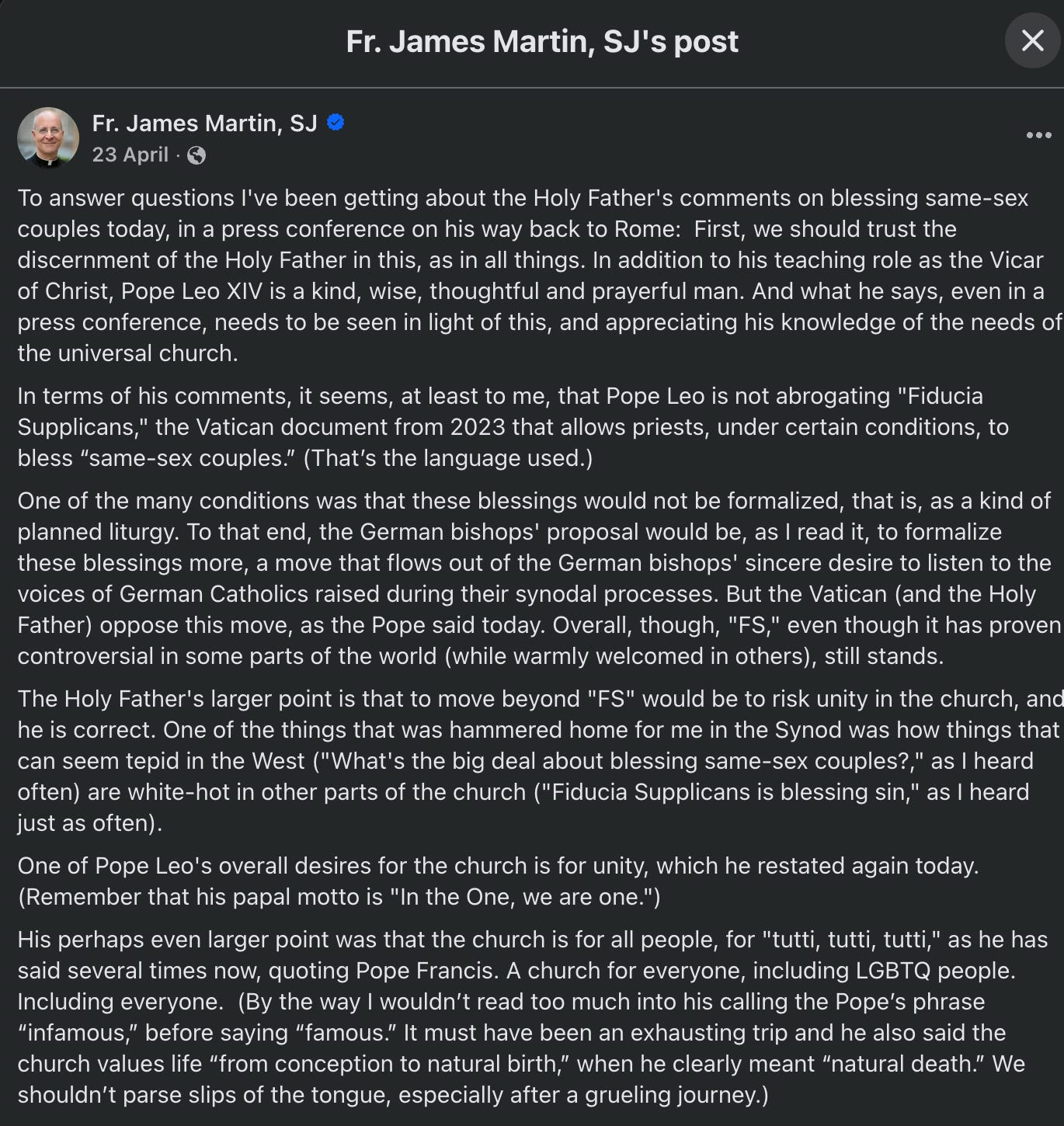
Yet the most revealing aspect of Father Martin’s intervention may not have been what he explicitly said, but the anxiety which necessitated saying it at all. Reassurance only becomes necessary when a community senses retreat. If Pope Leo’s remarks had been received as an uncomplicated continuation of the Francis trajectory, there would have been little need to insist repeatedly that Fiducia Supplicans “still stands”. The insistence itself betrays awareness that the ecclesial atmosphere has changed. What emerges is not formal repudiation, but something perhaps more significant: a narrowing of interpretive possibility. Pope Leo appears less interested in expanding ambiguity than containing it.
Yet the atmosphere in the comments below Father Martin’s post tells a deeper story. For many of those responding, this is no longer merely a question about blessings, accompaniment, or pastoral tone. It has become the defining moral question of Christianity itself. Some openly state they cannot remain within a Church which continues to describe homosexual acts as morally disordered. Others insist the Church must eventually “catch up” with modern understandings of sexuality or resign itself to irrelevance. What emerges is not simply a disagreement about pastoral practice, but a profound conflict about the nature of the human person.
This is precisely why the controversy surrounding Fiducia Supplicans has proved so destabilising. Defenders of the document frequently portray critics as harsh, fearful, or lacking compassion for those who experience same sex attraction. That accusation is often unjust. The more serious concern raised by orthodox Catholics is not hatred of persons, but the preservation of a coherent Christian anthropology. Catholic sexual ethics do not exist in isolation like arbitrary ecclesiastical regulations. They flow from a vision of reality in which the body possesses meaning, creation possesses order and human freedom finds fulfilment in conformity to truth, not in self invention. Once that framework is abandoned, the implications reach far beyond the blessing of couples.
The tragedy is that many progressive Catholics do not entirely misunderstand this. Father James Martin and those around him are not simply engaged in a superficial campaign for kindness. They are attempting to reconcile Catholicism with the moral intuitions of contemporary liberal society, especially the conviction that sexual identity lies near the very centre of personhood itself. In modern Western culture, sexuality is no longer viewed primarily as an act ordered toward procreation, sacrificial union and family formation. It is increasingly treated as a core expression of the autonomous self. To question the moral legitimacy of sexual relationships therefore appears not merely restrictive, but existentially cruel.
And yet this is precisely the anthropology Christianity has historically resisted.
The classical Christian understanding of the human person is not founded upon autonomous will, but upon nature, teleology and revelation. The human body is not raw material awaiting self definition. It possesses intrinsic meaning. Male and female are not interchangeable social constructs, but complementary realities embedded within creation itself. Sexual union is therefore not merely an emotional or psychological act. It is ordered toward communion, sacrifice and the generation of new life. The Church’s moral teaching flows from this wider metaphysical vision. It is more than simply a list of prohibitions. It is an account of what human beings are for.
This is why the Church has consistently resisted the reduction of sexuality to subjective identity or personal fulfilment. The 1986 Letter to the Bishops of the Catholic Church on the Pastoral Care of Homosexual Persons issued under Cardinal Ratzinger understood the danger with remarkable clarity. Far from expressing hatred or contempt for persons experiencing same sex attraction, the document repeatedly insists upon their full human dignity and condemns unjust discrimination. Yet it also warns against reducing the human person to sexual inclination and cautions against ideological movements which seek to redefine morality according to psychological or political categories detached from revelation and natural law. At the time many dismissed such concerns as reactionary. In retrospect they appear strikingly prophetic.