


The announcement that the Terminally Ill Adults (End of Life) Bill will return to Parliament this autumn has prompted a renewed intervention from Archbishop John Sherrington, the lead bishop for life issues in England and Wales. In a statement released this week, Archbishop Sherrington expressed his “deep disappointment” at the Bill’s reintroduction and reiterated the Catholic bishops’ longstanding opposition to assisted suicide. He warned once again of the dangers posed by the legislation, both to vulnerable people and to institutions such as hospices and care homes that could find themselves under increasing pressure to facilitate practices fundamentally opposed to their ethos.
The Archbishop is right to do so. Indeed, anyone familiar with the Church’s teaching on the sanctity of life would expect nothing less. Yet his intervention raises a deeper question. Is it enough for one bishop, however sincere and well informed, to issue another statement on what may prove to be one of the most consequential moral questions facing Britain in the twenty-first century?
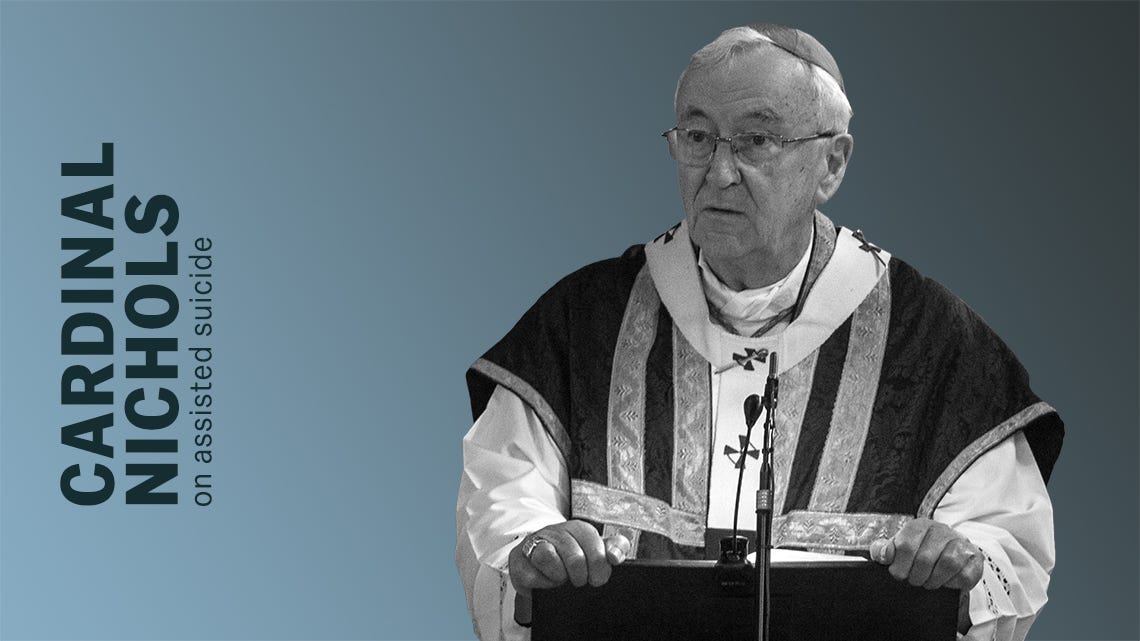
To be fair, the Catholic bishops have not been silent. Throughout the passage of the Bill they have issued statements, organised Holy Hours, encouraged Catholics to write to their MPs, mobilised parish campaigns and repeatedly warned of the dangers inherent in the legislation. Cardinal Nichols himself took the unusual step of urging Catholics nationally to lobby their representatives, something he has done only on the rarest occasions. Archbishop Sherrington has been consistent and courageous in his opposition, repeatedly describing the Bill as flawed both in principle and in practice. He was invited on to Catholic Unscripted to talk about this, but sadly he refused.
So the question is not whether the bishops have spoken, some clearly have. The question is whether they have spoken with a volume and urgency commensurate with what is at stake. For the issue before Parliament is not merely another contested item of social policy. It is not comparable to debates over taxation, planning regulations or public spending priorities. Assisted suicide strikes at something more fundamental. It concerns the most basic and indispensable of all human rights: the right to life itself.
Every other right presupposes the existence of the person who possesses it. Freedom of speech, freedom of religion, freedom of association, democratic participation and legal equality all rest upon a prior assumption that human life possesses an inherent dignity worthy of protection. Once the principle is accepted that some lives may be intentionally ended because they are judged no longer worth living, or because death is presented as a therapeutic solution to suffering, the moral foundation upon which every other right rests begins to shift.
This is why the Church has always regarded euthanasia and assisted suicide as uniquely serious matters. The prohibition against the deliberate taking of innocent human life is not an arbitrary religious rule. It is one of the first principles of natural law and one of the foundational pillars of civilisation itself.
Supporters of assisted suicide typically frame the debate in terms of autonomy, compassion and personal choice. Such language possesses an immediate emotional appeal. Nobody wishes to see another human being suffer. Nobody wishes to witness pain, fear or indignity in the final stages of life. Yet the crucial question is whether the deliberate facilitation of suicide represents a genuine solution to suffering or whether it fundamentally alters society’s understanding of medicine, care and human dignity.
Opponents of the legislation have repeatedly pointed to evidence from overseas jurisdictions where laws initially introduced under narrow and tightly controlled circumstances have gradually expanded beyond their original limits. What begins as an exceptional provision for a small number of terminally ill patients frequently evolves into something much broader. The logic of autonomy rarely remains confined within its original boundaries. If personal choice is the governing principle, it becomes increasingly difficult to explain why that choice should be restricted to particular categories of suffering or particular groups of people.
Equally troubling is the question of vulnerability. Advocates of assisted suicide often present the issue as one of individual freedom. Yet human beings do not make decisions in a vacuum. The elderly, the disabled, those suffering from loneliness, depression or feelings of burden upon their families may experience subtle pressures that are impossible to measure in legislation. The fear expressed by many disability rights organisations is not simply that vulnerable people might choose assisted suicide. It is that they may come to feel they ought to choose it.
The concern is not hypothetical. It is rooted in an understanding of human nature. We are social creatures whose decisions are shaped by expectations, relationships and circumstances. A society that increasingly presents assisted suicide as a rational and dignified response to suffering inevitably sends a message about which lives are valued and which lives are regarded as burdensome.
There is also the profound question of medicine itself. The historic vocation of the physician has always been to heal where possible, to care where cure is no longer available and never intentionally to bring about death. Assisted suicide represents a radical departure from that tradition. It transforms the doctor from healer into facilitator of death and alters the relationship of trust between patient and physician in ways that cannot easily be reversed.
Nor should the implications for palliative care be overlooked. Britain possesses a hospice movement admired throughout the world. The answer to suffering has traditionally been greater compassion, better pain management, stronger family support and more comprehensive palliative care. The danger is that assisted suicide becomes not an addition to such care but a substitute for it. Where resources are limited and care is expensive, the temptation to offer death as a solution rather than care as a vocation becomes increasingly difficult to resist.
Seen in this light, the frustration expressed by many Catholics becomes easier to understand. Their complaint is not that Archbishop Sherrington has failed to speak. It is that a matter of such gravity appears not to have elicited an equally dramatic response from the Church’s leadership as a whole.
Historically, bishops have often spoken with extraordinary clarity when they believed fundamental moral truths were under threat. The English martyrs resisted state interference in matters of conscience at the cost of their lives. Nineteenth-century bishops fought fierce battles over Catholic education. Across the centuries the Church has repeatedly demonstrated that there are moments when measured institutional statements are insufficient and when a more visible and prophetic witness becomes necessary.
Many Catholics believe this is one of those moments.
Perhaps the bishops have done more than their critics acknowledge. Perhaps much of their work has taken place quietly behind the scenes. Yet there remains a widespread sense that Britain is approaching a watershed in its understanding of life, death and human dignity. If that judgement is correct, future generations may look back on this debate not as a technical dispute over end-of-life legislation but as a defining moment in the moral history of the nation.
The reintroduction of the Bill should therefore prompt more than disappointment. It should provoke a renewed examination of what is truly at stake. For the question before Parliament is not simply whether some people should be permitted assistance in ending their lives. The deeper question is whether a society founded upon the equal dignity of every human person wishes to cross a threshold from which it may prove exceedingly difficult to return.
When the law begins to teach that some lives are candidates for intentional termination, it is not merely changing a policy. It is changing a principle. And principles, once surrendered, are rarely recovered without cost.
Thank you, Mark, for another timely and insightful article.
Agree completely with you that where legislation creates a right to die it becomes a duty to die, the pressure for which is sometimes subtle but other times not so subtle.
Many of us worry about becoming a financial and personal burden to family members at the end of our lives. We have the right to reject extraordinary medical interventions and rely on palliative care. But we as Catholic Christians cannot substitute our will for God’s will