


Written by Ciarán O’Regan for Catholic Unscripted
Despite being responsible for at least as much death as fascism, the spectre of communism haunts us far less intensely. Though many may have heard about the millions who died in Soviet gulags or Ukraine’s Holodomor, how many of us know about the 30 million people that Vaclav Smil, professor at University of Manitoba, estimates died in China’s Great Leap Forward famine of 1959-61? “The famine had overwhelmingly ideological causes,” writes professor Smil, and is “perhaps the most overlooked cause of 20th century mortality.” To make matters worse, he also estimates that, alongside the 30 million directly starved, “about the same number of births were lost or postponed.” This is without even mentioning the estimated 1.5 million people killed during China’s Cultural Revolution of 1966-76. The terrorism, torture, murder and even cannibalism reportedly wrought by Mao’s child revolutionaries, the Red Guard, need to become more well-known in the West. After all, it isn’t only the right that can go too far.
Yet fascism lives in Western imaginations and establishment discourse in a hysteric manner that communism does not. As recent illustration of the toxic fruits of this obsession, we can look to the seemingly endless videos of all sorts of people, including professors and teachers, justifying or even joyfully celebrating Charlie Kirk’s horrific assassination on the basis that Kirk, a moderate Christian conservative who engaged ideological opponents in peaceful debate, was supposedly “fascist”, far right”, or spreading “hate”.
Historian Tom Holland, author of an astonishing 2019 book, Dominion: The Making of the Western Mind, offers a fascinating hypothesis around our asymmetrical concern: “Communist dictators may have been no less murderous than fascist ones; but they — because communism was the expression of a concern for the oppressed masses — rarely seem as diabolical to people today.” The argument that anti-human totalitarianism strikes us as less repulsive if the ideology expresses concern for victims is quite the provocation. To cut to the crux of it, Holland argues that Christian moral foundations underpin the basic assumptions of the sort of secular-progressive worldview that holds fascism to be worse than communism; that judges murderous extreme-right wing ideology to be somehow worse than equally murderous extreme-left wing ideology: “The measure of how Christian we as a society remain is that mass murder precipitated by racism tends to be seen as vastly more abhorrent than mass murder precipitated by an ambition to usher in a classless paradise.”
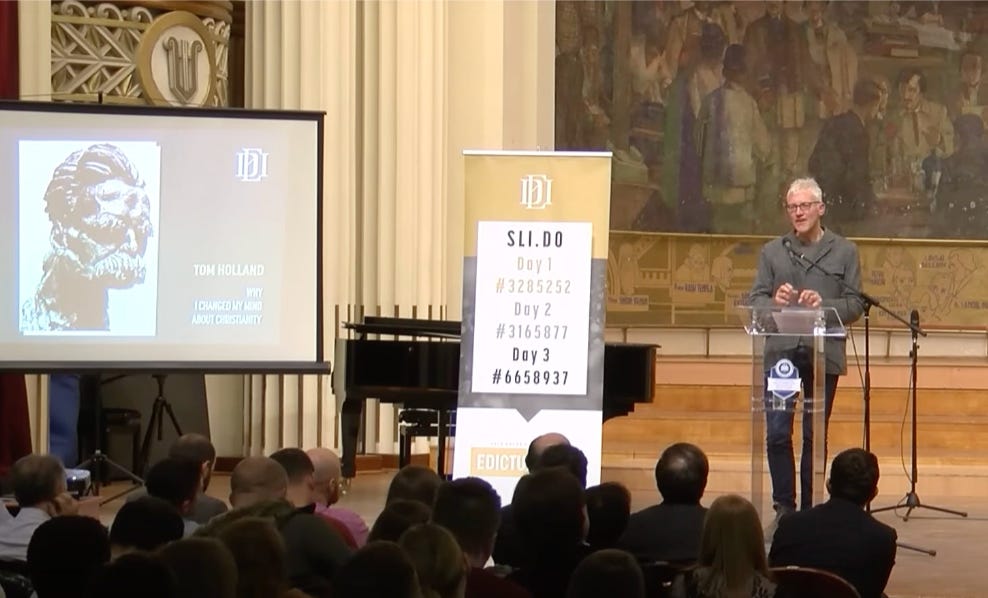
In a 2022 lecture, Why I changed my mind about Christianity, Holland succinctly presented this premise. He argues that, as church pews emptied out across the West, Germany’s racially focussed form of Fascism had given the West a “whole new post-Christian mythology”:
Because the reason that we in the West regard the Nazis as more evil than the Communists, by and large, is because they practiced genocide for unacceptable reasons, for racist reasons, for reasons to do with contempt for the weak. And that in turn means that in a society that is increasingly turning its back on the Church, our horror at what the Nazis did gives us a moral framework that remains Christian. So it’s a moral framework in which Hitler is the Devil, Nazis are demons, Auschwitz is hell. And if before the Second World War, people in the West would say ‘What should I do? I will do as Jesus did’, now when people say ‘What should I do?’, by and large people say ‘I will do the opposite of what Hitler did.
Holland’s central thesis builds on insights from a tortured soul with electric prose by the name of Friedrich Nietzsche. In his essay, The Founding Murder in the Philosophy of Nietzsche, professor René Girard of Stanford brilliantly argues: “The greatness of Nietzsche is that he apprehends the truth of Christianity with incomparable force.”
It was Nietzsche’s nemesis, St Paul, who most clearly outlined the Christian view of personhood: “There is neither Jew nor Greek, there is neither bond nor free, there is neither male nor female: for ye are all one in Christ Jesus.” (Galatians 3:28) In a late work, The Anti-Christ, Nietzsche refers to St Paul as “the greatest of all apostles of revenge”, and he did so because of St Paul’s elevation of the lowly as epitomised in readings like 1 Corinthians 1.27: “God chose the weak things of the world to shame the strong.” Nietzsche rails with vicious precision against St Paul’s assertion that “everybody is equal to everybody else”. “The poison of the doctrine ‘equal rights for all’ – this has been more thoroughly sowed by Christianity than anything else”.
A glaring contrast in weltanschauung can be found in an early work, Homer’s Contest. Here Nietzsche describes a pre-Christian world in which “combat is salvation; the cruelty of victory is the pinnacle of life’s jubilation.” This is a world in which “the victor in a fight among the cities executes the entire male citizenry in accordance with the laws of war, and sells all the women and children into slavery.” A historical example of such cruelty could be read in Julius Caesar’s The Conquest of Gaul when, in describing the siege of Avaricum of 52 BC, his men issued brutal revenge for a Gallic treachery that had previously led to Romans being slaughtered. Caesar mentions, with banal nonchalance, how his men were so enraged they didn’t even bother taking slaves and simply massacred nearly 40,000 people: “They were exasperated by the massacre of Romans at Cenabum and the labour of the siege and spared neither old men nor women nor children.” This was just a single massacre from a military campaign which historians reckon resulted in a million Gauls killed, and a further million enslaved.

