


It’s Holy Saturday, this is the moment each year when the Church seems to stop breathing.
On Good Friday, the altar is stripped, the tabernacle stands empty, and the Sacrifice that sustains the world is not offered. It is the only day in the entire year when the Church, who lives from the Eucharist, consents to silence. But is this absence? No. It is disclosure.
The liturgy is not simply recalling a past event. It is drawing us into a pattern that governs the whole of Christian history, and more than that, the very structure of reality. For the Church does not stand outside the mystery of Christ. She lives within it. What happens to Him happens also, in time, to her.
Ronald Knox saw this with an almost disarming clarity. Ronald Arbuthnott Knox (17 February 1888 – 24 August 1957) was an English Catholic priest, theologian, author, and radio broadcaster. Educated at Eton and Balliol College, Oxford, where he earned a high reputation as a classicist, Knox was ordained as a priest of the Church of England in 1912. He was a fellow and chaplain of Trinity College, Oxford until he resigned from those positions following his conversion to Catholicism in 1917. Knox became a Catholic priest in 1918, continuing in that capacity his scholarly and literary work.
Knox saw that the Church was buried in the catacombs, rose with the Empire. The Church fractured in one age, renewed in the next. Again and again, she seems to pass through death into life. Not metaphorically, but concretely, historically, visibly. This is not a cycle of decline and recovery. It is something far more precise. It is participation in the Cross.
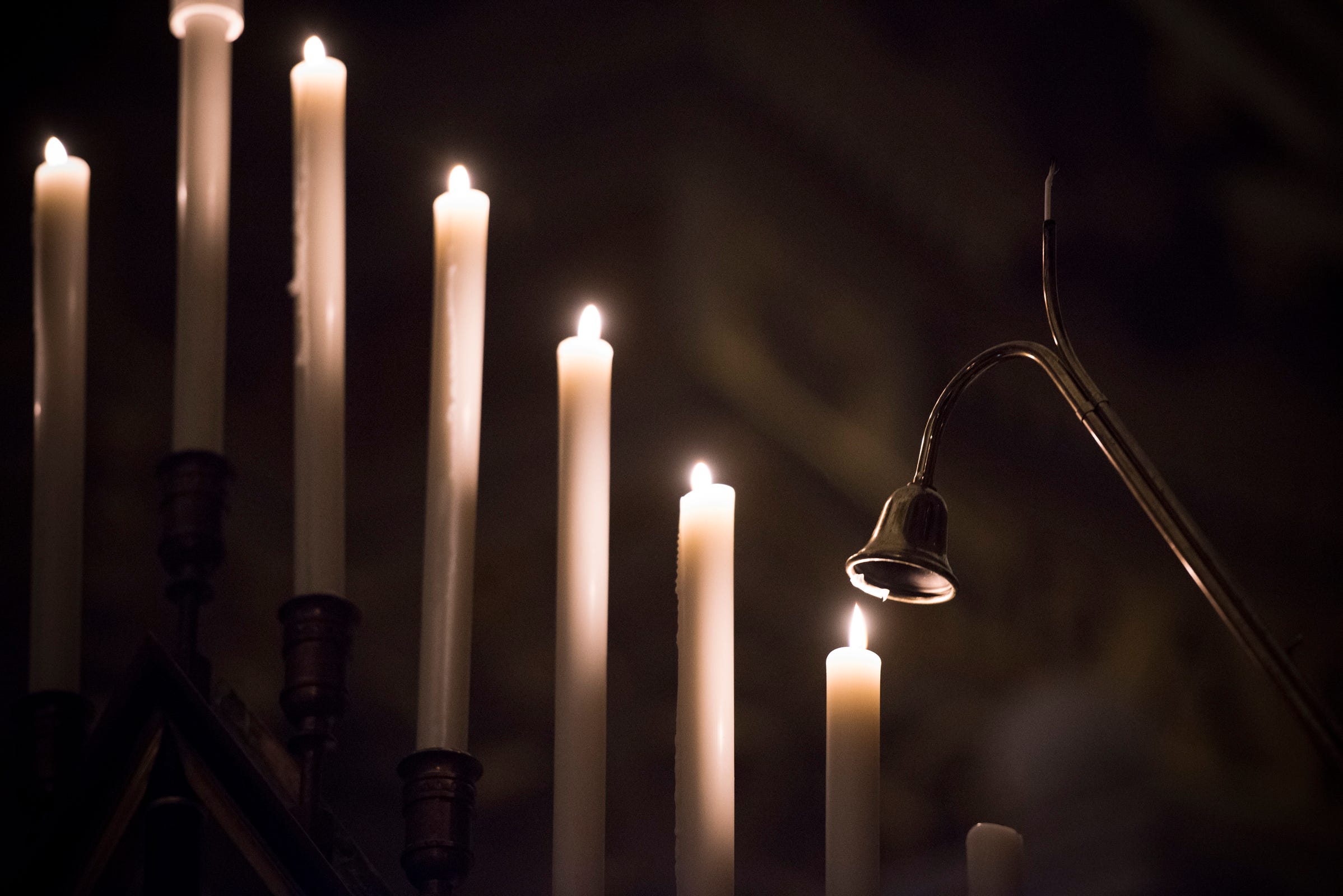
Good Friday reveals something quintessential to Christianity, something that is otherwise difficult to see. The Church does not always appear as victorious. There are moments when she appears to lose everything that gives her visible form: influence, clarity, unity, even the confidence of her own members. On those days, she does not look like a triumphant society moving through history. She looks like a body taken down from the Cross. And our liturgy does not hide this. It insists upon it.
There is no Mass on Good Friday because the Victim has been slain. The Church does not pretend otherwise. She does not rush to Easter. She remains, deliberately, within the silence of the tomb.
But if this is remembrance, it is also instruction.
For the Fathers of the Church speak with a striking consistency about the end of history. Before the final triumph, the Church herself will undergo a Passion. Not simply persecution, which has never ceased, but a deeper stripping away. A moment in which her public worship is curtailed, her voice constrained, her presence reduced to something hidden and fragile. A time when, to outward appearances, she will seem to have been overcome.
Good Friday is not only about Christ. It is about the Church. And so the empty altar becomes a sign not only of what has been, but of what will be.
