


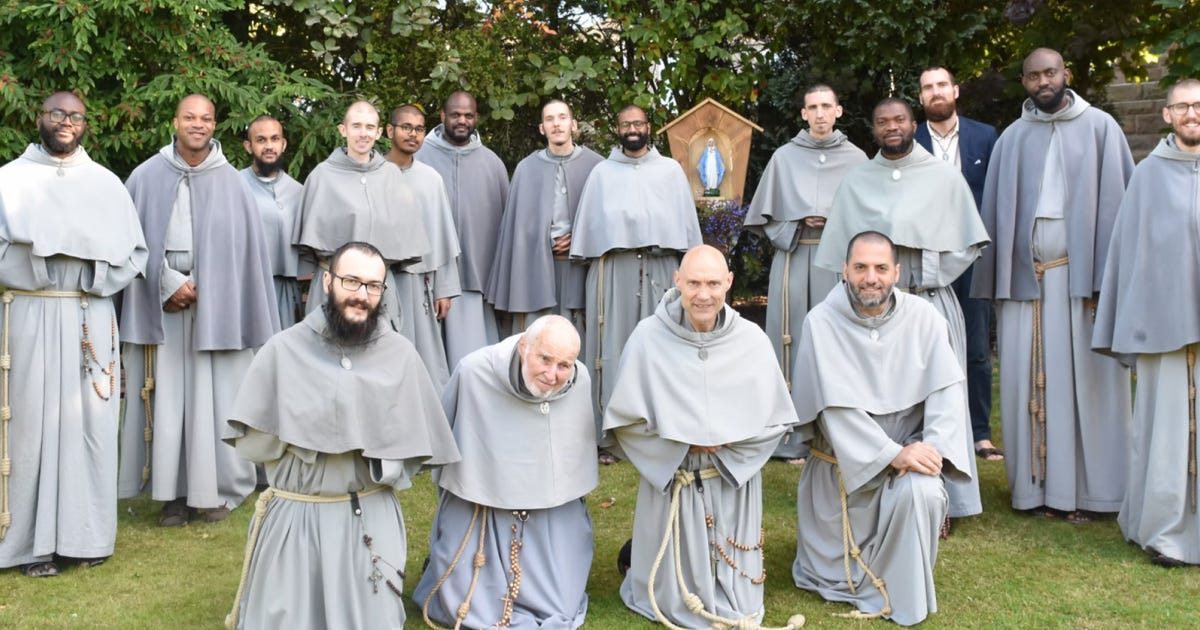
The quiet dissolution of the Marian Franciscans marks the end of one of the most intriguing and symbolically important traditional Catholic apostolates to emerge in Britain during the pontificate of Pope Francis. The official statements released by the community itself, alongside subsequent statements from the Dioceses of Dunkeld and Portsmouth, are restrained, sorrowful and carefully ecclesial in tone. There are no accusations, no denunciations, no appeals to factional outrage. Instead there is gratitude, obedience, prayer and an unmistakable sense of grief.
Yet underneath that restraint lies a profound story about the state of the Church in post Francis Catholicism and the increasingly fractured ecclesial culture which now exists within diocesan life itself.
The Marian Franciscans emerged from the spiritual world of the Franciscan Friars of the Immaculate, the once flourishing international Franciscan community which found itself subjected to Vatican intervention in 2013 shortly after the election of Pope Francis. At the time, many Catholics, myself included, struggled to interpret events calmly and conservatively. I wrote then on my blog that Catholics should resist alarmism and trust that Rome was acting prudently. I genuinely believed Pope Francis was a fundamentally decent and orthodox pope attempting to govern a difficult Church. Looking back now, that optimism appears almost painfully naïve.
The Franciscan Friars of the Immaculate controversy has since come to occupy an almost prophetic place in the story of the Francis pontificate. What many initially dismissed as an isolated disciplinary matter increasingly appeared, in retrospect, as an early indication of a much wider ecclesial direction. The restrictions on traditional liturgy, the suspicion directed toward visibly traditional communities and the growing instability surrounding orthodox Catholic apostolates would all become recurring features of the next decade.
The Marian Franciscans themselves became a distinct diocesan association under Bishop Philip Egan in Portsmouth. They were not simply a continuation of the original Franciscan Friars of the Immaculate, though spiritually and culturally the continuity was obvious. Marian devotion, visible Franciscan life, reverent liturgy, sacrificial spirituality and a clear counter cultural Catholic identity defined the community. Their apostolate attracted young families, converts and vocations in an age when many diocesan structures are experiencing ageing congregations and institutional exhaustion. That alone makes this story important.
The community’s own statement repeatedly emphasises that there was no single scandal, no disciplinary collapse and no one precipitating incident behind the dissolution. Instead, the crucial phrase concerns the inability to secure “the practical and canonical support needed for formation, sponsorship and future priestly ordinations.” That sentence is very revealing. They point not to moral failure but to a gradual collapse of institutional viability.
The statements from Dunkeld and Portsmouth reinforce this reading. Dunkeld Diocese confirmed that the priests themselves petitioned for the dissolution of the association and went out of its way to thank the friars warmly for their ministry. Portsmouth likewise framed events in calm juridical language rather than ideological condemnation. Yet when the chronology is examined carefully, a striking pattern emerges.
In 2022, under Bishop Stephen Robson, Dunkeld Diocese publicly welcomed the Marian Franciscans enthusiastically. The diocese described them as an “Old and New Rite traditional Catholic Community” and praised their youth, zeal and missionary spirit. They were entrusted with substantial apostolic responsibilities in Dundee and appeared to flourish rapidly. Then a new bishop was appointed.
Following the arrival of Bishop Andrew McKenzie, reports began emerging that the friars had been asked to leave Dundee and return south. Official diocesan language referred to consultations with “appropriate experts” and the diocesan Council of Priests. One need not indulge in conspiracy theories to recognise that this points toward institutional unease within diocesan structures themselves.
Why? That question can’t just be dismissed as the grievance of online traditionalists. It is the central question raised by this story. I cannot help but wonder why, in an age of collapsing Mass attendance, priestly shortages, doctrinal confusion and demographic decline, a visibly flourishing Catholic community struggled to secure stable episcopal backing in Britain?
The Marian Franciscans were not accused of heresy. They were not morally disgraced. They attracted vocations. They drew young families. They promoted prayer, sacramental life, Marian devotion and reverent liturgy. They represented precisely the kind of supernatural seriousness many Catholics quietly hunger for amidst the banality and exhaustion of much contemporary ecclesial culture.
And yet they appear ultimately to have found themselves institutionally homeless.
Part of the answer lies in the fractured ecclesial landscape which now exists after Pope Francis. The Catholic Church increasingly feels less like a universally coherent institution and more like a patchwork of competing theological instincts depending on geography, episcopal personality and ecclesial tribe. A community warmly embraced under one bishop may become deeply problematic under another. Liturgical practices celebrated in one diocese are discouraged in another. Priests praised for courage in one context are regarded as dangerously divisive in another. This inconsistency creates a profound instability within Church life itself.
The Marian Franciscans also became symbolic figures within wider ecclesial culture wars. Their visible traditionalism, strong Catholic identity and willingness to challenge progressive cultural assumptions inevitably attracted scrutiny. I experienced this personally during the controversy surrounding Fr Rosario Ebanks in Portsmouth in 2022. His outspoken criticism of gender ideology and LGBT activism in Catholic schools provoked a public rebuke from Bishop Egan which shocked many orthodox Catholics precisely because Egan himself had long been regarded as one of the more reliable bishops in England.
Here is Fr. Ebanks wonderful interview with us from December 2025:
Looking back now, that moment appears significant. It revealed the increasingly difficult position occupied by communities which refuse accommodation with prevailing secular assumptions. In modern ecclesial culture, boldness itself can become a liability.
And yet throughout all of this, the Marian Franciscans have refused to weaponise their suffering. Those close to the community speak of a conscious decision to avoid inflaming tensions or encouraging backlash against the bishops involved. This too is profoundly revealing. Several of their priests were ordained by Bishop Egan himself. There exists therefore not merely an administrative relationship but a paternal and sacramental bond. The friars clearly do not view themselves as ecclesiastical revolutionaries or victims leading a resistance movement. Their response has instead been marked by what can only be described as Marian and Franciscan docility. There is pain, but no rebellion. Sorrow, but no bitterness.
Given our current seeming addiction to outrage, that silence is itself eloquent.
Perhaps the deepest tragedy here is that the Church often appears strangely afraid of overt supernatural vitality when it manifests too clearly. The Marian Franciscans represented something undeniably counter cultural. Young men embracing sacrifice. Families embracing large Catholic households. Priests wearing habits. Traditional liturgy attracting converts. Eucharistic devotion flourishing. A serious Catholicism unembarrassed by transcendence.
One might have expected such a phenomenon to be treasured and protected amidst the spiritual confusion of modern Britain. Instead, the community quietly disappears.
History may ultimately judge this episode as a minor footnote in the turbulent post conciliar period. Or it may come to be seen as one more sign of a deeper ecclesial crisis in which institutional Catholicism, uncertain of its own identity, grows nervous whenever the Holy Spirit produces communities too visibly alive, too disciplined, too traditional and too obviously fruitful. For now, the friars themselves ask only for prayers. That, perhaps, is the most Franciscan ending imaginable.
As always very well written by you Mark on such a tragic situation, which makes no sense especially when they have been flourishing since arriving in Dundee as they had the facilities to grow as a community. The buildings which the Friars and Sisters lived were previously the convent of the Sisters of Mercy and their associated buildings, which first was a school then a nursing home, before being taken over by the Diocese, which I was told many years ago they got it for a steal. When they moved the Diocesan centre to a parish they looked for buyers of this beautiful property, which resulted in the Friars and Sisters moving in as Mark says and welcomed by Bishop Stephen.
I did not attend the Sunday services, however more out of curiosity went to their evening adoration/ rosary / benediction around 5 times, which was so reverent and beautiful with all these young friars and sisters. I said to myself we are so lucky to have this presence in our Diocese and will surely bring lots of blessings. Little did I know that our new bishop was seeking to have these 50 holy souls removed from the premises with a very cryptic announcement.
We should have been rejoicing of their presence and supporting them practically including financial assistance to support their vocations. As a Diocese we have one priest under 40 who was ordained 4 years ago with no students in seminary and what was 3 in the pre formation in Spain now being reported in the Cathedral bulletin as 2. If we are lucky then we may get a newly ordained priest in 7 years, which is 11 years after the previous one. The yearly collections to support our students of which there were none could have been used to support the Friars and Sisters.
The harvest was rich but those who should have been supporting and nurturing this vibrant community have cut them down. As said previously I do not attend the Sunday Mass, however it hurts me that this is happening especially given what other nonsense is allowed elsewhere. My aunt was a Poor Clare for over 70 years and as a contemplative they rely on support to carry out their prayerful work glorifying God and supporting us in prayers just as these good Sisters do and they will be removed from their home. I would have hated for that to happen to my aunt and her community, yet this is what is happening. Where is the mercy?
This is such a sad read! 😢