


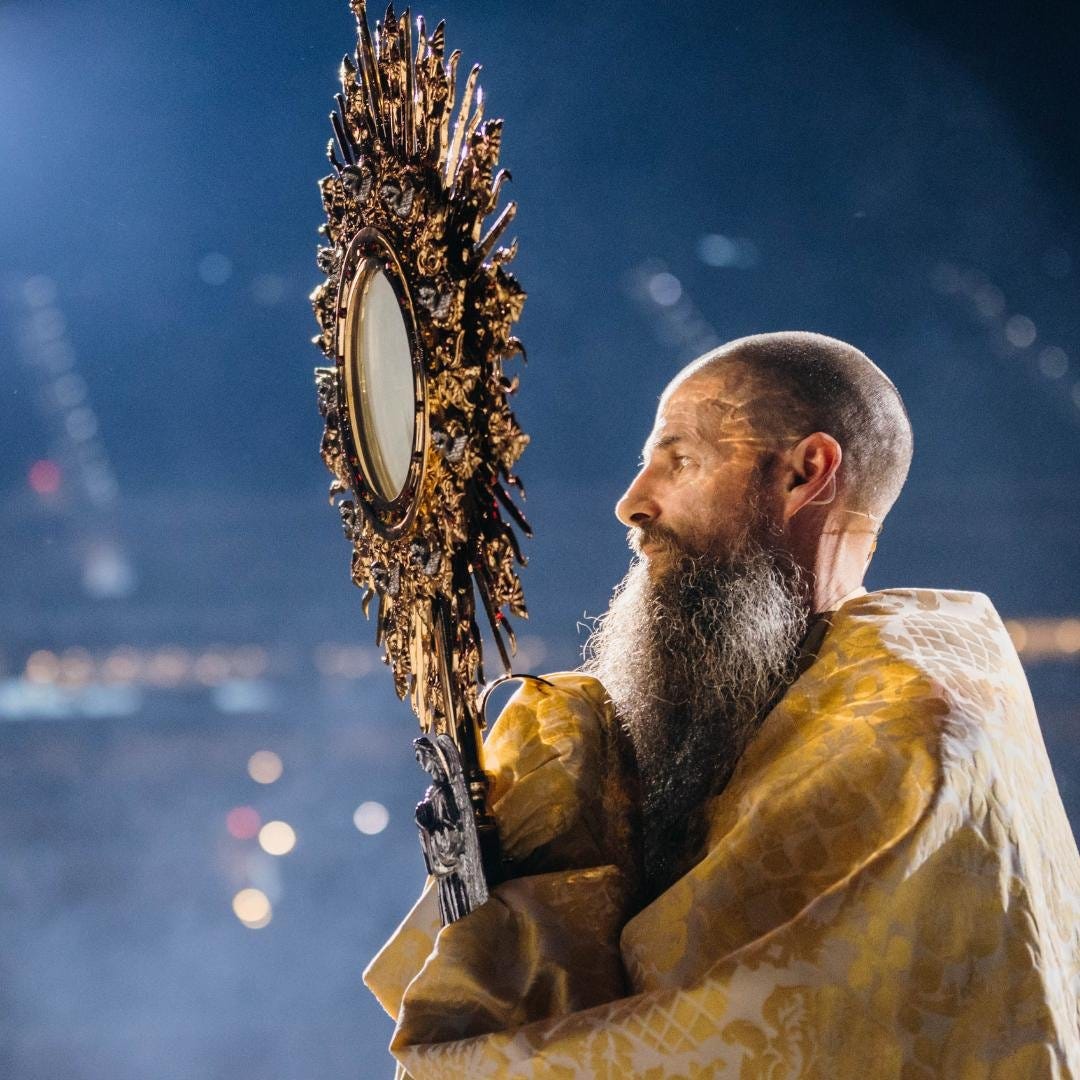
A new study of American Catholics has revealed a deeply uncomfortable reality which cannot be ignored by the Church. After three years of the National Eucharistic Revival, during which the bishops invested enormous energy (and, it has to be said, money) in catechesis, pilgrimages, processions and a national congress, belief in the Real Presence appears to be almost exactly where it was before. I am completely unsurprised and I really was struggling to see how the US Bishops thought the Eucharist Revival was going to move the dial. Why? Well, what if they are trying to repair through conferences and courses a conviction that ought to be formed, week after week, by the way we celebrate Mass? [1]
I am commenting on this as someone who is grateful for the Revival, who regularly attends the reformed Roman liturgy, and who has no patience with the suggestion that fidelity to Catholic tradition requires estrangement from the Church’s legitimate authority. I know the Novus Ordo can be celebrated with profound beauty and reverence. The question is why such celebrations still seem exceptional enough to acquire a special reputation and why the Church tolerates so many Masses that are in no way reverent or beautiful?
What the surveys tell us
The latest peer-reviewed research, published in Sociological Inquiry in September 2026, draws on a nationally representative survey conducted in September 2025. Of the 1,049 self-identifying Catholics asked about the Eucharist, 28.8% said that the bread and wine really become Christ’s Body and Blood; 58.8% chose the answer that they are symbols; and 12.4% were unsure, the published analysis used 1,032 respondents. In 2019, Pew Research Center had found a figure of 31%, the difference is not statistically significant. Belief was much stronger among weekly and more frequent Mass-goers, although even among those attending more than weekly it was below 70 per cent. [1, 2]
We should resist the temptation to overstate what this proves. The questions used in different studies were not identical, and the researchers themselves acknowledge that this limits direct comparison. A separate study by Georgetown University’s Center for Applied Research in the Apostolate, published in 2023, found that 64% of Catholics affirmed the Real Presence when responses to several differently framed questions were taken together; among weekly attenders its figure was 95%. These findings cannot all be treated as interchangeable measurements. They tell us, among other things, that language matters, and that Catholics sometimes understand the doctrine more securely than a single survey answer suggests. [3]
There is another qualification which matters for fairness to the bishops. Their own 2026 impact assessment reported increased Eucharistic devotion, confidence and sacramental practice among people who actually took part in Revival activities. It was based largely on participants’ accounts of change, however, and its comparison group was hardly representative of the average lapsed Catholic: of 300 general-population respondents, 83 per cent attended Mass at least weekly. Such research can reveal encouraging fruit among the already engaged; it cannot establish that national Catholic belief has improved, both reports can be true. [4] This, then, is the problem. The Revival may have deepened conviction among thousands who attended its events, while scarcely touching the wider religious culture in which millions of nominal and occasional Catholics live. The Church organised something impressive but we have yet to demonstrate that we changed the ordinary experience of Catholic worship.
Was the Mass deliberately changed from sacrifice to meal
Here we need to be historically precise. It is often said that the architects of the liturgical reform sought to replace the idea of the Mass as sacrifice with the idea of a communal meal. There is evidence of a shift in emphasis and in the signs through which the liturgy communicates its meaning, but it is inaccurate to say that the Second Vatican Council abandoned sacrificial theology or that Pope Paul VI officially intended to abolish it. Sacrosanctum Concilium, §47, explicitly identifies the Eucharist as the sacrifice of Christ’s Body and Blood perpetuating the sacrifice of the Cross, while also calling it a paschal banquet. The Catechism insists that these dimensions are inseparable. [5]
Nevertheless, the documentary record contains a striking episode. The original 1969 General Instruction of the Roman Missal, at paragraph 7, described the Mass principally as the Lord’s Supper, the sacred assembly of God’s people gathered under the presidency of a priest to celebrate the memorial of the Lord. That description was criticised for failing to give adequate expression to the sacrificial nature of the Mass, the Real Presence and the distinct character of the ministerial priesthood. This is not merely the allegation of later traditionalist critics, a Vatican account of the controversy in 2005 acknowledges those very criticisms and records that the text was amended for the 1970 Missal, although the congregation had found no doctrinal error in the original formulation. [6]
