


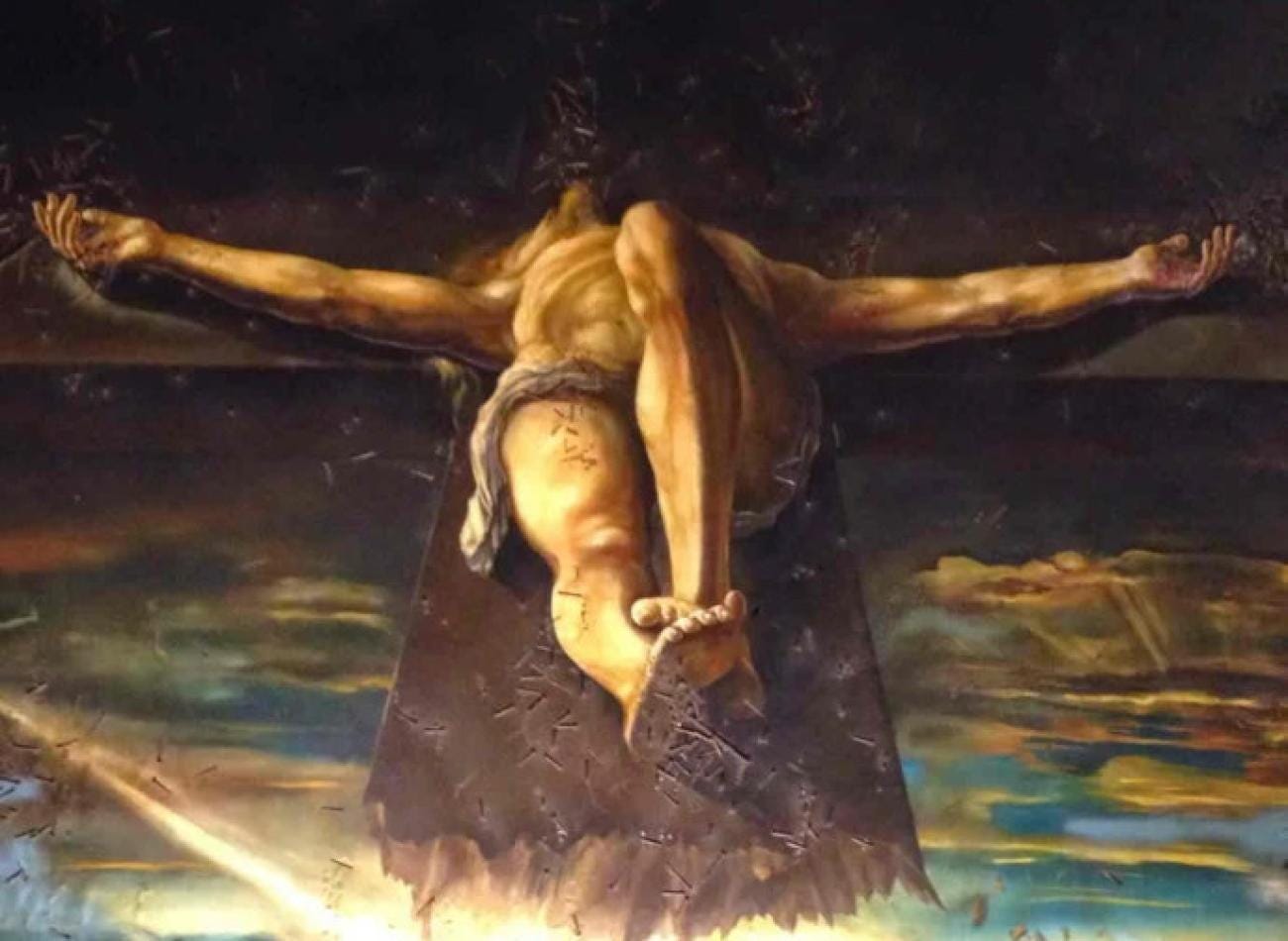
In 2016, Bishop Robert Barron published an essay entitled How Strange Is The Cross. This essay contains a point I have heard him make a number of times, perhaps initally in his 2011 series Catholicism. What he says is that we have become so accustomed to crucifixes that we have lost the capacity to see them as a first-century person would. Crucifixion involved nakedness, public humiliation, prolonged agony and often leaving the corpse exposed. Cicero called it the summum supplicium — the supreme or unsurpassable punishment, which makes St Paul’s language deliberately shocking when he says:
“We preach Christ crucified: a stumbling block to Jews and foolishness to Gentiles.” — 1 Corinthians 1:23
Paul isn’t using a pious cliché. To a Roman audience, Christ crucified sounded almost intrinsically absurd: you are proclaiming as Lord and Messiah somebody who suffered the most degrading death the Roman state could inflict. Crucifixion was designed to be a deliberate a sign of disgrace and defeat for its victims. Perhaps this is most powerfully reinforced in Romans 1:16 “For I am not ashamed of the gospel. It is the power of God for the salvation of everyone who believes: for the Jew first and then Greek.” This clearly shows how the Gospel, centring as it does around a man who was put to death on a cross was seen as something scandalous and shameful. Bishop Barron makes this particularly vivid elsewhere:
“How strange this feast would have sounded to someone in the ancient world! The triumph of the cross!”
He compares it to somebody today celebrating “the triumph of the electric chair or the exaltation of the noose.”
So the question is, why would God’s salvation of the human race have to include something as horrifying as crucifixion? Why would the Son of God have to endure not only death, but as Paul eloquently specifies, “death on a cross”? This has long fascinated me and numerous popes have wrestled with it over the centuries, although, perhaps surprisingly, there isn't one encyclical entitled Why the Cross? Rather, the answer emerges across several major papal texts. And I think Benedict XVI gets especially close to the heart of what is so fascinating about this question to the modern mind in Deus Caritas Est.
In §12 Benedict describes Calvary in extraordinary terms. The Cross is not simply a punishment which God inflicts upon Jesus in order to balance an account. In Christ, God Himself enters into the extremity of the human condition:
“His death on the Cross is the culmination of that turning of God against himself in which he gives himself in order to raise man up and save him.”
And then the crucial sentence:
“This is love in its most radical form.”
This begins to address the question about the horror of crucifixion. If God’s purpose were merely to demonstrate that He possessed the power to forgive sins, the Cross seems unnecessary. Christ could simply have pronounced forgiveness. But if God intends to reveal what divine love actually is, something much more profound is happening. God goes to the furthest point to which fallen humanity can descend — violence, injustice, betrayal, humiliation, abandonment, suffering and death — and enters it Himself. Hence the extremity of the Cross corresponds to the extremity of God’s love.
In his book The Lord, Romano Guardini puts it like this:
God followed man into the no man’s land which sin had ripped open. God not only glanced down at him and summoned him lovingly to return, He personally entered into that vacuous dark to fetch him, as St. John so powerfully expresses it in his opening Gospel. Thus in the midst of human history stood one who was both human and God. Pure as God; but bowed with responsibility as man. He drank the dregs of that responsibility — down to the bottom of the chalice. Mere man cannot do this…The plunge from God towards the void which man in his revolt had began, Christ undertook in love. Knowingly, voluntarily, He experienced it with all the sensitiveness of His divinely human heart. The greater the victim, the more terrible the blow that fells him. No one ever died as Jesus died, who was life itself. No one was ever punished for sin as He was, the Sinless One. No one ever experienced the plunge down the vacuum of evil as did God’s Son.
