


There is one particular phrase we seem to hear a lot of in contemporary Catholic discourse and it is “the faithful remnant”.
This phrase carries with it the pathos of exile, the courage of martyrdom, the steadfastness of the prophets and the quiet conviction that, even when the world appears to have abandoned God, He never abandons His people.
It is a phrase capable of inspiring us to extraordinary fidelity. But does it also tend towards a nurturing of extraordinary presumption?
It has become increasingly common in recent months to hear it invoked by those who believe the Catholic Church has entered the greatest crisis in her history, a crisis so profound that the ordinary structures of ecclesial life have become unreliable custodians of the Faith. Among some traditionalist circles, particularly those sympathetic to the Society of St Pius X, the language of the faithful remnant has become almost instinctive. It is not generally presented as an official ecclesiology, but rather as an explanation of present circumstances. Yet ideas have trajectories. They develop according to an internal logic and what begins as a description of a crisis can become a redefinition of the Church herself.
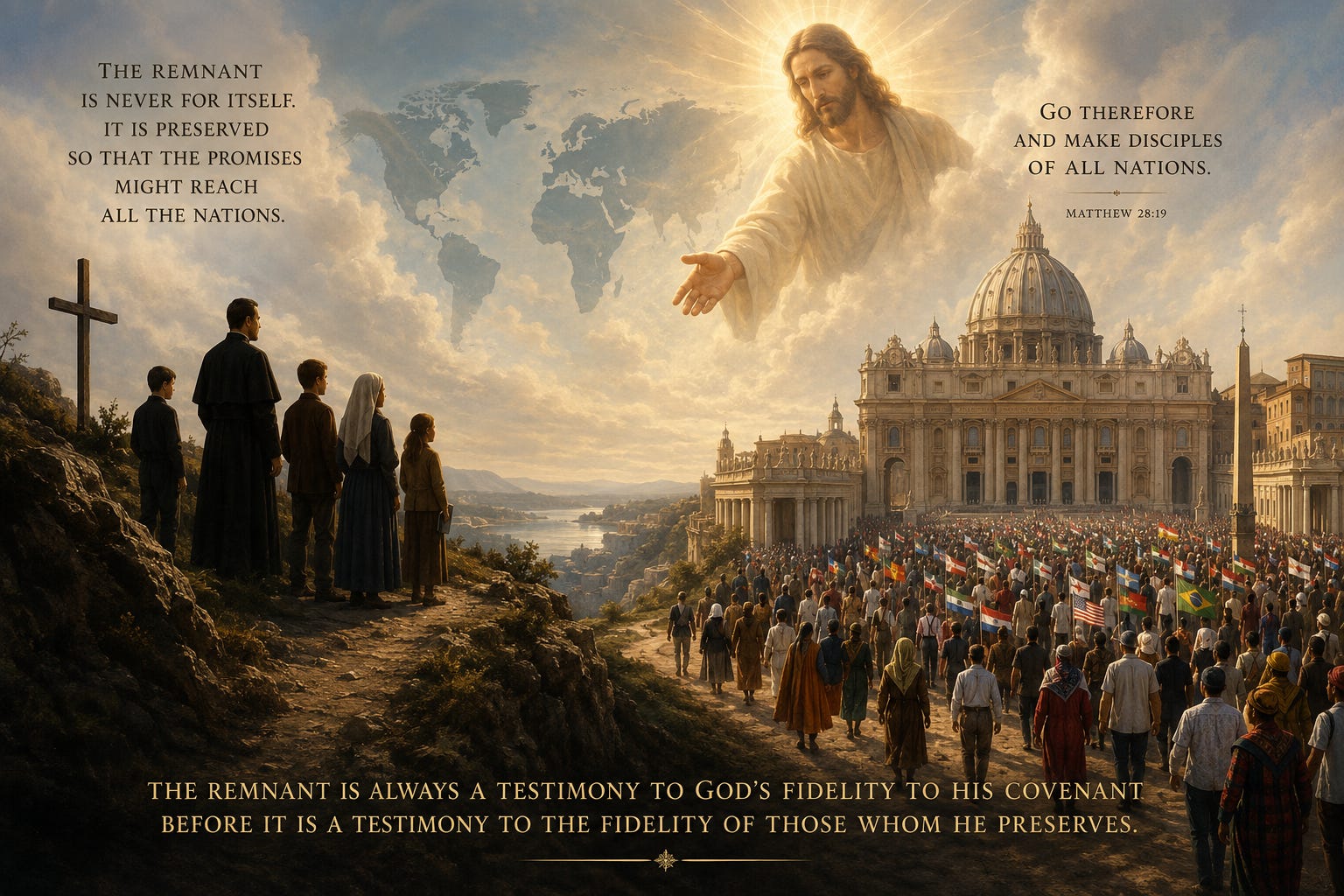
That is not to say that the present crisis is in any way imaginary. It would be intellectually dishonest to pretend otherwise. The collapse of Mass attendance across much of the Western world, the catastrophic decline in priestly and religious vocations, the widespread ignorance of even the most elementary truths of the Catholic faith, the moral scandals that have devastated confidence in the hierarchy, the liturgical experimentation that has often obscured the sacrificial nature of the Mass and the theological ambiguities that have characterised so much ecclesiastical discourse since the Second Vatican Council have left many Catholics ignoratnt of their faith and many who do know their faith bewildered and wounded. Those who seek refuge in communities where doctrine is taught clearly, where the liturgy is celebrated reverently and where the demands of the Gospel are proclaimed without embarrassment do not deserve either caricature or contempt. Their concerns are frequently real and often justified.
However a problem arises when the search for refuge becomes the search for identity. It is one thing to seek a haven during a storm, it is quite another to conclude that the storm has destroyed the ship itself and that only those gathered within one’s own lifeboat now constitute the true vessel of salvation. This is the distinction which lies at the heart of the contemporary debate over the faithful remnant.
The expression itself is profoundly biblical. Indeed, it would be impossible to understand the history of salvation without it. The story of God’s dealings with humanity is repeatedly the story of His preserving a faithful remnant through whom His promises are fulfilled. When the world descended into violence before the Flood, Noah and his family became that remnant through whom creation itself was renewed. When Elijah despaired that he alone remained faithful amidst Israel’s apostasy, God reminded him that He had preserved seven thousand who had not bent the knee to Baal. Isaiah repeatedly speaks of the remnant of Israel that will survive judgement and become the seed of restoration. Following the Babylonian Exile, it is the returning remnant that rebuilds Jerusalem and prepares the way for the coming of the Messiah. St Paul himself takes up this theme in his Epistle to the Romans, seeing within the believing Jews of his own day the fulfilment of Isaiah’s prophecy that “a remnant shall be saved.”
Nor does the rest of the New Testament abandon this language. Our Lord speaks of the “little flock” to whom the Father has chosen to give the Kingdom. He warns that the gate is narrow and the way hard that leads to life. He asks the haunting question: “When the Son of Man comes, will he find faith on earth?” The Book of Revelation depicts those who remain faithful amidst persecution as those who “keep the commandments of God and bear testimony to Jesus.”
The existence of a faithful remnant is therefore not a theological novelty but a permanent feature of biblical revelation, However there is a subtle distinction running through every one of these biblical examples that deserves closer attention: In Scripture, the remnant is always identified by God.
Noah did not declare himself the remnant. Elijah did not identify the seven thousand. Isaiah did not appoint the survivors of Israel. Even St Paul does not presume to define the boundaries of God’s remnant by his own authority. In every case, it is God who preserves, God who chooses, God who reveals and God who judges.
The remnant is therefore an object of divine election before it is an object of human recognition.
That distinction carries enormous ecclesiological significance. The remnant in Scripture never exists because it has judged itself superior to the rest of God’s people. Rather, it exists because God, in His providence, preserves His covenant despite the failures of His people. The remnant is never primarily evidence that a few men have remained faithful. It is evidence that God has remained faithful to His covenant when almost everyone else has forgotten it.
This is perhaps why Scripture consistently discourages any premature confidence in identifying who precisely constitutes that remnant. The prophets call Israel to repentance, not to self-congratulation. Christ warns His disciples to persevere, not to assume that they alone have understood the Father’s purposes. Even the Apostles, who knew they had been specially chosen by Christ, continually exhort the faithful to humility, vigilance and perseverance lest they themselves should fall.
The danger, then, is not in believing that God preserves a remnant. The danger lies in believing that we are competent to identify ourselves as that remnant in such a way that the category ceases to be God’s judgement and becomes our own. This temptation has accompanied the Church from her earliest centuries. Every age has believed itself to be living in extraordinary times. Every age has looked upon its own confusions and concluded that history had reached its decisive moment. The conviction that one’s own generation occupies the final chapter of salvation history possesses an almost irresistible attraction. It lends urgency to every controversy and apocalyptic significance to every crisis and it makes sense because our time is limited and the Church endures.
The first Christians themselves expected the imminent return of Christ. St Paul had to correct misunderstandings within the Church at Thessalonica concerning the Day of the Lord. Throughout the patristic era there were those convinced that the great apostasy had already begun. Medieval Europe repeatedly witnessed movements proclaiming the end of the age. The upheavals of the Reformation were interpreted by many as unmistakable signs of the Antichrist’s arrival. The French Revolution, with its open assault upon Christianity, appeared to countless Catholics to herald the final rebellion against God. The twentieth century, scarred by two world wars, totalitarian ideologies and unprecedented technological destruction, gave fresh plausibility to such expectations.
Yet Christ’s own words remain stubbornly resistant to every attempt to identify the timetable of Providence.
“Of that day and hour no one knows.”
These words are not merely a prohibition against date-setting, they are a profound theological warning against interpreting history as though we possessed God’s perspective upon it. Christians are commanded to discern the signs of the times, but they are never authorised to declare with certainty that they are living through the definitive fulfilment of every prophetic warning.
There is wisdom in this restraint. It protects the Church from the arrogance that mistakes contemporary events for the final chapter of God’s dealings with humanity. It reminds each generation that countless Christians before them have lived through crises which appeared no less decisive than their own.
One of the remarkable features of Church history is how often groups convinced that they represented the final faithful remnant gradually separated themselves from the visible life of the Church. The pattern is strikingly consistent. The crisis is judged unprecedented. The hierarchy is judged compromised. The majority of ordinary Catholics are judged to have capitulated. Fidelity becomes concentrated within an increasingly self-conscious minority. What began as a call to reform slowly becomes an alternative account of where the Church herself is to be found. This trajectory is not confined to one period or one movement. It has appeared in various forms throughout Christian history because it arises from a perennial temptation. Faced with genuine corruption within the Church, it becomes increasingly difficult to distinguish between preserving the Church and replacing her. It is precisely here that the biblical understanding of the remnant offers a necessary correction.
The remnant never exists because God has abandoned His people. It exists because He refuses to. Once you understand that important distinction, it changes everything.
The remnant is not God’s alternative to Israel, it is the means by which Israel herself is restored. Noah is preserved so that humanity may begin anew. Elijah’s seven thousand are preserved so that Israel’s covenant may endure. The exiles return so that Jerusalem may be rebuilt. Even the Apostles, the smallest of beginnings, are immediately commanded to preach the Gospel to every nation under heaven. The remnant is never an end in itself, it is always the seed from which God intends something larger to grow.
This observation leads naturally to a question that contemporary discussions of the faithful remnant do not always address with sufficient care: If the remnant exists only for itself, has it remained faithful to the biblical pattern at all? Or has it become something fundamentally different?
These are much more than merely historical questions, they strike at the heart of the Church’s understanding of herself, of her mission and of the abiding presence of the Holy Spirit within her. They invite us to ask not simply whether the Church is experiencing a profound crisis, but whether our interpretation of that crisis remains faithful to Christ’s own promises concerning His Body. It is to those promises and to the astonishing universality of the Gospel they proclaim, that we must now turn, contrasting the expansiveness of the Gospel and the living action of the Holy Spirit with the tendency of remnant ecclesiology to become defensive and static.
The New Testament introduces a development so profound that it is easy to overlook precisely because it has become so familiar to us. The Old Covenant was entrusted to one people, one nation, one Temple and one priesthood. Israel was chosen not because she was greater than the nations but because through her God intended to bless the nations. Election was always ordered towards universality, the remnant preserved throughout Israel’s turbulent history was never preserved for its own sake. It existed so that God’s promises to Abraham, that through his descendants all the families of the earth would be blessed, might finally come to fulfilment.
This is why everything in the ministry of Christ moves in the direction of expansion rather than contraction. The Kingdom begins with twelve Apostles but immediately reaches towards every tribe and nation. The barriers separating Jew and Gentile begin to fall. The Samaritan woman, the Roman centurion, Zacchaeus, Cornelius and the Ethiopian eunuch all become signs that God’s salvific plan is widening beyond anything Israel had imagined. Pentecost itself is an event of astonishing catholicity. The miracle is not that everyone suddenly speaks one language, but that each hears the Gospel proclaimed in his own tongue. Diversity is not abolished but gathered into unity.
This universal horizon reaches its fullest expression in the Great Commission. The Apostles are not instructed to preserve a small enclave of doctrinal purity until Christ returns. They are commanded to “make disciples of all nations”. The Church’s instinct, from her very birth, is centrifugal rather than centripetal. She is constantly moving outwards, carrying the Gospel into the world because the love of Christ impels her.
It is in this context that St Paul’s remarkable declaration must be understood: God “desires all men to be saved and to come to the knowledge of the truth.” The universality of God’s salvific will is not a peripheral doctrine but one of the great affirmations of the New Testament. Christ did not offer Himself merely for an elect few. He died for all. The Church exists because God refuses to abandon the human race to sin and death. Every sacrament, every missionary endeavour, every theological development and every act of pastoral charity participates in that universal desire.
This creates a tension which every authentic theology of the faithful remnant must resolve. How can the Church simultaneously affirm that the way is narrow and that God desires the salvation of all? How can Christ speak of a little flock while commanding that the Gospel be preached to every creature?
The answer given by Scripture is subtle but profoundly beautiful: the remnant exists for the many, it is never presented as God’s abandonment of the many. It is essential that we remember this distinction especially when some Christians begin to identify themselves with the remnant. There is always a danger that what Scripture presents as God’s instrument for the salvation of the world becomes, in human hands, the justification for withdrawal from the world. The missionary impulse gradually gives way to a defensive posture. Preservation begins to eclipse proclamation. The Church ceases to appear as the sacrament of salvation for humanity and instead becomes a sanctuary for those who have already recognised the truth.
It is difficult to read the New Testament without noticing how relentlessly Christ frustrates every attempt to narrow the scope of God’s mercy. Again and again He refuses the categories by which His contemporaries sought to define the boundaries of the Kingdom. He praises the faith of Gentiles. He eats with sinners. He tells parables in which the expected heirs of the Kingdom find themselves standing outside while those invited from the highways and hedgerows enter the wedding feast. None of this diminishes the seriousness of judgement, the Gospel never suggests that salvation is automatic or that repentance is unnecessary. But the movement is always outward, God’s grace constantly exceeds expectation.
This theological instinct has characterised the Church throughout her history. It is one of the reasons why authentic Catholic development has always been expansive. The Church does not invent new revelation, public revelation concluded with the death of the last Apostle. Yet she grows in her understanding of that revelation because she is not merely an institution preserving ancient documents but a living Body animated by the Holy Spirit.
It was this living quality of the Church that John Henry Newman explored with such brilliance in his Essay on the Development of Christian Doctrine. Newman recognised that Christianity presented an historical puzzle. The Church of the nineteenth century confessed doctrines and employed theological language that the Apostles themselves had never articulated in precisely those forms. The Nicene definition of the consubstantiality of the Son with the Father, the Chalcedonian definition of the two natures of Christ, the mature articulation of sacramental theology and the Marian dogmas all represented developments. Yet none of them constituted new revelation. Rather, they unfolded what had always been contained within the apostolic deposit of faith.
Newman’s great insight was that living ideas develop because they are alive. Corruptions and developments are not the same thing. A corruption alters the identity of a thing, a genuine development enables it to become more fully itself. As we often say on Catholic Unscripted, an acorn becomes an oak. It does not become a different species of tree.
This organic understanding of development has enormous implications for ecclesiology, it means that the Church’s life cannot simply be frozen at any particular moment in history, however venerable. Every generation receives the same apostolic faith, yet each generation must also deepen its understanding of that faith under the guidance of the Holy Spirit. It is essential then that we recognise that development is therefore not a concession to modernity but an expression of the Church’s vitality.
The liturgy itself bears eloquent witness to this truth. It is often forgotten, particularly in contemporary debates, that what is commonly called the Traditional Latin Mass is itself the fruit of centuries of organic growth. The Roman Rite did not descend complete from heaven. Nor did it emerge fully formed in the apostolic age. Its prayers, ceremonies, calendar and ceremonial developed gradually across more than a millennium. St Gregory the Great would have recognised much in the Missal of 1962, yet he would also have encountered elements unknown in his own day. Likewise, the Christians of the second century would have recognised the Eucharistic sacrifice but not every liturgical form through which that sacrifice later came to be expressed. Before the middle of the 20th Century, it was quite rare for catholics to receive Holy Communion during Mass.
Traditional Catholics rightly defend this liturgy because they recognise in it the accumulated wisdom of centuries. Yet that very fact demonstrates that they already believe in liturgical development. The question is not whether development is possible, the question is whether authentic development remains possible after the Second Vatican Council. This is where Pope Benedict XVI made one of his most important contributions to modern Catholic thought. His vision was neither that nothing had changed nor that everything had changed. He rejected both the hermeneutic of rupture and an antiquarian desire simply to return to an earlier moment in history. Instead he proposed what he famously called a hermeneutic of reform in continuity. The Church remains herself precisely because she is alive. Continuity does not exclude reform. Reform does not require rupture.
His Moto Proprio Summorum Pontificum reflected precisely this conviction. Benedict did not envisage two permanently competing liturgical worlds existing in mutual suspicion. He hoped that the older form of the Roman Rite would preserve those treasures of reverence, silence and sacrificial emphasis that had become obscured in many celebrations of the newer Missal. At the same time, he believed that the ordinary form possessed genuine riches, including a broader lectionary and certain pastoral developments, from which the older form might also benefit. I certainly think it could be argued that having readings in the vernacular is a valuable development, but my point is that Pope Benedict XVI’s vision was not static preservation but mutual enrichment.
Whether that vision was realistic is a question historians may continue to debate. After Pope Francis promulgated Traditiones Custodes, many decided that Pope Benedict’s vision was dead. Yet Benedict’s theological instinct remains profoundly significant. He truly believed in the Church’s supernatural dimension and thus that the Holy Spirit had not ceased guiding the Church in 1962. He believed that the same Spirit who had guided the Church through the development of the Roman Rite over fifteen centuries had not suddenly withdrawn His assistance after the Second Vatican Council.
This point deserves careful reflection because it exposes a question that lies beneath almost every contemporary dispute about tradition. Where, precisely, do we believe the Holy Spirit is acting?
Catholics rightly affirm that the Holy Spirit protects the Church from formally teaching error in matters of faith and morals under the conditions defined by the First Vatican Council. Yet His activity cannot reasonably be reduced to those comparatively rare moments. Christ promised not merely isolated interventions but His abiding presence. “I am with you always, even to the end of the age.” The Spirit is the soul of the Church, He sanctifies, purifies, corrects, renews and deepens her life continuously. The Church is not a museum whose treasures are merely guarded against decay. She is a living organism in whom divine life continues to circulate.
This observation introduces a question that deserves to be asked with both charity and seriousness. If one concludes (as the FSSPX does) that the Church’s ordinary life has remained in profound doctrinal confusion for more than sixty years, that her principal liturgical reform represents a rupture rather than an authentic development, that successive pontificates have largely failed in their fundamental task of strengthening the brethren, and that the ordinary structures of ecclesial governance have become unreliable custodians of the apostolic faith, what account remains of the Holy Spirit’s ordinary guidance of the Church?
The question is not whether grave mistakes have been made. History leaves no room for naïveté on that score. The Church has survived corrupt popes, weak bishops, disastrous pastoral decisions and periods of astonishing moral collapse many times before. The question is rather whether Christ’s promises permit us to conclude that the Spirit’s ordinary work has effectively migrated from the visible structures of the Church to those communities that stand in increasing tension with those structures.
It is at precisely this point that the contemporary discussion of the faithful remnant begins to move beyond questions of liturgy or canon law and enters the far deeper territory of ecclesiology itself.