


There are some conversations that feel less like interviews and more like encounters with a mind circling something it cannot quite name. I feel like our recent discussion with David Starkey was one of those conversations.
Starkey is not an easy man to categorise. For decades, he was one of Britain’s most recognisable historians: a Cambridge scholar, a formidable interpreter of the Tudor period and a ubiquitous presence on television and radio. He could be brilliant, caustic, theatrical. He relished argument. He seemed, at times, to embody the old English intellectual tradition in full voice. Then came his fall. After controversial remarks in 2020, he was effectively cast out of polite public life. Publishers withdrew. Institutions distanced themselves. The historian who once explained the English past to millions found himself treated as a relic to be buried. Has exile and the wisdom of years mellowed him?
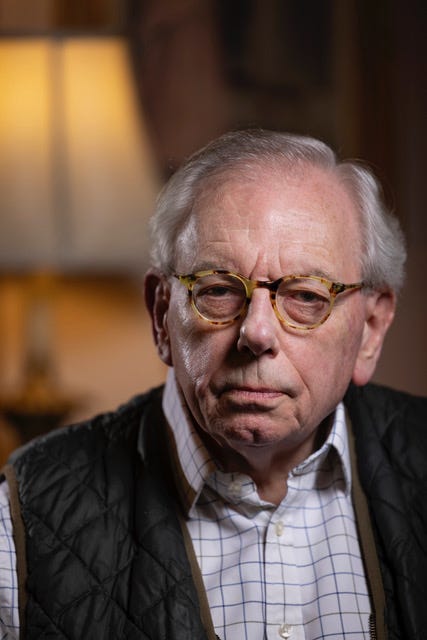
What we encountered was not simply the old Starkey, though the wit and bite remain, but a man who has, in some sense, turned his historical method on the present moment and found something deeply wrong. His central claim is this: Britain has not lost its history. It has been taught to repudiate it. Starkey began our interview with an observation that is almost disarmingly simple. Ordinary people have not stopped loving the past. They still visit museums. They restore churches. They volunteer in local history societies. They walk through ancient streets with quiet affection. The rupture, he argues, lies elsewhere. The governing class; political, legal, cultural, has undertaken what he describes as a deliberate act of historical amnesia. Not mere forgetfulness, but repudiation. The past is no longer something to inherit but something to apologise for.
His metaphor is striking: a kind of “national Alzheimer’s”, which, like all such conditions, produces dysfunction. A people that does not remember what it is cannot meaningfully govern itself. What makes a society is a shared understanding of moral norms and hard won rights. Here, something important happens. Without using theological language, Starkey begins to describe a reality that Catholics should recognise immediately because Catholicism is, among other things, a civilisation of memory, or as Chesterton put it, the democracy of the dead. “Do this in memory of me” is not only liturgical instruction. It is the pattern of continuity itself. The Church hands on what she has received. Tradition is not nostalgia. It is the condition of truth remaining alive in time. Starkey sees politically what Catholicism understands sacramentally and lives existentially: That society, when severed from its memory does not become freer. It becomes easier to remake.
From here his argument deepens. What has replaced this inherited order, he claims, is a new constitutional settlement that removes power from democratic life and relocates it in institutions that cannot easily be challenged: courts, quangos, international frameworks, “expert” bodies insulated from popular correction. Yes, elections remain but they no longer decide as much as people think, thus a strange phenomenon emerges: citizens feel that nothing changes, even when governments do.
At this point in the conversation, the language is political but the reality is moral, because what Starkey is describing is not merely institutional drift. It is a loss of subsidiarity, even if he does not use the word. Power has moved upward and outward. Responsibility has been detached from authority. The human scale of political life has been eroded and with it, something else disappears: trust. Our belief that we can hand our individual power to representative who will effect change and act in our best interests.
But it is when Starkey turns to globalism that the conversation becomes most revealing. He makes an arresting claim. Modern globalism, he suggests, is a secularised and disfigured form of Christianity: It borrows the language of universality, the idea that all distinctions ultimately dissolve, but detaches it from its theological source. It attempts, in effect, to build in politics what belongs properly to the order of grace. He reaches, instinctively, toward St Paul: the vision in which there is neither Jew nor Gentile, slave nor free. But then he makes the crucial observation. That vision belongs in Christ. Remove Christ and attempt to impose the same unity politically, and the result is not redemption but coercion.
This is where the conversation becomes something more than political commentary because Starkey has seen something real. The modern West still runs on Christian moral assumptions, dignity, equality, universal concern, but has severed them from their foundation. It wants the fruits without the root. It wants universal brotherhood without conversion. Universal dignity without creation. Universal rights without a lawgiver, and so the system begins to distort. What begins as compassion ends as control. What begins as liberation ends as regulation. What begins as unity ends as fragmentation. Starkey can see this clearly. But he cannot yet fully explain it.