


I do wonder if the echo chamber of the internet sometimes makes problems appear larger than they really are and there does seem to be a disproportionate number of sedevacantists/ SSPXers online arguing about the perceived depravity of the Church and the rectitude of their own subjective position (whatever that may be). These positions are often conflicting and based on false premises but I do get regular contact and I think the theology is worth tackling and discussing because there is a crisis, no one is denying that and perhaps these polemics will serve the Church in the long run.
What really saddens me is the division which has so obviously arisen. One lady in particular on X consistently messages me irrespective of what I am posting about to basically tell me I am going to hell if I don’t reject the Catholic Church — the insanity of this position is most unsettling!
I think there is a peculiar irony at the heart of the present crisis surrounding the Society of St Pius X in that much of the debate has been conducted as though Catholics are faced with a stark choice between two opposing visions of the papacy. On the one hand lies an exaggerated form of papal maximalism in which every papal decision is treated as though it carries something approaching divine certainty. On the other lies an increasingly common argument that the Pope’s jurisdiction ceases to bind whenever a sufficiently serious prudential disagreement arises. Neither position represents the Catholic tradition. Yet it is a reality that confidence in ecclesiastical governance has diminished over recent years and as a result, many Catholics have found themselves drifting from one error towards the other, often without recognising that they have done so.
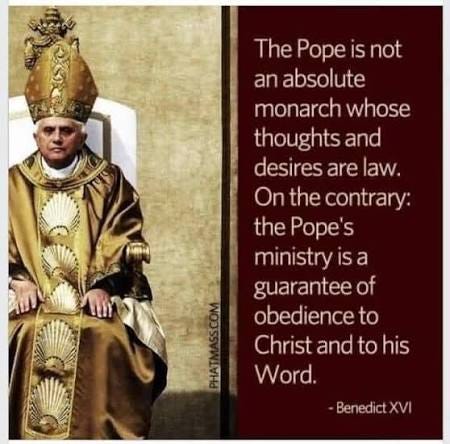
The controversy surrounding the recent episcopal consecrations carried out by the Society of St Pius X illustrates this danger with remarkable clarity. Defenders of the Society frequently begin by rehearsing a series of propositions with which every orthodox Catholic should readily agree. The Pope is not an absolute monarch. He cannot invent doctrine. He cannot contradict divine revelation. He cannot command sin. He is the servant of the deposit of faith rather than its master. Every one of these statements is true. Indeed, they are explicitly taught by the Church herself. Thus the difficulty lies not in these premises themselves but in the conclusion that is subsequently drawn from them. Having demonstrated that papal authority possesses limits, it is then asserted that Pope Leo XIV’s prohibition of episcopal consecrations without pontifical mandate must therefore fall outside those legitimate limits, however this is not an argument, it is a logical leap wherein the conclusion simply does not follow from the premise.
The Catholic tradition has never taught that because papal authority is limited, every individual Catholic acquires the competence to determine independently when those limits have been exceeded. On the contrary, the First Vatican Council simultaneously rejected papal absolutism and affirmed one of the strongest doctrines of papal jurisdiction in the history of the Church. Pastor Aeternus teaches that the Roman Pontiff possesses ordinary, supreme and immediate jurisdiction throughout the universal Church and that all the faithful owe him hierarchical subordination and true obedience not merely in matters concerning faith and morals but also in those which concern the discipline and government of the Church. That final clause is frequently overlooked but it is also decisive.
The appointment of bishops and the regulation of episcopal consecrations belong precisely to the government of the Church. They are not accidental administrative conveniences but essential expressions of the visible unity which Christ entrusted to Peter and his successors. Vatican II reaffirmed the same principle in Lumen Gentium, while the Code of Canon Law continues to recognise the Supreme Pontiff’s ordinary authority in precisely these matters. None of this transforms the Pope into an autocrat, it simply acknowledges that jurisdiction has real content. Authority that binds only when its subjects happen to agree with its prudence ceases to be authority in any meaningful way at all.
The distinction between potestas ordinis ("the power of orders") and potestas jurisdictionis ("the power of jurisdiction") is often invoked in these discussions, but frequently in a manner that undermines the very point it is intended to establish. Episcopal consecration undoubtedly belongs to the sacramental power of orders. Yet whether that sacramental power may be lawfully exercised within the communion of the Church belongs to jurisdiction. A bishop may validly consecrate another bishop, but the Church has always distinguished validity from legitimacy. The sacramental act cannot simply be detached from the juridical communion within which Christ established His Church. The visible constitution of the Church is not an unfortunate bureaucratic appendage to the Gospel but part of the divine economy itself.