


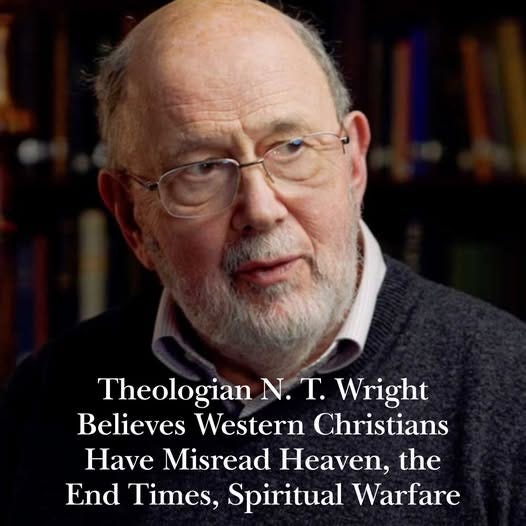
Few contemporary biblical scholars have done more than N.T. Wright to unsettle the thin, escapist Christianity that dominates much of the Western imagination. As an Anglican bishop and New Testament scholar, Wright has spent decades insisting that Christianity is not about souls fleeing the world but about God renewing it, about Heaven and Earth finally united under the reign of Christ. For many Protestants this has sounded revolutionary. For Catholics it simply sounds correct.
Wright’s critique is not aimed at historic Christianity as such but at a distorted catechesis, one that quietly replaced resurrection with evacuation, new creation with spiritual consolation, and eschatological hope with charts, timelines and fear. His recent reflections, developed in connection with his work on the Letter to the Ephesians, sharpen this challenge. Paul’s vision, Wright argues, is not of believers abandoning the world but of God’s purpose to unite all things in Christ, things in Heaven and things on Earth. The Church is not a waiting room for departure but the place where this uniting work is already meant to be visible.
At the heart of Wright’s argument is a claim that unsettles many Christians only because it is so often misunderstood. The goal of Christianity is not to go to Heaven when you die. That sentence, taken on its own, sounds provocative. Taken in its proper theological frame, it is simply orthodox. Heaven is real, necessary and glorious, but it is not the end of the story. The New Testament does not conclude with souls floating free of history but with God coming down to dwell with humanity. The final vision of Scripture is not escape but arrival, not abandonment of creation but its transfiguration.