


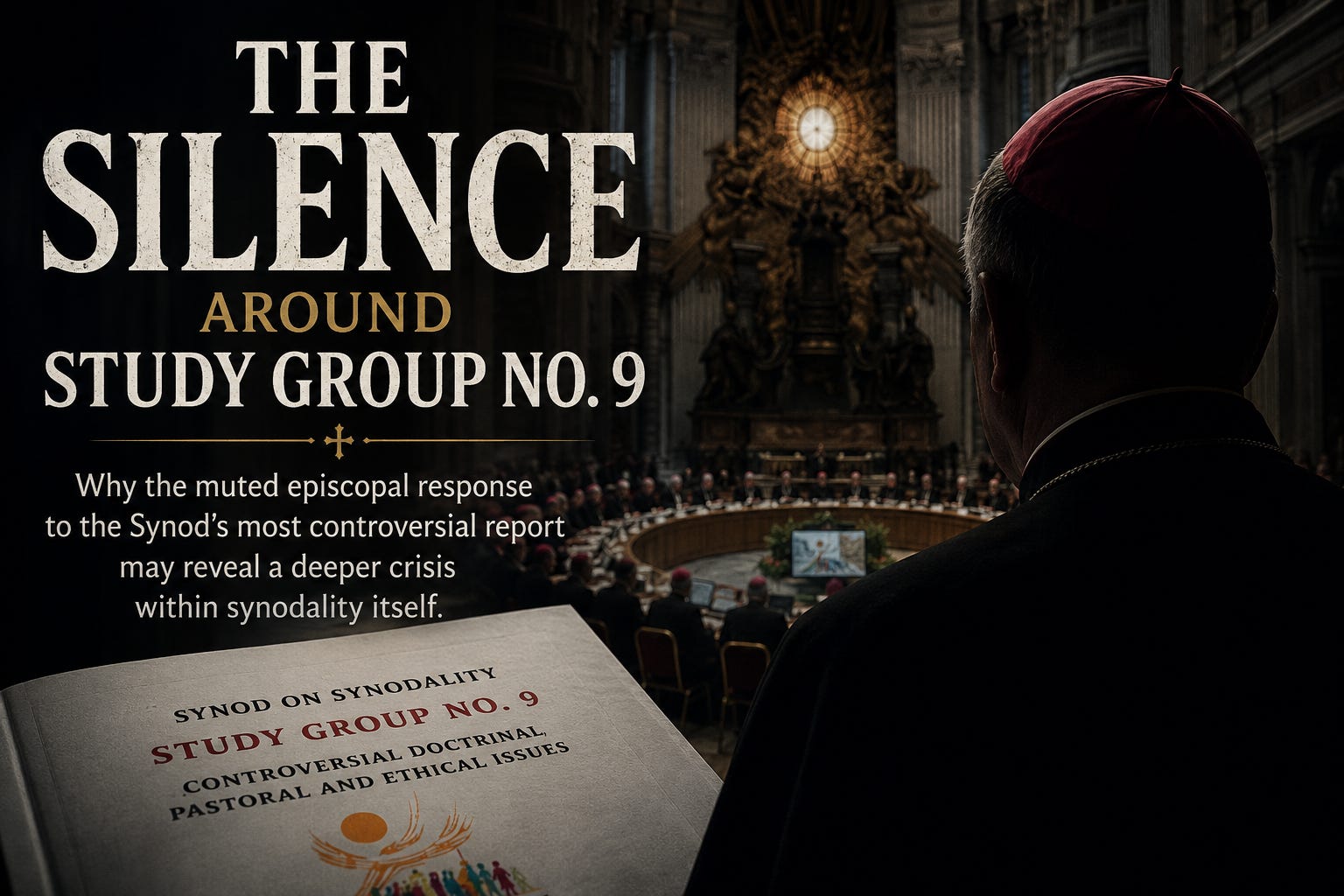
We are now beginning to see reactions from high profile bishops and cardinals to Synod Study Group No. 9’s controversial and deeply worrying report. Yet perhaps the most revealing aspect of the reaction may not be the criticism itself, but the silence.
In recent days, several prominent bishops and cardinals have voiced grave concerns regarding the report produced by the Synod’s Study Group on “controversial doctrinal, pastoral and ethical issues”. Cardinal Müller has warned of an implicit surrender to ideological currents fundamentally incompatible with Catholic anthropology. Bishop Schneider has described elements of the report in terms approaching theological alarm. Bishop Strickland has denounced it outright as an emergency within the Church. Bishop Eleganti has again raised concerns regarding the deeper ideological currents circulating within ecclesial life.
Yet perhaps more striking than these criticisms has been the remarkable absence of any broad episcopal defence.
One might have expected, given the significance of the report and the enormous publicity surrounding the Synodal process over recent years, a vigorous chorus of support from bishops’ conferences, diocesan structures, theologians attached to episcopal faculties, or senior pastors eager to explain the report’s orthodoxy and reassure the faithful. Instead, outside the Synod machinery itself and a relatively narrow circle of advocates, much of the episcopate appears cautious, hesitant, or entirely silent.
That silence is significant.
For over a decade now, a growing number of bishops from across the theological spectrum have expressed concern that the Synodal process risks evolving into something far more consequential than a pastoral consultation. Increasingly, the anxiety has centred not merely upon particular conclusions, but upon the methodology itself. The concern is that synodality, at least as presently practised, contains within its own procedural assumptions a continual pressure toward doctrinal adaptation, particularly in matters relating to sexuality, anthropology, authority and moral theology.
This is not merely the complaint of internet polemicists or fringe traditionalist circles. Some of the most intelligent and measured critiques have come from bishops who actually participated in the Synodal discussions themselves.
Archbishop Anthony Fisher of Sydney warned plainly that the Synod cannot “reinvent the Catholic faith”. Bishop Robert Barron offered a notably sharp critique of procedural ambiguity and ideological framing within the process. Archbishop Stanisław Gądecki questioned whether the Synod risked transmitting unbelief rather than belief. Archbishop John Wilson insisted that authentic synodality must remain rooted in revelation rather than adaptation to prevailing cultural pressures.
Long before the publication of Study Group No. 9, these bishops had already begun identifying what they perceived as a clear trajectory within the process itself.
The common line of reasoning running through these interventions is impossible to ignore. Though these bishops emerge from different nations, ecclesial cultures and theological sensibilities, they nevertheless converge upon the same underlying apprehension: that the Catholic faith they hold in common is being subtly and incrementally reshaped through the methodology of synodality itself. The deeper concern is not merely that particular doctrines may eventually be revised, but that revelation itself risks becoming subordinated to subjective experience. Classical Catholic theology understands human experience as something illuminated, corrected and redeemed by divine truth. Much contemporary synodal language, however, can appear to reverse this relationship, treating lived experience, psychological affirmation and communal discernment as interpretative lenses through which settled doctrine must continually be reconsidered. The fear, therefore, is that synodality risks becoming less a means of faithfully transmitting the deposit of faith and more a permanent process of theological destabilisation in which ambiguity, emotional framing and perpetual discernment quietly erode doctrinal clarity over time.
This helps explain why Study Group No. 9 has generated such intense reactions, and perhaps also why so many Catholics are now paying unusually close attention to documents which, in another era, might have passed almost entirely unnoticed. The report is not being interpreted in isolation. It is being read within the wider context of a process which many Catholics increasingly suspect has sought, from the beginning, to create momentum toward doctrinal revision without ever explicitly declaring such an intention.
Indeed, much of the frustration surrounding the Synod stems precisely from this perception of indirection. Rarely are doctrines directly denied. Instead, the language shifts subtly toward “listening”, “inclusion”, “pastoral accompaniment”, “new paradigms”, “discernment” and “lived experience”. The effect is cumulative rather than revolutionary. Yet over time, many faithful Catholics have come to suspect that the process itself has been designed to loosen doctrinal certainty indirectly by placing settled questions into a permanent atmosphere of pastoral reconsideration.
Whether that suspicion is entirely justified remains debated. But what can no longer seriously be denied is that a substantial number of bishops clearly perceive the danger. Critics increasingly discern within the synodal process the influence of theological and pastoral currents seeking gradually to reconfigure the Church’s relationship to questions long considered doctrinally settled.
