


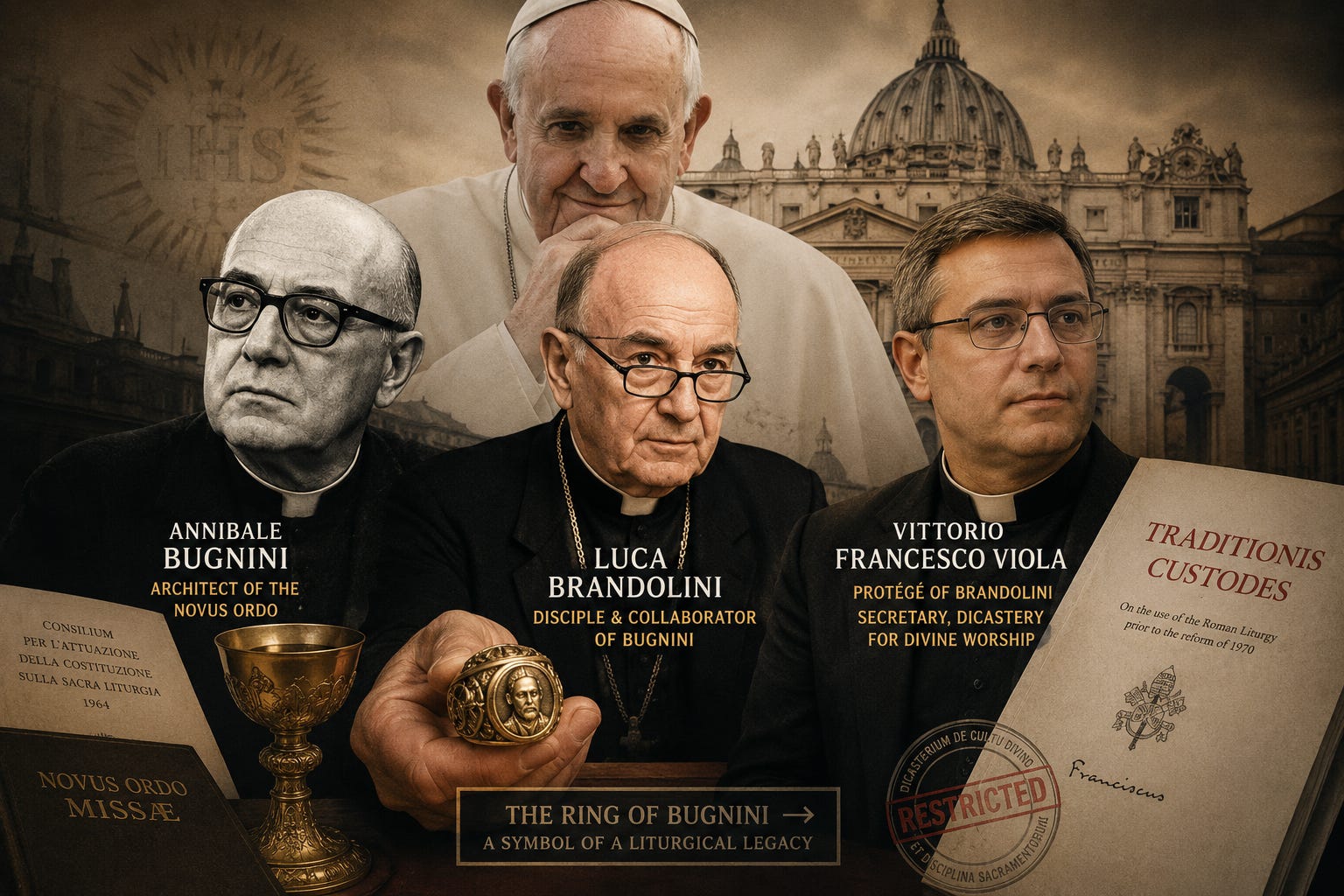
As I keep repeating I think the future of the Prefect for the Dicastery for Divine Worship will be highly informative for the future of the Leonine Papacy. For Catholics attached to the traditional liturgy, the prospect of Cardinal Arthur Roche remaining Prefect of the DDW would be devastating. Roche has become, perhaps more than any other figure in Rome, the public face of the restrictions imposed upon the Traditional Latin Mass under Pope Francis. His interpretation of Traditionis custodes has been relentlessly restrictive, his public comments about the older liturgy have frequently appeared dismissive of those attached to it, and his recent interview with The Tablet contained the extraordinary assertion that Pope Leo XIV is “not going to change Traditionis Custodes“ and is “not going back to Summorum Pontificum.”
He does not seem to be a suitably erudite person for this important role in the Church. Yet there is another possibility which I have been considering. What if the continuation of Roche at the head of the Dicastery would not represent the worst available outcome? What if, paradoxically, keeping Roche were preferable to the most obvious alternative?
That alternative has a name: Archbishop Vittorio Francesco Viola.
The question is particularly pertinent because the terms of the present leadership of the Dicastery are now in play. Under Article 17 of Praedicate Evangelium, prefects, secretaries and other senior Curial officials are appointed for five-year terms. Roche and Viola were appointed to their respective positions together on 27 May 2021. Their five years have therefore elapsed. This leaves Pope Leo with a decision which I still believe will be extremely revealing about his future direction but is perhaps even more complex and nuanced than it initially appears.
The obvious path of institutional succession would be to promote Viola. That is, after all, precisely how Roche himself became Prefect. Roche had been Bishop of Leeds from 2004 until 2012, while simultaneously occupying an influential position in the liturgical establishment as Chairman of the International Commission on English in the Liturgy, ICEL, from 2002. In that capacity he was intimately involved in the long and sometimes bruising process which produced the new English translation of the Roman Missal. In June 2012, Benedict XVI removed him from Leeds and appointed him Secretary of the Congregation for Divine Worship, simultaneously raising him to the rank of Archbishop. At the time there was persistent talk in English Catholic circles that the Roman appointment had the additional advantage of removing Roche from a diocese where his governance had become deeply unpopular and was widely regarded by his critics as unsuccessful. That allegation should not be confused with an established explanation for Benedict’s decision, but the reputation followed him nonetheless. What is certain is that Rome provided Roche with a remarkable change of trajectory: from a difficult episcopate in Yorkshire to the number-two position in the Vatican department responsible for the liturgy. Francis completed that ascent by promoting him to Prefect in 2021 and placing Vittorio Francesco Viola in precisely the position Roche had vacated. The institutional succession could hardly be clearer: Roche went from Secretary to Prefect, and Viola became Secretary. If Leo now follows the same pattern, Viola is the obvious man waiting in the wings.
Viola is also considerably younger. Born in October 1965, he is sixty years old. Roche, born in March 1950, is seventy-six. If Leo wanted to ensure the long-term continuation of the liturgical policy pursued under Francis, the appointment of Viola would therefore make a great deal of sense. It would install at the head of the Dicastery a professional liturgist with the potential to dominate its direction for years and this is precisely why the possibility ought to concern traditional Catholics.