


One of the reasons we choose to attend the Traditional Latin Mass is because we recognise that the liturgy forms us, even when it is not immediately intelligible. Day after day, week after week, year after year, that which is both invisible and visible, its words, gestures, silences, postures and prayers teach us who God is, who we are, and how the creature ought to stand before his Creator. And formation matters because human beings are not merely stuff.
We are, of course, made of stuff. We are born, we eat, we move, we grow and eventually we die. But this is true of all living things. Our cats and dogs are born, eat, move, grow and die. So does the tortoise. Even the terrifying house spider lurking in the corner has a life proper to its kind. There are things we share with other living creatures, but that does not make us the same as them. A dog is not a cat, a cat is not a tortoise, and none of them is a human being.
So what makes the human creature different from the dopey dog lying at my feet?

This is where the idea of form becomes useful.
Think of building a house. To get a house, you need stuff: bricks, timber, glass, tiles. You also need someone to do something with that stuff. But a builder does not simply move bricks and bits of wood around hopefully, like a chimp typing randomly on a keyboard (who will not eventually type the complete works of Shakespeare). The builder works according to a plan. And the plan itself depends upon what the house is intended to become.
If I want a three-storey brick house with a glass roof, the architect draws plans accordingly. The materials are selected, ordered and shaped towards that end. The stuff alone is not enough. And neither is the stuff of us.
We are not merely collections of cells to be fed, exercised, entertained and eventually buried. We have a nature, and we have an end. And throughout our lives our intellects, appetites, habits, imaginations and desires are being formed towards something.
The important point is that formation is unavoidable. Nobody gets to opt out.
We have something different to other creatures in that we can choose the things that form us. We have a will. We can choose our friends, our books, our habits, our food, what we worship, our music and our entertainment. But if we make no deliberate choices about our formation, that does not leave us unformed. It simply means that other people and other forces will do the forming for us. The world is quite happy to oblige.
The great English convert G. K. Chesterton is said to have remarked “When men choose not to believe in God, they do not thereafter believe in nothing, they then become capable of believing in anything”
We might likewise say that when men make no conscious decision to be formed by God, they will be formed by everything else around them.
There are those who believe that there is no intended end for the human person at all. We are, on this account, essentially accidental lumps of matter. But even the person who believes this cannot escape formation. He will still acquire habits. He will still learn what to admire and what to despise. His imagination will still be populated with images. His appetites will still be trained. His sense of what is normal, desirable, shameful, funny, beautiful or disgusting will still be shaped.
The only question is: by whom, and towards what?
The Christian has a very different starting point. The Christian believes that we were made deliberately, by a Creator who knows what we are because He made us, knows the end for which we were made: union with Him, and tells us how to get there (Jn 14:6)
If that is true, then surely the safest hands in which to place our formation are those of the One who knows both the material and the end. This is why the Church has always taken formation so seriously. It is why our prayers matter. Why our habits matter. Why beauty matters. Why the liturgy matters. Why what we repeatedly see, hear and do matters.
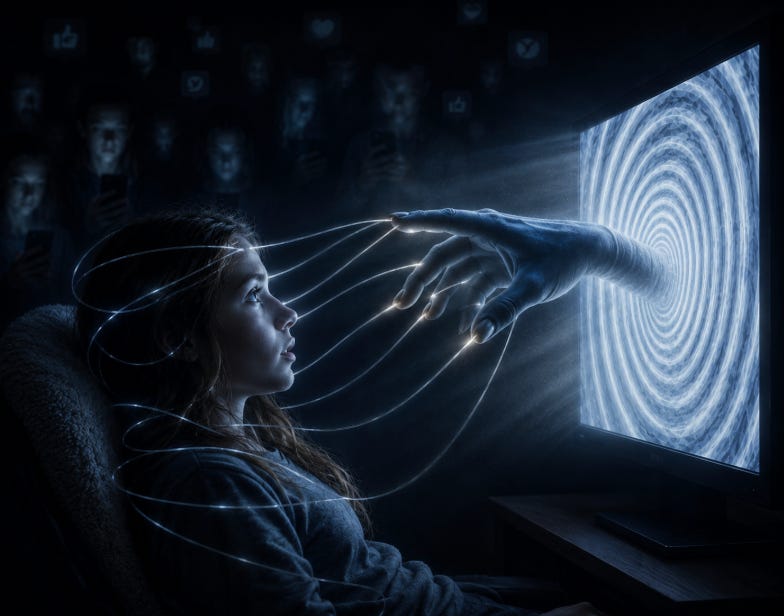
And this brings us to the screen.
Television and film are extraordinarily powerful instruments of formation, partly because they rarely announce themselves as such. We sit down believing that we are merely being entertained. But for an hour, or two hours, or perhaps several hours each day, someone else is supplying the images, telling the stories, creating the heroes, identifying the villains, deciding what is funny, presenting what is normal, and inviting us to sympathise with particular desires, choices and ways of life. There is always a mind behind the screen, and that mind is presenting some vision of man: of what he is, what he is for, what constitutes happiness, what love means, what sex means, what marriage means, what is good and what is evil.
Where that vision corresponds with reality (and ultimately with the mind of God) there may be much that is good, beautiful and worthwhile in what we watch. But where it does not, we should be extremely cautious.
We would be foolish to imagine that we are clever enough to recognise the message, or sufficiently Catholic to be unaffected by it. What happens when we repeatedly place our formation in the hands of people whose intention is to form us towards an end radically different from the one for which we were made?
Look around you.
There is a reason that many Catholics choose to homeschool and don’t own a television. If that puts them in Hillary Clinton’s basket of Deplorables, then so be it.

Another reason why we should take the screen particularly seriously is because a film does not approach us in quite the same way as a written argument. If somebody writes an article telling me that adultery is good, marriage is oppressive, motherhood is a waste of a woman’s potential and Christianity is ridiculous, I know what I am dealing with. The propositions are sitting there on the page. I can examine them, argue with them and reject them.
The screen works differently. It beckons us into a world; gives the beautiful music to one character and the sinister music to another. It decides whose suffering we see, whose motives we understand, whose jokes we laugh at and whose humiliation provides the punchline. It can make one way of life appear warm, courageous and attractive while another appears ridiculous, repressed or cruel, without ever making a single explicit argument for either.
That is part of the extraordinary power of the moving image.
Pope Pius XII understood this remarkably well. Writing about cinema in Miranda Prorsus 1957, he observed that dramatic action combined with moving images, voices and music reaches “not only the intelligence and other faculties, but the whole man”. He even recalled Pius XI’s description of cinemas as “schools”.
Schools.
It is worth dwelling on that word. When we watch something, we tend to think we are sitting down to be entertained, but the Church was warning us nearly seventy years ago that we were also sitting down to be taught. And the lessons do not necessarily arrive in the form of propositions, but through pictures and stories; the appetites through attraction and repulsion; our sympathies through the people with whom the storyteller teaches us to identify. Eventually we acquire instincts about what is normal, embarrassing, admirable, cruel, liberating, oppressive, beautiful or absurd.
We might be perfectly capable of articulating the correct Catholic teaching on marriage while having spent thirty years consuming stories in which marriage is almost invariably suffocating. We might intellectually believe that motherhood is a vocation while having absorbed a thousand images in which the successful woman is unencumbered by children. We might affirm the complementarity of the sexes on Sunday while spending the rest of the week laughing at stories in which fathers are idiots, husbands are lazy, women are perpetually constrained by men and liberation consists in escaping them.
This is why “But it’s only a film” is not a sufficient response. Whether we know it or not, we do more than spectate. We are swept into participation and media itself becomes a kind of liturgy. So instead of being called into THE story, not simply to read the word but to live the word, consume the word and let the word form us, we are called to participate in some other man manufactured story, asked to sing along to the lyrics he provides, buy the merch he has prepared, become like the character he has created, do the things he does.
This is why the liturgy we choose matters.
The French philosopher Jean Baudrillard, coming from a very different intellectual tradition, was also fascinated by the power of images in modern society. His concern was that a culture saturated with images and representations could eventually lose its grip upon the distinction between representation and reality itself. The screen does not simply show reality; increasingly, it supplies the categories through which reality is interpreted.
What repeatedly enters the imagination does not remain neatly sealed off from the intellect, appetites and will. We learn to love certain things, fear certain things, laugh at certain things and sympathise with certain things. Long before we sit down to formulate a proposition about marriage, sex, authority, masculinity, femininity or family, we may already have absorbed a thousand stories telling us how we are supposed to feel about them.
