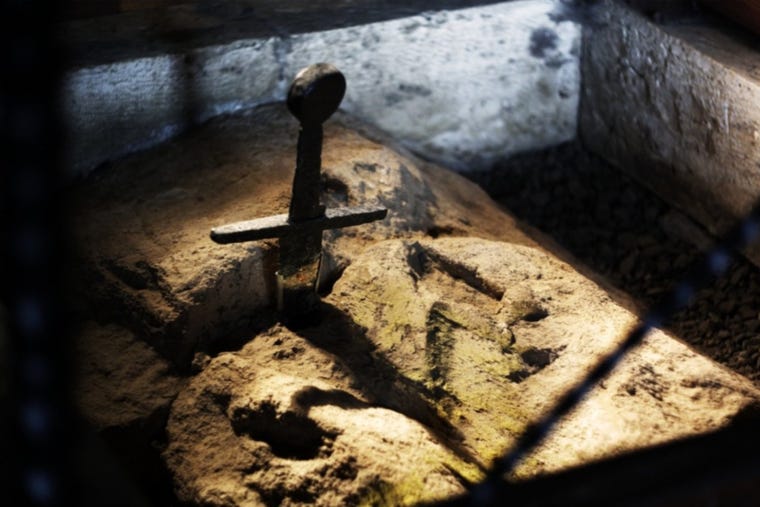
A sceptic replied to my recent post about St Galgano’s sword with a line many modern people would find perfectly sensible: “There are no miracles — only ordinary things sufficiently misunderstood.” It is a neat sentence. It sounds wise and flatters our modern secular age. But it also smuggles in a huge assumption: that every alleged miracle is, by definition, either fraud, ignorance, exaggeration, or emotional projection.
That assumption is easy to make if all miracle stories are treated as folklore. It becomes harder to sustain when a claim is old, public, materially enduring, and bound up with records that can actually be examined. It becomes harder still when the claim is subjected not merely to pious retelling but to medical scrutiny, documentary testing, and decades of hostile questioning. That is why it is worth beginning with St Galgano’s sword, and then moving to Lourdes, where the modern world has thrown every analytical tool it can at alleged miracles and still found cases that resist reduction.
St Galgano: more than a charming medieval legend
Galgano Guidotti was a real 12th-century Tuscan nobleman and knight, traditionally dated to 1148–1181, whose life was important enough that a papal canonization inquest was opened in 1185, only a few years after his death. Historians of canonisation regularly note his case as the earliest or among the earliest examples of the more formal papal investigative process that would later become standard. That matters, because it means we are not dealing with a saint invented centuries later out of mist and rumor. We are dealing with a figure who appears close to his own time, under investigation by ecclesiastical authority, with early biographical traditions and an enduring local cult.
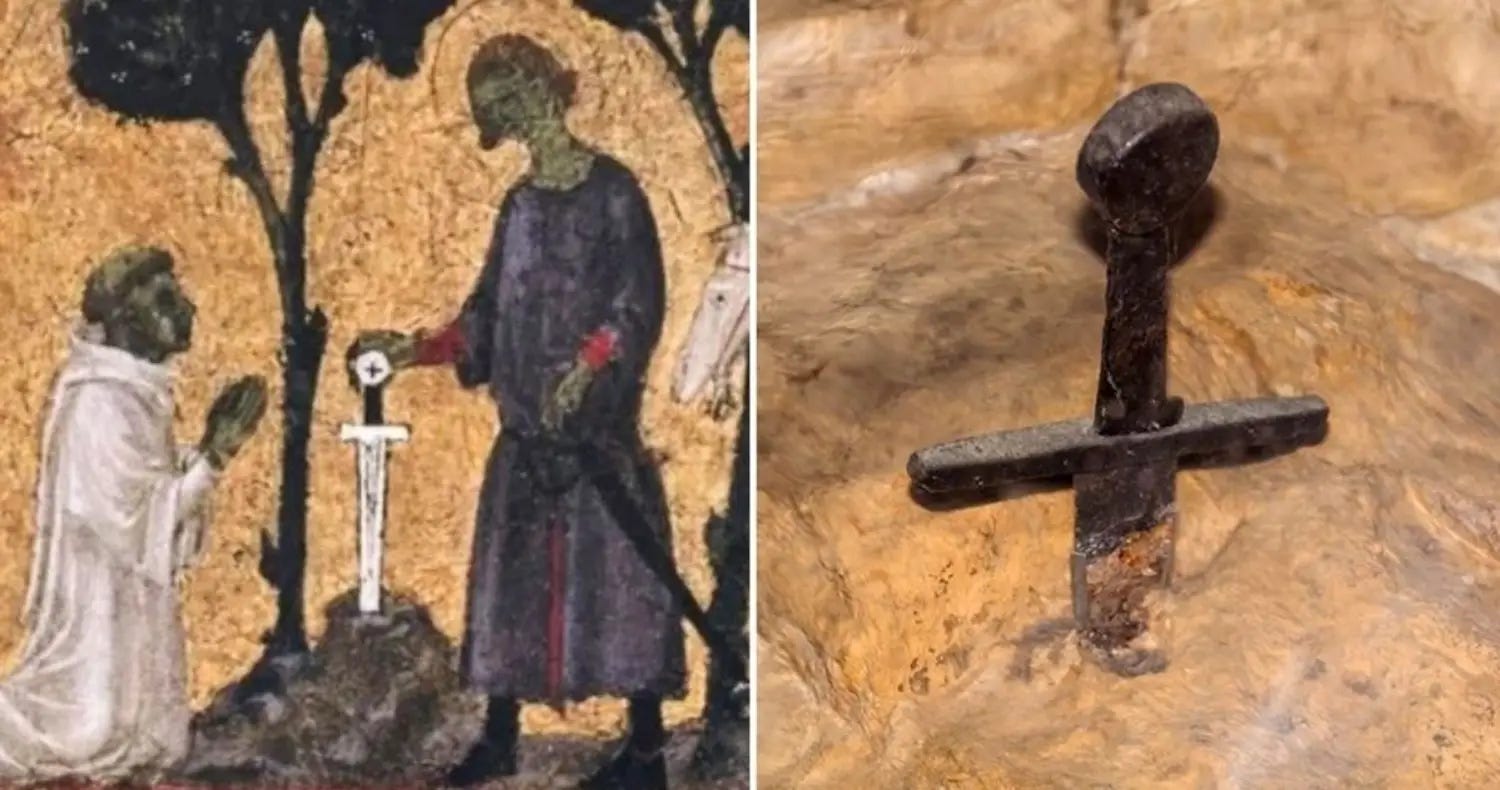
The basic outline of the story is well known. Galgano, once a worldly knight, underwent a profound conversion, embraced the eremitical life, and in a dramatic gesture of renunciation thrust his sword into rock at Montesiepi, turning the weapon of violence into a sign like a cross. The important point for a sceptic is not that every detail of the medieval narrative can be proven in the modern sense. The important point is that the sword itself is real, it is still at Montesiepi, and the association between the relic and Galgano is not a late tourist invention but part of the site’s ancient devotional history. Medieval art at the site and in surrounding collections depicts Galgano with the sword in the rock, showing that the tradition was established very early.
That is already more than “just a made-up story.” A made-up story does not usually leave behind a physical object venerated continuously in the place tied to the original account, embedded in a network of early local memory, liturgy, art, pilgrimage, and canonisation materials.

What the evidence does, and does not, prove
This is where Christians should be careful, because sceptics are right to distrust overstatement.
What can reasonably be said is this. Research discussed in scholarly and journalistic treatments of the sword reports that its metallurgy and form are consistent with a 12th-century weapon, not with a modern fake. The archaeological literature on the site also notes investigations linked to Luigi Garlaschelli’s 2001 work and points to ground-penetrating radar that suggested a structure or cavity beneath the area of the sword. In other words, serious examination did not debunk the relic as a recent fabrication.
What cannot be proven by laboratory analysis is the precise miraculous mechanism of the event. Science can say that the sword appears genuinely old. It can say the object fits the medieval period. It can say the tradition is early. It cannot replay the moment Galgano struck the rock. And that is exactly the sort of point a sceptic will seize upon.
Fair enough. But notice what follows. The honest Catholic claim need not be: “We have experimentally reproduced the miracle.” The claim can be more modest and still very powerful: there is enough historical and material substance here that the story cannot be dismissed with a smirk. The burden shifts. The sceptic is no longer confronting a bedtime tale. He is confronting a convergence of relic, site, memory, chronology, art, and investigation.
The sceptic’s best questions about Galgano
A serious unbeliever might ask several reasonable questions.
First, could the sword have been planted later to dramatize the saint’s conversion? That is a fair question. But the early artistic depictions and the longstanding cultic association make a very late fabrication much less plausible. The story is not first attested in a romantic novel centuries afterward; it is woven into the early memory of the place.
Second, even if the sword is medieval, could it simply have been inserted into a crack or prepared stone by ordinary means? In principle, perhaps. But that objection no longer eliminates the strangeness of the tradition; it merely proposes an alternative mechanism without direct evidence. It becomes a possibility, not an explanation demonstrated. The sceptic is entitled to that possibility. He is not entitled to present it as settled fact.
Third, does this prove a miracle? Not in the way a mathematical theorem proves itself. Miracles are not the sort of things that can be placed under repeatable experimental control. But Christianity has never claimed that every miracle must function like a chemistry experiment. A miracle is a sign in history. Signs are weighed by context, witnesses, effects, credibility, and fit with the larger economy of God’s action. Galgano’s story is persuasive not because it compels assent on its own, but because it refuses to vanish under scrutiny.
In that sense, Galgano is a threshold case. He is useful precisely because he forces the sceptic to move from lazy dismissal to harder questions.
But Lourdes is where the modern world runs out of easy answers
If Galgano gives us a medieval case with real historical substance, Lourdes takes us into a completely different register. Here the question is no longer whether a tradition is ancient, but whether the modern age, armed with medicine, documentation, sceptical habits, committees, and long follow-up periods, can reduce all alleged miracles to misunderstanding.
The answer, plainly, is no.