


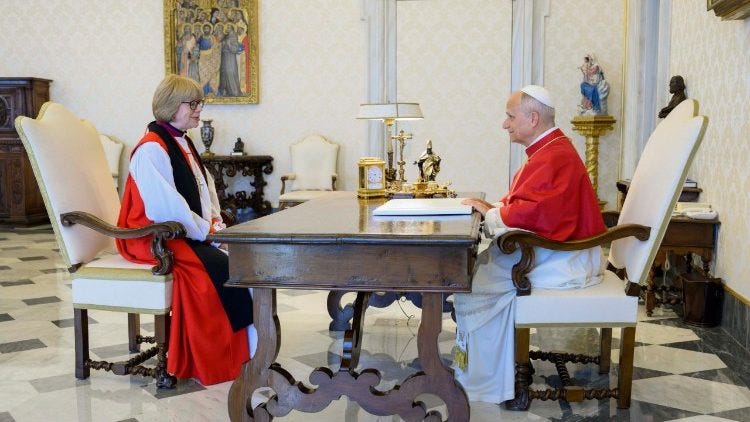
Today’s meeting between Pope Leo XIV and Sarah Mullally has been presented, in the official reporting, as an expression of “dialogue in truth and love.” It is a carefully chosen phrase, one that situates the encounter within the theological framework established by the Second Vatican Council and articulated most clearly in Unitatis Redintegratio. The language is not incidental. It is meant to signal that what is taking place is not mere diplomacy, but a participation in the Church’s understanding of ecumenism as a movement towards unity grounded in truth.
Yet it is precisely here that the difficulty emerges. For unity, in the Catholic understanding, is not a matter of sentiment or shared aspiration. It is theological before it is relational. It is rooted in the truth of the faith as received and handed on, and it is expressed visibly in sacramental communion. Any claim to unity that brackets or obscures that truth risks becoming something else, a form of concord that lacks substance.
The Church has not been silent about what belongs to that truth. In Ordinatio Sacerdotalis, Pope St. John Paul II declared that the Church has no authority whatsoever to confer priestly ordination on women. This is not presented as a provisional judgement or a disciplinary preference, but as a definitive teaching to be held by all the faithful. It rests on the Church’s understanding of apostolic tradition and the nature of the priesthood itself. It is, in other words, not open to revision.
That teaching must be read alongside the earlier and equally definitive judgement of Apostolicae curae, in which the last Leo, Pope Leo XIII, declared Anglican orders to be “absolutely null and utterly void.” The reasoning was precise and theological. The Edwardine Ordinal was found to have altered the form of ordination in such a way that it no longer signified the sacrificial priesthood, while the intention expressed in the rite was judged to be incompatible with the Catholic understanding of the priesthood as ordered to the offering of the Eucharistic sacrifice. The consequence of this rupture in form and intention was the loss of apostolic succession, such that subsequent ordinations could not restore what had been broken.
These judgements establish the parameters within which any Catholic engagement with Anglicanism must take place. They are not historical curiosities. They define, in the Church’s own understanding, the reality of the situation. If Anglican orders are null, then the question of who is ordained within that communion, whether male or female, is not simply irregular but situated outside the sacramental structure that the Catholic Church recognises as constitutive of the Church itself.