


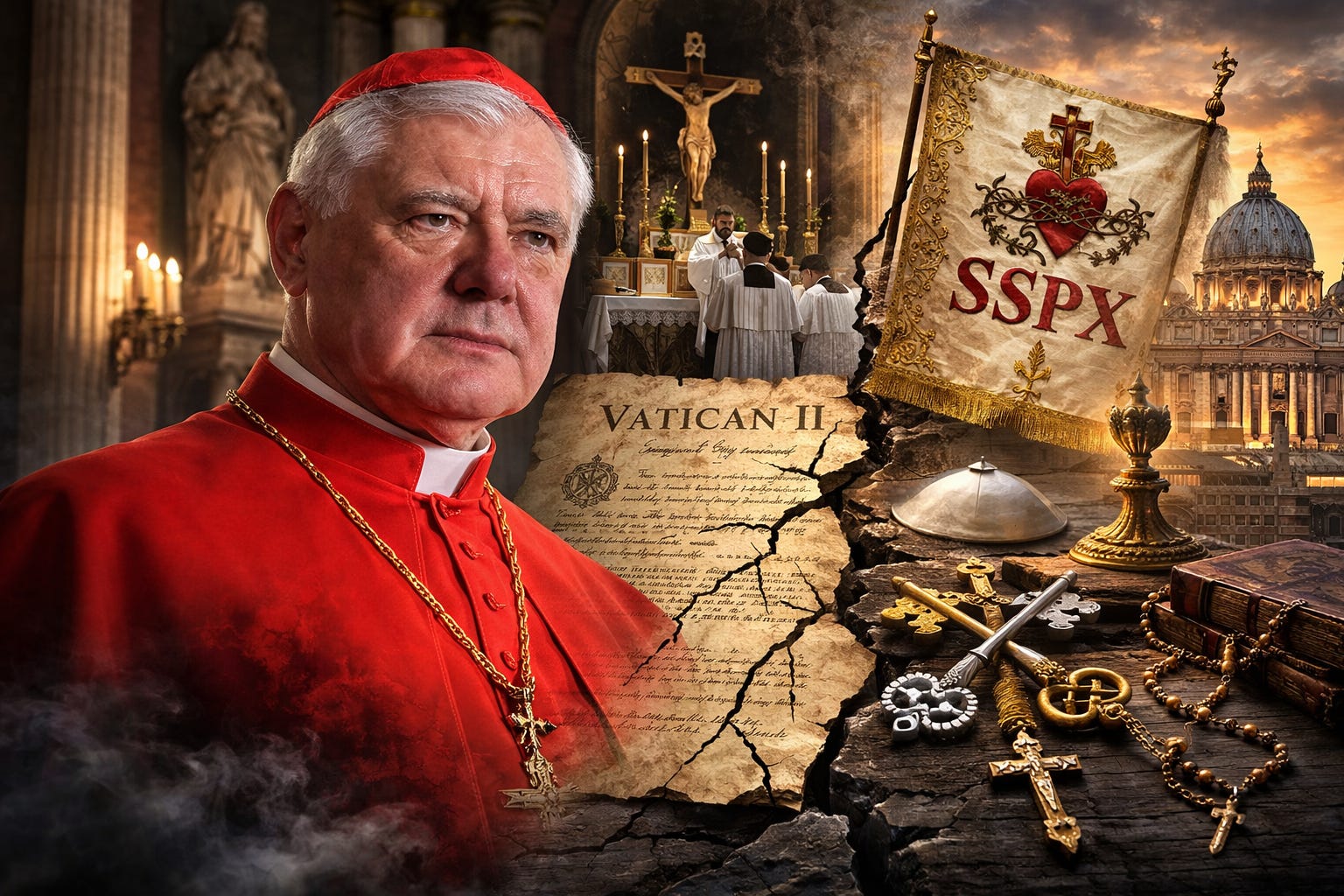
Cardinal Gerhard Ludwig Müller is not a man easily dismissed by traditional Catholics. As former Prefect of the Congregation for the Doctrine of the Faith, appointed by Benedict XVI and formed in the theological school of continuity, he has never been a cheerleader for doctrinal ambiguity. He has publicly questioned the theological coherence of Fiducia Supplicans, insisted that Amoris Laetitia must be read in strict continuity with prior moral teaching and rejected any suggestion that Catholic doctrine can bend to modern cultural pressure. For that reason alone, when he addresses the Society of Saint Pius X and its unity with the Church, his words deserve careful and serious attention.
He has just published an intervention on the German-language Catholic news portal Kath.net regarding the SSPX. In it, Cardinal Müller places the issue where, in his view, it properly belongs. I am relieved to say, based on my arguments to date, Müller is clear that the question is not first about liturgical preference, nor about sociological decline, nor even about post conciliar confusion. It is about ecclesiology. What does it mean to be Catholic in full communion with the Church? His answer is direct and unambiguous. Unity with the Roman Pontiff is not an optional ornament of Catholic life but a constitutive element of the Church’s visible structure. A body that separates itself from the principle of unity cannot claim to embody that unity.
I think the pivotal passage in his argument is striking in its clarity. He writes that there is no doubt that the Society of Saint Pius X agrees with the Catholic faith in substance, apart from the Second Vatican Council, which it erroneously interprets as a departure from tradition. And if it does not recognise the Second Vatican Council in whole or in part, it contradicts itself, since it rightly states that the Second Vatican Council did not present a new doctrine in the form of a defined dogma for all Catholics to believe. The force of this claim lies in its internal logic. If Vatican II did not define new dogma and did not promulgate a new faith, then to reject it as a rupture in substance appears incoherent. If it is not doctrinally novel, then refusal of assent cannot be justified on the grounds of preserving orthodoxy.
Müller’s thesis rests upon the hermeneutic of continuity so strongly articulated by Benedict XVI. An ecumenical council, even when primarily pastoral in intention, belongs to the living magisterium of the Church. It does not create a new Church. It stands within the organic development of doctrine. Therefore it cannot be selectively accepted as though it were a theological opinion offered for debate. Religious submission of intellect and will is owed to the authentic magisterium, even when it is not exercising the charism of infallibility in a definitive manner.
From this perspective, the inconsistency in the SSPX position becomes evident. On the one hand the Society insists that it does not reject Vatican II as such. On the other hand it frequently treats key conciliar teachings on religious liberty, ecumenism and collegiality as doctrinal deviations requiring correction. Müller argues that such a stance undermines ecclesial unity. If the Council is truly part of the Church’s authentic magisterium, then persistent structural resistance to it becomes not merely a theological dispute but an ecclesiological rupture.
Yet here the deeper question emerges.