


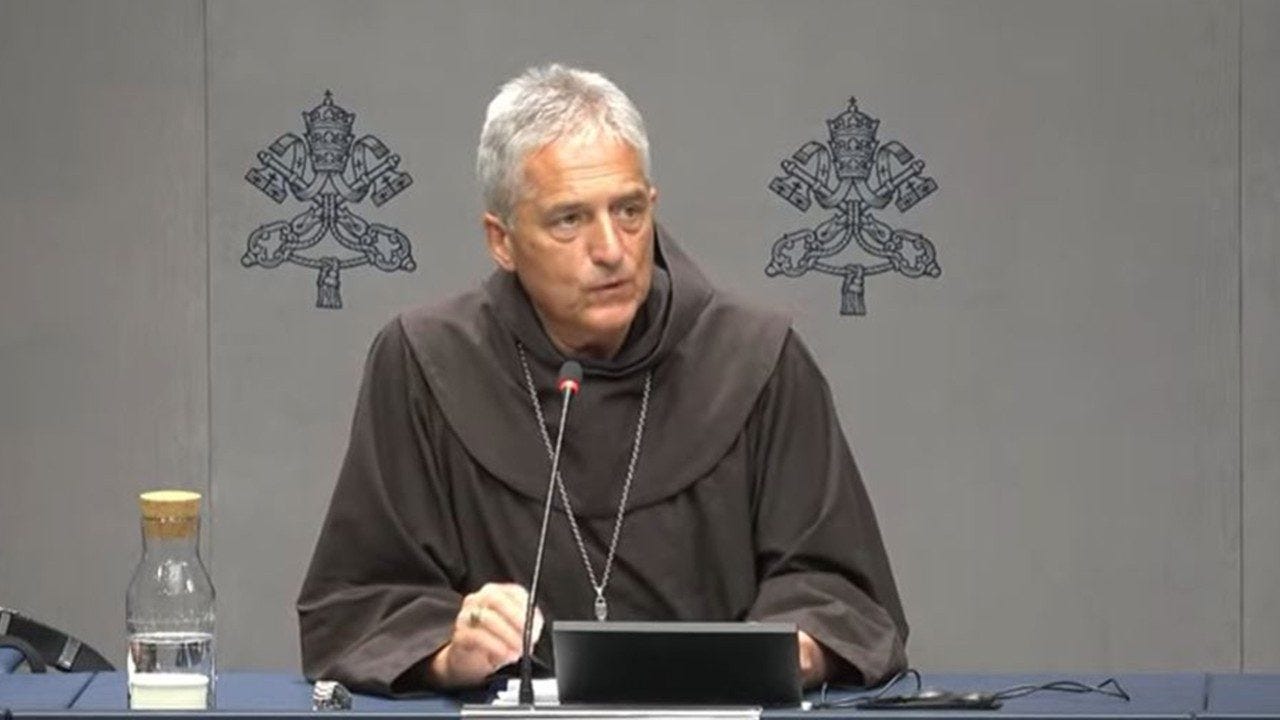
Pope Leo XIV’s decision to appoint Archbishop Vittorio Francesco Viola as Archpriest of St Peter’s Basilica will understandably unsettle Catholics attached to the traditional Roman liturgy. A prelate closely associated with the restrictions of the Francis pontificate now assumes responsibility for the basilica to which those Catholics make pilgrimage precisely to express their communion with Peter. His departure from Divine Worship creates an opportunity for change, but his arrival at St Peter’s offers little immediate reassurance.
The appointment, announced on 10 October, places Viola in the three offices previously held by Cardinal Mauro Gambetti: Archpriest of St Peter’s, Vicar General for Vatican City and President of the Fabric of St Peter. Bishop Aurelio García Macías, previously undersecretary of the Dicastery for Divine Worship and the Discipline of the Sacraments, succeeds him as secretary. These are substantial responsibilities, and Viola’s transfer cannot plausibly be described as his disappearance into institutional obscurity.
To understand the concern, however, we need to distinguish the record from the rhetoric surrounding it. Viola’s reputation does not rest entirely on hostile descriptions in traditionalist publications. There is documentary evidence of a restrictive approach, and the most revealing example is his correspondence with Archbishop Peter Comensoli concerning the traditional Mass in Melbourne. In a letter dated 18 April 2024, signed by Viola, the dicastery permitted celebrations according to the 1962 Missal in two parish churches for a further two years, while refusing permission for St Patrick’s Cathedral. Its reasoning was significant: the cathedral should exemplify the liturgical life of the diocese, and the older liturgy was considered inappropriate there. Future requests were to include information about attendance and the steps taken to lead these congregations towards the reformed liturgy.
This was an approach in which permission for the older rite was accompanied by an expectation that its adherents should eventually move away from it. For Catholics who regard their attachment as a legitimate expression of Catholic faith, rather than a temporary difficulty requiring correction, that is deeply problematic. It also explains why Viola’s appointment to another exceptionally important basilica will provoke anxiety: his previous decisions give them concrete reasons to question whether their worship will receive a sympathetic hearing.
His reported involvement in developing restrictive policy also deserves attention. The Pillar has identified Viola as one of the principal drafters of Traditionis custodes, while its reporting this April attributed to a senior Vatican official the assessment that he had played a substantial role in drafting the document and in subsequent proposals for further restrictions. That gives the concern a basis beyond polemical characterisations, although the internal drafting process has not been publicly documented in full.
Separately, Diane Montagna reported in June 2024 that a further restrictive document had been presented to Pope Francis, with Viola centrally involved in its preparation and supervision. Her account relied on unnamed sources and must be reported as such. It supports the assessment that Viola was an influential advocate of tightening restrictions; it does not permit us to reconstruct every private conversation or establish why the proposed text was never promulgated.
Responsibility nevertheless cannot be displaced entirely onto an influential official. Pope Francis appointed Viola secretary of Divine Worship on 27 May 2021, alongside Cardinal Arthur Roche’s appointment as prefect, shortly before Traditionis custodes appeared. Viola exercised authority within a leadership structure Francis had chosen. Even if he was a principal instigator or drafter, the policy promulgated by Francis remained Francis’s policy. Equally, today’s appointment belongs to Leo: an inherited official has now been entrusted with new responsibilities by the reigning Pope.
The immediate context at St Peter’s makes that decision particularly sensitive.
