


Ten years ago, Jordan Peterson exploded into a culture increasingly aware of what a massive failure the post war liberal project was. He spoke of meaning and myth, story and people, he travelled across continents and into various podcast studios, all while eating only meat. He had certianly hit on something. Since then an extraordinary amount of time has been spent both on and offline discussing how to save Western civilisation. Conferences were convened, political movements established, economic theories advanced and speeches delivered about restoring prosperity, rebuilding communities and recovering the values upon which our nations were founded. Donald Trump and JD Vance speak of Making America Great (Again), while organisations such as the Alliance for Responsible Citizenship with whom Peterson is associated, bring together thinkers and public figures to consider how the West might recover its confidence and purpose. Much of what is discussed is important, but listening to Pope Leo XIV’s extraordinarily beautiful homily in Uruguay (delivered 18 years to the day since I gave birth) I was struck by something which ought to be obvious, yet is all too often absent from our grand conversations about civilisational renewal. We cannot rebuild a Christian civilisation without rebuilding Christian families, and we cannot rebuild Christian families if we are commited to the sterile promises of the devil who tempts us to believe that there are a host of things that need fixing before we have babies.
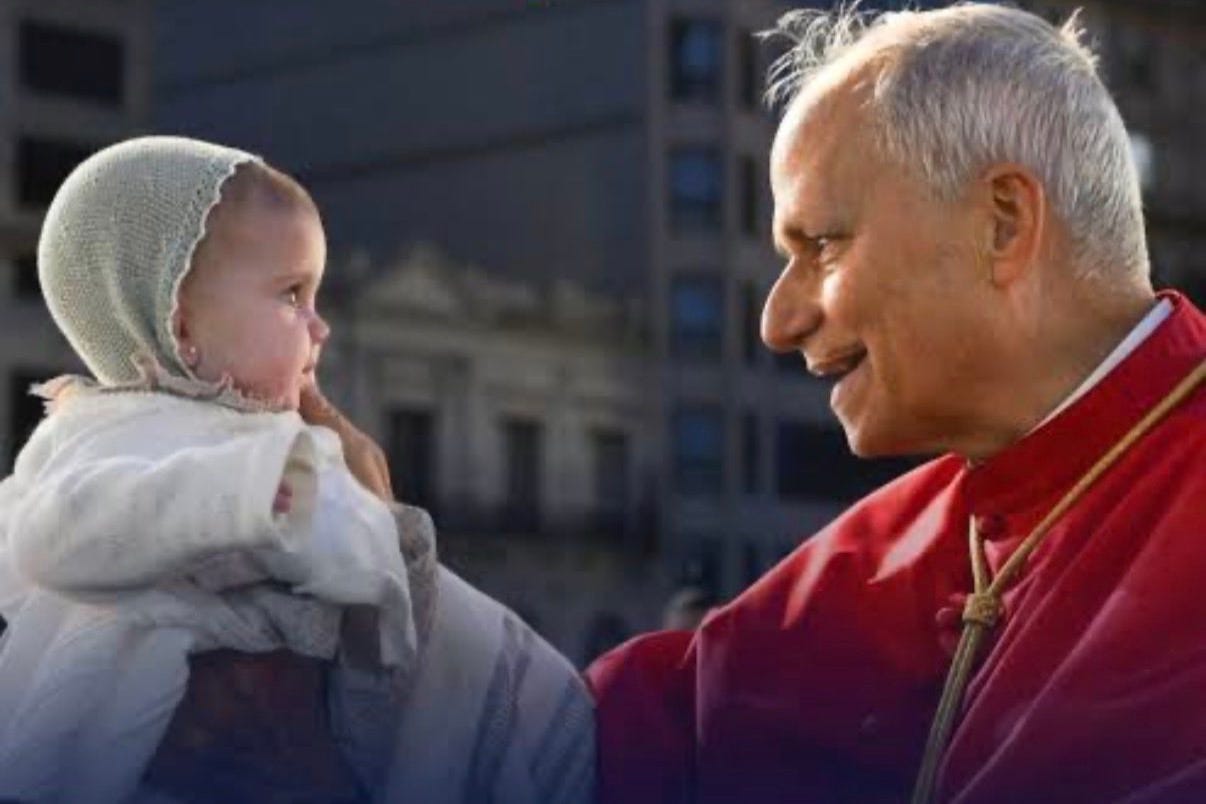
Pope Leo, the 267th successor of St Peter, visible head of Christ’s Church on earth, spoke not about economic growth, immigration, productivity or political reform, but about mothers and fathers, grandmothers and grandfathers, family devotions, the sacrifices made without recognition, and the faith handed down through generations. He spoke of the women who had kept open a path to God when others had abandoned it, and of the men who modelled what it meant to be a husband and father; suffering, sacrificing and kneeling before their Creator. He reminded us that the transmission of the faith is not the work of governments, institutions or clever programmes, but of ordinary men and women living extraordinary fidelity in the most ordinary circumstances.
I couldn’t help but think of my own mother, an Irish Catholic who had inherited the faith of her fathers. She lived to see the culture which had formed her turn increasingly hostile towards the Church she loved. Ireland, once so thoroughly Catholic that the faith was woven into the very fabric of life, underwent a transformation which was not merely secular but, bitterly antagonistic towards its religious inheritance. Beliefs once regarded as sacred became objects of ridicule, and fidelity to the Church was increasingly treated as something embarrassing, even shameful. My mother watched this happen. She watched people fall away, her own brothers and sisters abandoning the Church and jumping aboard the bad ship progress. Yet she never surrendered what she knew to be true. I know this wasn’t easy for her. I remember her being ridiculed, even by memebrs of her own family. In a hand scrawled note I found written to the 17 year old rebellious me who had absorbed a lot of worldly influences, she had said “My darling girl, you have been lied to. Everything the world is offering is false and will let you down, but God will never let you down. One day you will see this more clearly than you are able to now”. That I do see it now, is largely down to suffering. Something that we are told we must eradicate.
After her death, I inherited my mother’s breviaries and missals, along with those of my Irish grandfather. As I pray with them today, I think of my pious old Grandfather trying to find a bit of space to pray while the children and grandchildren rushed about him. I remember my mother sitting in a little corner of the house that she had carved out for prayer, candle lit, reading the Psalms and praising God at the beginning and end of each day. And now, here I am, almost 50 years later, turning the same pages she did, offering the same Psalms of thanksgiving to God that generations have offered before me. As St John Henry Newman writes: “I am a link in a chain, a bond of connection between persons. He has not created me for naught. I shall do good; I shall do His work."
There is something profoundly moving about holding the books through which another soul spent a lifetime speaking to God. Their pages are tangible evidence of a fidelity which outlived the people who practised it. I cannot know every petition offered, every sorrow carried into prayer, every anxious appeal made for children and grandchildren whose futures the petitioners could not see. But I know that they prayed, and I know that my own children, living in 2026, remain close to Christ. I believe with all my heart that these things are connected. The prayers of my mother and grandfather did not cease to bear fruit when their earthly lives ended, and neither will mine. What they planted in faith, often in darkness and without consolation, continues to grow in a generation they could scarcely have imagined.
My mother knew that suffering comes to us whether we welcome it or not, that no amount of comfort, prosperity or technological advancement can remove the Cross from human existence. But she also knew that suffering united to Christ is not wasted. She offered up her own considerable sorrows for me. In a world increasingly organised around the avoidance of pain and the pursuit of personal fulfilment, she understood the profoundly Christian truth that love is sacrificial, that suffering can become redemptive when joined to the sacrifice of Calvary, and that the greatest gifts we leave our children may be those purchased through tears they never knew we shed. No Cross, no Crown.
“Who shall separate us from the love of Christ? Shall trouble or hardship or persecution or famine or nakedness or danger or sword?…No, in all these things we are more than conquerors through him who loved us.
Romans 8:35-38
This is why Pope Leo’s words moved me so deeply. He spoke directly to those mothers who had taught their children to pray, only to watch them abandon the faith, and who are left wondering whether their efforts had been futile. My own mother died, not knowing, but believing that hers were not. Recalling St Monica, whose prayers accompanied the long conversion of her son Augustine, Pope Leo reminded them that the seed can grow without the sower knowing how. What an immense consolation to parents who have spent years praying for children who seem lost to the world. What a magnificent vindication of the quiet, hidden lives of faithful mothers and fathers whose sacrifices will never be celebrated at a conference or recognised by the architects of our political future.
There is a place for politics, economics and the serious work of governing nations. But no government can manufacture the love of a mother who prays for her children, or a father who kneels before God, and no political movement can produce the supernatural life of grace. We speak endlessly about the culture we wish to recover, while forgetting that culture is what grows out of the lives we lead. If we want a Christian civilisation, we must live as Christians. We must marry, welcome children, raise them in the faith, pray together, sacrifice for one another and carry Christ into the world. We cannot outsource to ‘experts’ the work entrusted to parents.
My mother never set out to save Western civilisation. She wanted to save the souls of her children. But that is precisely how a civilisation is saved: one family, one generation, one faithful soul at a time, through prayers whose fruits may not be seen until long after the hands that hold the prayer book have grown cold.
As St Paul wrote:
“For in this hope we were saved. But hope that is seen is no hope at all. Who hopes for what they already have? But if we hope for what we do not yet have, we wait for it patiently.” Romans 8:24–25
We cannot talk our way back to Christendom; we have to live our way back into it.
Katherine by God’s grace you have many talents but for me you are at your absolute best when you speak from the heart and your own history. A very moving and inspiring article.